


Currency: Colombian Peso (COP)
Hire, manage, and pay employees in Colombia
Hiring in Colombia? Rippling handles local complexity and compliance so you can focus on growing your business.
Capital: Bogota (UTC-5)
Payroll cycle: Monthly
Official language: Spanish
We value your privacy. Learn more.
![[Hero - Image] Colombia](/_next/image?url=https%3A%2F%2Fimages.ctfassets.net%2Fk0itp0ir7ty4%2Ft0Atiygv1QzLZp908jZ4s%2Fec845d69064af9db76f49992a9c84668%2Fcolombia-eor-hero-image-min_8-min.png&w=1440&q=75)
Trusted by 25,000+ companies
Rippling EOR makes it easy to hire in Colombia
Onboard Colombian employees in 90 seconds
Set up new hires in Colombia with everything they need, from country-specific trainings to apps like Slack.
Pay your Colombian team in COP — in minutes
Pay all of your employees in Colombia without waiting on transfers or conversion.
Automate your HR compliance work
Understanding and complying with Colombian laws is hard work. Rippling does it for you.
Manage HR, IT, and Finance in one system
Juggling multiple systems for your team? That creates silos and busy work. Rippling does it all — in a single system.
Employer of Record (EOR) pricing
Everything you need to run and pay a global team
Rippling can help you address every step of your international growth while allowing you to transition easily between stages.
“Our CEO describes Rippling’s ability to scale globally as ‘priceless.’
Annabel Tomlin
VP of Operations at Sitemate

“Before Rippling, I would have had to coordinate with seven different people in different time zones. But I was able to do it for myself in 15 minutes — it was surprising and delightful, and inspirational.”
Varun Sharma
CEO at Enterpret
“I feel safe with Rippling—much more safe compared to Deel.”
Jisselle Baldwin-Todd
Head of HR at Crate
“We were originally working with Remote, as Deel was too expensive—but we knew we needed an all-in-one platform for future growth, and that was the key differentiator with Rippling.”
Christoper Welz
General Manager of Operations at Mozaik
“Rippling has eliminated tedious manual work, improved accuracy, and enabled faster, more efficient people operations, making HR and IT processes far more scalable and strategic.”
Selina Purdie
Head of People at SurrealDB
The preferred choice in the industry


Trusted by 25,000+ companies worldwide
Global hiring & employment
Hire employees in Colombia in 90 seconds
Payroll and taxes
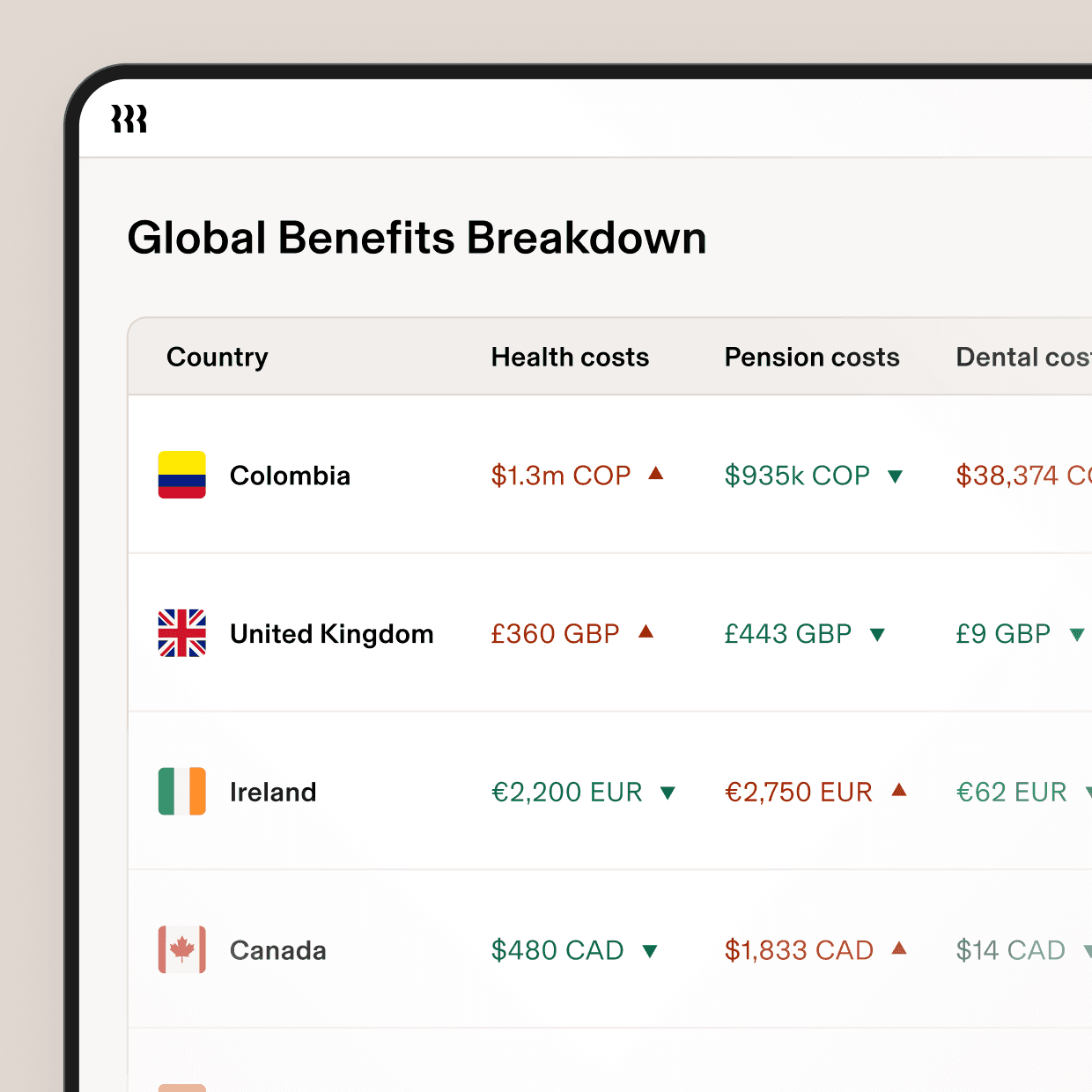
To run payroll in Colombia, you need to understand national wage regulations, classify your workers correctly, and calculate all mandatory employer and employee contributions. Rippling simplifies the entire process with one system for payroll and compliance. Since employers are responsible for calculating payroll deductions, it’s important to keep the following costs and regulations in mind:
Pension fund
12.00%
Medical plan
8.50%
Labor Risks
0.52% – 6.96%
Family Compensation Funds
4.00%
Family Welfare (ICBF)
3.00%
National Apprenticeship Service (SENA) (applied only on integral salary)
2.00%
![[River Flow Item - Image] Run Global Payroll | Paid Global Colombia](/_next/image?url=https%3A%2F%2Fimages.ctfassets.net%2Fk0itp0ir7ty4%2F75YqWOg1dH8TtFKZfy56hL%2F7b4e7e2cdcc1e605b24888687ff105f1%2FRun_Global_Payroll_enCO.png&w=2880&q=75)
Determine your Colombian workers’ employment status
Before onboarding your workers, and certainly before you run payroll, it’s crucial to understand who you’re paying in the eyes of Colombian labor law: Are your workers employees or contractors?
It’s essential to classify them correctly to avoid penalties and compliance issues. If they’re employees, you’ll also be responsible for payroll deductions and mandatory contributions—such as income tax withholding, pension and health contributions, labor risk insurance, and other statutory benefits required under Colombian law.
With Rippling you can:
Employees
Employees are more integrated into the company, follow employer direction, receive benefits like insurance and paid leave, and are generally engaged for ongoing indefinite roles, with the employer responsible for workplace protections.
Contractors
Contractors have greater control over how they work, use their own tools, aren’t entitled to employee benefits, and typically work on short-term projects while managing their own taxes and liabilities.

Mandatory employee benefits in Colombia
When hiring in Colombia, employers must provide compliant benefits packages, as workers are entitled to extensive statutory protections and social security coverage. Colombia’s system is unique in allowing an integral salary—a higher wage that substitutes for certain benefits if both parties agree—though paid leave cannot be replaced. Otherwise, employees must receive all standard mandatory benefits.
Social security contributions
Employers must contribute to the Colombian social security system as part of their income tax.
Short- and long-term disability
On short-term disability, employees can receive two-thirds of their salary for up to 90 days. After that, they’re eligible for 50% of their salary for an additional 90 days, with a possible 180-day extension. Long-term disability pay is dependent on factors such as age and how/where the disability occurred.
Healthcare
Public healthcare is legally required and provided by the Empresa Promotora de Salud (EPS). Both employers and employees pay into the EPS.
Leaves
Colombian employees receive 15 days of paid annual leave per year after their first year, with prorated leave for shorter service. Sick leave pays 100% for the first two days, then two-thirds of salary through day 90, and 50% from days 91–180 via social security. Parental leave includes 18 weeks of maternity leave and two weeks of paid paternity leave, with parents able to share the final six maternity weeks.
Public holidays
There are 18 statutory holidays in Colombia. Employees receive paid time off on these days. If a holiday falls on a weekend, they'll usually get a replacement holiday instead.
Overtime pay
Employees can work up to 12 hours of overtime a week. Overtime should be paid at 125% of their usual wages. Overnight overtime or overtime on Sundays or holidays is paid at 175%.
13th-month salary
13-month salary payments are mandatory in Colombia, typically paid in two installments.
Severance pay
If you terminate an employee without just cause, they are entitled to severance pay. The amount is dependent on their earnings and duration of employment.
Complying with Colombian labor laws
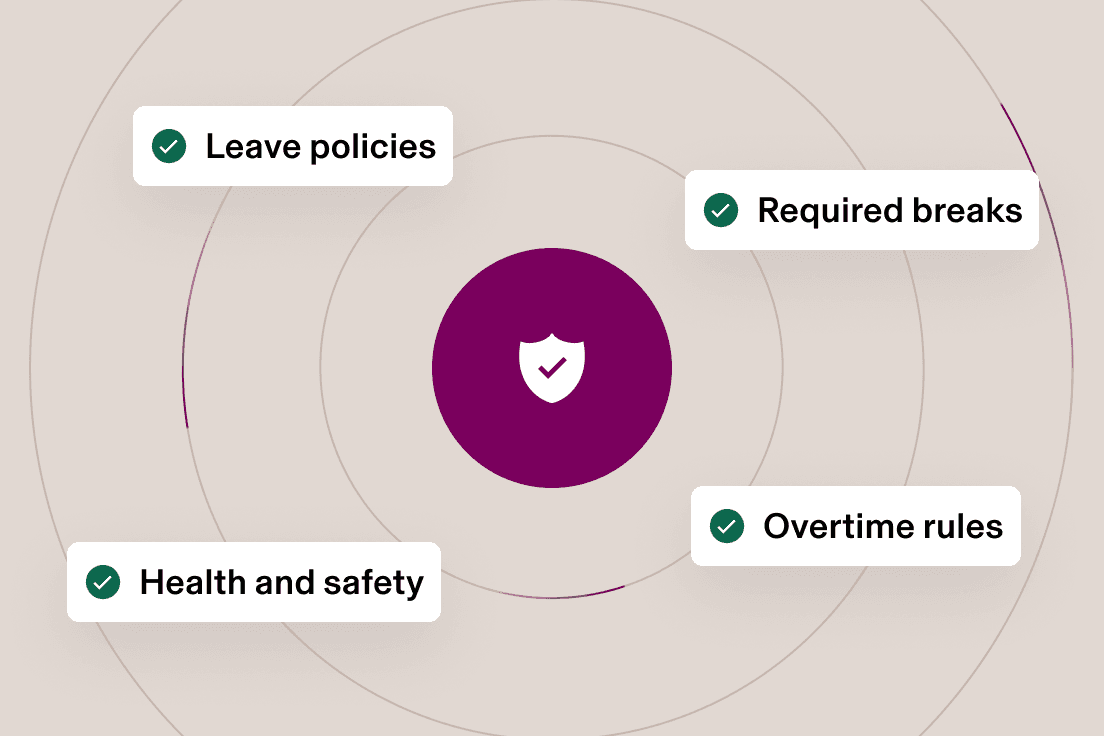
Ensuring you’re in compliance with Colombian labor laws is one of the most crucial aspects of hiring. But Colombia’s compliance landscape can be complex, especially as employers must navigate multiple labor regulations, strict working-hour rules, and unique compensation structures—each with its own requirements and standards.
Here are some of the most important regulations you need to know when hiring in Colombia:
Written employment contracts aren’t required (usually)
You only need a written employment agreement in specific circumstances, including if the contract is fixed-term, there’s a probationary period, the employee is receiving an integral salary, or the employee is receiving non-salary payments.
Working hours are strictly regulated
According to Colombia’s Labor Code, employees can only work up to 47 hours a week. Sunday is a mandatory rest day, but employees can negotiate a different rest day instead.
Employees can receive an integral salary
If the employee and employer agree to this, the employee can receive an integral salary in lieu of many of their statutory benefits. This does not apply to paid leave.
Terminating employees in Colombia
In Colombia, employers may terminate employees at any time, but severance is required when termination occurs without just cause. Notice periods are generally not required, except in specific cases: 15 days’ notice for dismissals related to performance or conduct issues, and 30 days’ notice for non-renewal of fixed-term contracts. Employees on indefinite-term contracts receive severance based on their tenure and salary.
FAQs
Do I need a local entity to hire in Colombia, or can I use an EOR?
You can hire in Colombia either by setting up your own legal entity or by using an Employer of Record (EOR).
Legal entity
You register with local authorities, open a local bank account, translate documents into Spanish, and handle compliance with the Colombian labor code yourself. This is slower and more complex, but can be more cost-effective if you plan to build a larger team.
EOR
An EOR becomes the legal employer on your behalf. They handle contracts, onboarding, payroll, tax withholding, social security, and compliance. It is faster to start hiring and lighter on internal admin, but costs scale with headcount.
How does Colombia classify employees vs contractors?
Colombian law looks at how the work is actually done, not just what the contract says.
Contractors
- Control how, when, and where they work
- Use and provide their own tools and equipment
- Are not entitled to employment benefits and pay their own taxes and social security
- Are not subject to internal discipline and can be ended without notice or cause
- Can work for multiple clients at the same time
Employees
- Work under subordination and direction of the employer
- Use company tools and equipment
- Are entitled to minimum wage, leave, parental benefits and other protections
- Can be disciplined under company policy
- May be contractually bound to work only for one employer
Misclassification is a growing enforcement focus in Colombia, especially for foreign companies relying on local “contractors.”
Who needs a work visa in Colombia, and what are the main types?
Anyone who is not a Colombian citizen and does not have permanent residency needs the right visa to work in Colombia. There are some special options for MERCOSUR nationals, but in general foreign workers must hold an appropriate status, such as:
- Visitor (V) visa – For short stays without work
- Migrant (M) visa – The most common option for living and working in Colombia long term, often tied to investment, a local job offer or marriage. Typically valid up to three years
- Resident (R) visa – For permanent settlement, usually after several years on an M visa
- Technical visa – For short term technical assistance of up to 180 days in a 365 day period
- Digital nomad visa – For people employed by foreign companies who want to live in Colombia while working remotely
You must confirm that any non Colombian hire has the correct authorization before they start working.
How does payroll work in Colombia, and what employer taxes apply?
Once you choose between an entity and an EOR and pick a payroll solution, you must:
- Classify workers correctly as employees or contractors
- Collect required data (identity, address, bank details, health insurance proof)
- Pay employees in Colombian pesos only (COP). Running payroll in another currency is illegal
- Calculate and withhold the correct deductions
- Run payroll on schedule
Typical employer contributions include:
- Pension fund – 12.00%
- Medical plan – 8.50%
- Labor risks – 0.52% to 6.96%
- Family Compensation Funds – 4.00%
- Family Welfare (ICBF) – 3.00%
- SENA – 2.00% (on integral salary)
These are on top of gross salary and must be budgeted into your total employment cost.
What mandatory benefits and termination rules should I know about in Colombia?
Colombia has robust statutory benefits and clear rules on severance:
Mandatory benefits (for standard salary arrangements)
- Social security contributions
- Public healthcare via EPS, funded by employer and employee contributions
- Paid annual leave – 15 paid vacation days per year after the first year (prorated before that)
- Sick leave with a mix of employer paid and social security paid wages over time
- Maternity leave – 18 weeks for birth or adoption
- Paternity leave – two weeks paid, with the option to split part of maternity leave
- 18 paid public holidays
- Overtime premiums – 125% for normal overtime, 175% for night, Sunday or holiday overtime
- Mandatory 13th month salary, usually in two installments
- Severance pay if terminated without just cause
Integral salary option
For higher earners, some statutory benefits can be monetized and included in an “integral salary” if both parties sign a written agreement. This does not replace paid leave.
Termination
You can usually terminate at any time, but:
- Termination without just cause requires severance
- No notice is required for indefinite contracts in most cases
- 15 days’ notice is required for termination based on performance, inability, addiction, or certain health issues
- 30 days’ notice is required when a fixed term contract will not be renewed
Severance depends on seniority and salary level, with different formulas above and below 10 times the minimum monthly wage.
Rippling global solutions
Ready to see Rippling Global in action?
We value your privacy. Learn more.