

























An employer of record (EOR) is a company that legally employs workers in Canada on your behalf. The EOR will handle all your payroll, taxes (CPP, EI, income tax), contracts, benefits, and compliance, so you can hire in Canada without setting up a local entity.
The 29 best employer of record (EOR) services for Canadian businesses

In this article
An Employer of Record (EOR) is a third party that legally employs staff on your behalf in other countries. This generally includes handling payroll, benefits, and making sure you are meeting compliance regulations within the company you are hiring for.
EOR providers vary in approach. Some are software-first platforms like Rippling, others use hybrid models that blend a software platform with services, and some are service-led firms focused on compliance, visas, and local expertise.
As there are so many different models and options on the market, sometimes it can be difficult to know what will suit your needs without going over the top or not having enough support.
To support your business in making the right decision, I’ve used and scored 28 EOR options available to Canadian businesses. I added up the final scores based on six elements. These are compliance in Canada, local hiring, country coverage, ease of use, user ratings, and support.
Here is a quick overview of how each option landed when I added up my scores. For a deeper look at how I scored each EOR option, you can look at my full spreadsheet of ratings here.
Provider | Score (out of 5) | Best suited for | Choose this if you need… | Model type |
|---|---|---|---|---|
1. Rippling | 4.82 | Mid-enterprise | Everything managed in one system (HR, IT, payroll, compliance) | Software (SaaS) |
2. Asanify | 4.73 | SMBs | Budget-friendly setup for micro or small businesses | Software |
4. Horizons | 4.67 | Mid-sized | Wide reach that’s well-suited for mid-sized businesses | Hybrid |
4.67 | SMBs to enterprises | Award interpretation with modern HR tools for Canadian teams | Hybrid | |
6. Remote | 4.62 | Mid-sized to enterprises | Strong self-serve platform, plus good benefit bundles | Hybrid |
7. Multiplier | 4.47 | Mid-sized to enterprises | Global with strong Canadian compliance | Hybrid |
8. Oyster | 4.47 | Mid-sized to enterprises | An easy UI for both employees and employers | Hybrid |
9. RemoFirst | 4.42 | SMBs to mid-sized | Affordable global hiring with Canadian payroll support | Hybrid |
10. Skuad | 4.42 | SMBs to enterprises | Flexible benefit options with scalable global coverage | Hybrid |
11. Papaya Global | 4.33 | Mid-sized to enterprises | Payroll plus benefits packages | Hybrid |
12. HR Blizz | 4.33 | SMBs to mid-sized | Combined payroll and EOR | Hybrid |
13. Safeguard Global | 4.27 | Enterprises | Enterprise-grade compliance | Hybrid |
14. Justworks | 4.21 | SMBs to mid-sized | North America-friendly EOR with structured payroll and benefits | Hybrid |
15. PamGro | 4.21 | SMBs to mid-sized | Hands-on EOR support with a Canadian legal entity | Hybrid |
16. Borderless AI | 4.07 | SMBs | A light EOR with automation to cut down on manual admin | Software |
4.07 | Enterprises | A strong platform plus hands-on HR support | Hybrid | |
18. Native Teams | 4.03 | SMBs | Software-led EOR with contractor workflows | Software |
19. Pebl | 4.02 | Enterprises | Large-scale international hiring in governance-heavy locations | Hybrid |
20. Remote People | 3.72 | Mid-sized | Compliance support with a service-heavy, human touch | Service-led |
21. Gloroots | 3.57 | SMBs to mid-sized | Simple compliance with operations | Hybrid |
22. TopSource | 3.56 | Mid-sized | Consultative, people-driven support for mid-sized firms | Service-led |
23. GoGlobal | 3.42 | SMBs to mid-sized | A boutique, direct-entity approach with local guidance | Hybrid |
24. Agile Hero | 3.36 | SMBs to mid-sized | Flexible benefits and a quick global setup | Hybrid |
25. Remundo | 3.21 | SMBs to mid-sized | Hands-on, service-led delivery for multi-country hiring | Service-led |
3.01 | SMBs | Canada-only, service-led EOR and payroll provider | Service-led | |
3.01 | SMBs to mid-sized | Canada-based payroll and EOR specialist support | Service-led | |
28. CXC | 2.96 | SMBs to mid-sized | Recruitment paired with EOR compliance expertise | Service-led |
29. Brunel | 2.64 | Enterprises | Compliance expertise in technical sectors | Service-led |
The 11 best EOR options in Canada
Based on our full analysis of 29 different EOR providers, 11 options rose to the top.
I found that these 11 options had the strongest compliance, reach and local expertise. In the following sections, I’ve expanded on why these platforms stood out and include some positive quotes and limitations taken directly from customer reviews.
Here are the 11 platforms we are going to take a closer look at:
Rippling
Asanify
Horizons
Employment Hero
Remote
Multiplier
Oyster
RemoFirst
Skuad
Papaya Global
HR Blizz
1. Rippling
Rippling combines HR, IT, compliance, and global payroll in one platform, making it one of the most versatile EOR providers.
What makes it stand out is the balance between Canadian compliance and global reach. Having strong coverage in Canada, plus coverage in 160+ countries, allows businesses to get one system that can replace multiple tools without adding complexity to their workload.
Unlike its competitors, Rippling is built as a single SaaS platform. This means that payroll, employee data, devices, and even apps can all be managed in the same place. For companies expanding overseas, this cuts down time spent on admin work and keeps all your data in one place, lowering the risk of compliance mistakes.
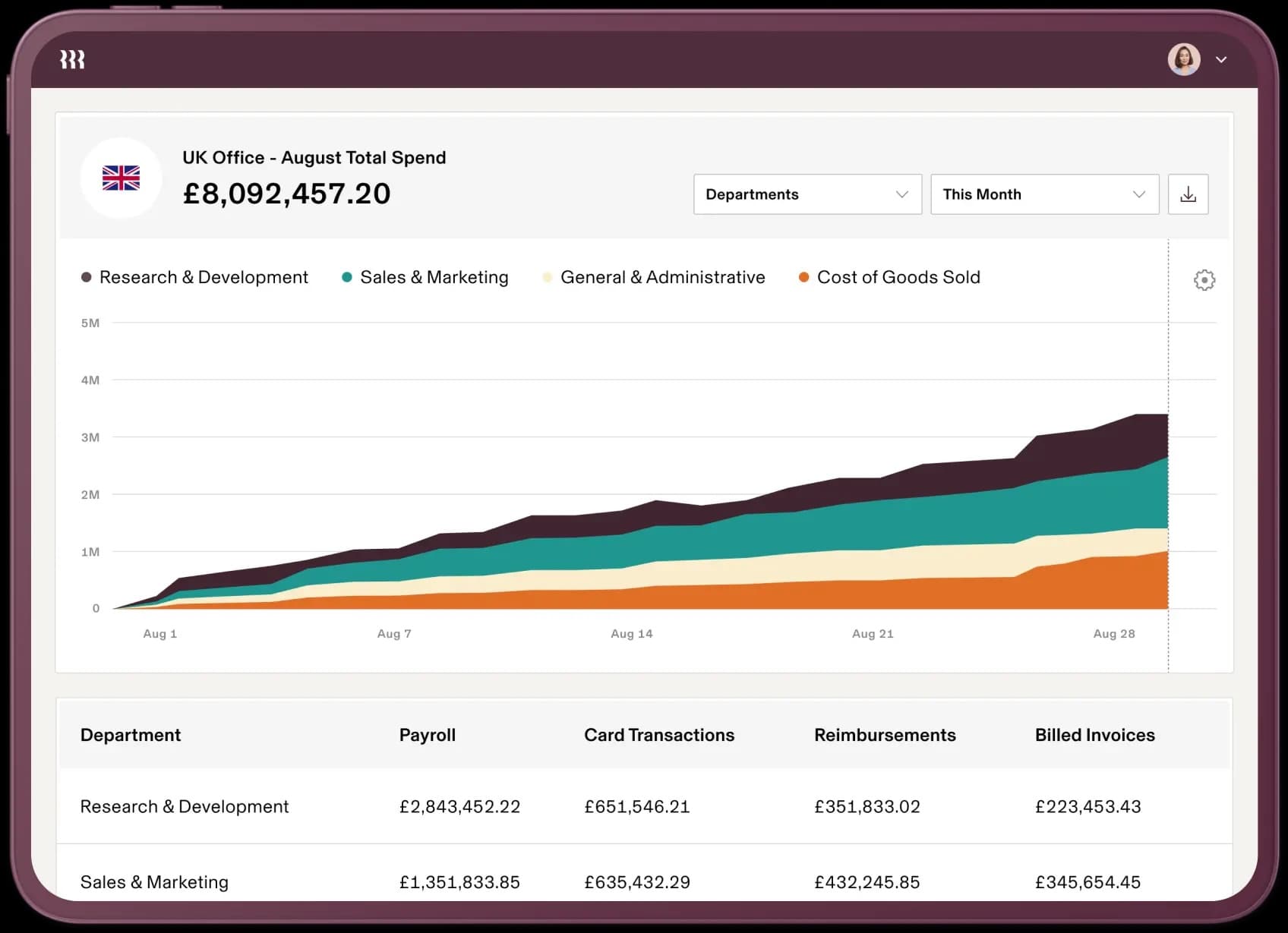
Source: Rippling
Why do companies choose Rippling?
All-in-one platform that replaces multiple HR, IT, and payroll tools
Offers more than 600 integrations
Canadian payroll and employment law compliance (CPP, EI, provincial standards)
Global reach across 160+ countries with automated compliance built in
“The platform is intuitive and a great tool for consolidating all our HR information as we continue to grow and improve our organization. One of the key reasons we chose Rippling over other options is its strong integration with contractor and international employee payroll.” - Rippling review on Capterra
User-flagged challenges
Visa and immigration support is advisory only
The wide feature set can be a lot for smaller teams
Setup and configuration can require an upfront time investment
Is Rippling right for your business?
Rippling is a smart option if you want HR, payroll, IT and compliance managed in one place. Everything sits within a single system, so you’re not juggling different providers or platforms. The platform works especially well for fast-growing businesses that need to stay compliant in Canada while building teams overseas.
2. Asanify
Asanify is made for startups and small businesses that want payroll and HR handled with as little manual effort as possible. It’s a software-first platform, with automation at the core, covering payroll, leave, attendance, and compliance in Canada.
Its system is built to be quick to set up and easy for non-HR teams to use day-to-day.
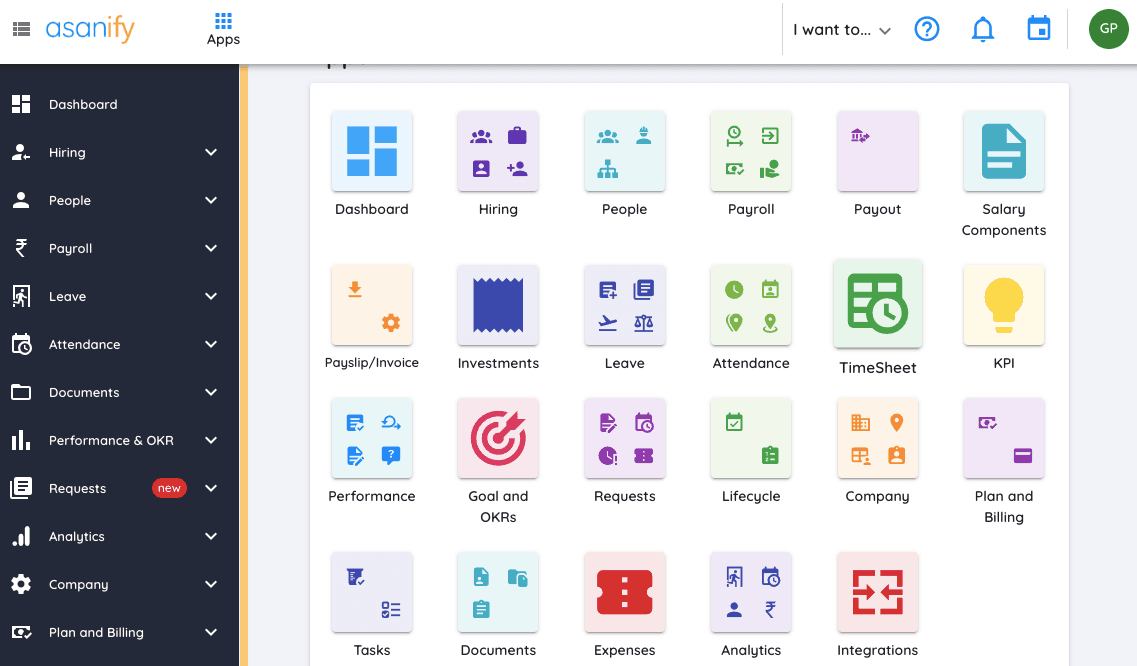
Source: Asanify
Why do companies choose Asanify?
Simple, automated payroll and HR workflows
User-friendly interface that non-HR staff find easy to use
Quick chat support that helps small teams resolve issues fast
“It's become critical to my HR Operations in the company. I no longer have to worry about any people-related matters or payroll.” - Asanify review on Capterra
User-flagged challenges
The initial setup can be technical and time-consuming
Reporting and data management features are limited
Customization is limited, with many features fixed rather than optional
Is Asanify right for your business?
Asanify is a good fit for small teams that want a simple, software-based way to hire in Canada without paying for enterprise-level services. It covers payroll, statutory deductions, benefits, and employment contracts, with the added bonus of global coverage. However, if you need hands-on immigration support, the platform might be too light for your needs.
3. Horizons
Horizons stands out for its employee-first approach, with a platform designed to give workers self-serve access to payslips, contracts, and key employment documents. Businesses like this set-up as it can reduce back-and-forth between employees and HR, and helps distributed teams feel more supported day to day.
Users also consistently mention the quality and responsiveness of Horizons’ support team as a major positive, especially compared to platforms which offer ticket-only support.
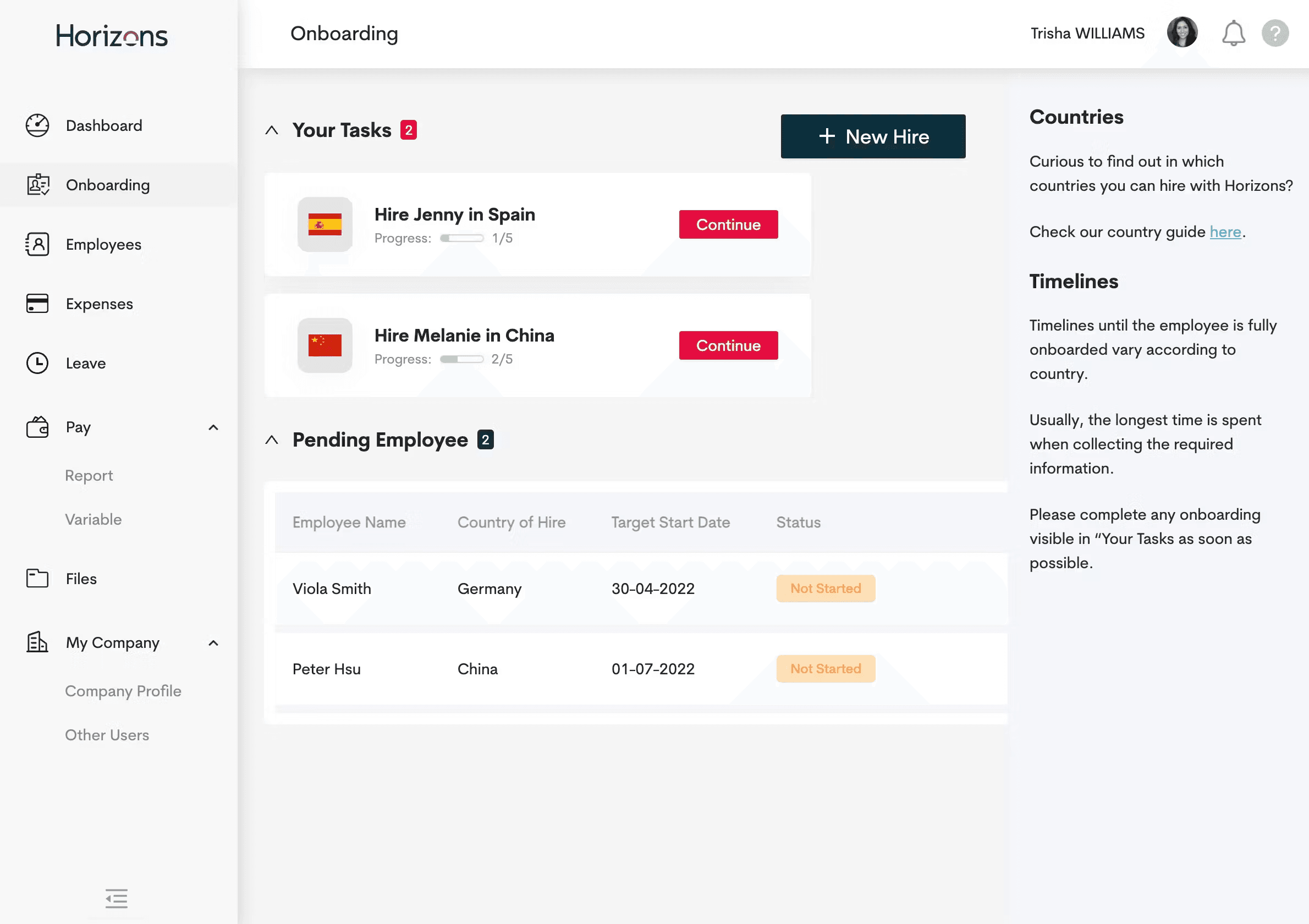
Source: Horizons
Why do companies choose Horizons?
Employee self-service for payroll, documents, and leave
Highly rated, responsive customer support with live assistance
Service-led approach that complements the software platform
“Joining Horizon was an incredibly smooth and positive experience. From the very first interaction, their onboarding process stood out: efficient, thoughtful, and genuinely welcoming.” - Horizons review on Capterra
User-flagged challenges
Payroll calculations can be difficult to interpret without support
Reporting is lighter than finance-focused platforms
Pricing is higher than basic payroll or contractor-only tools
4. Employment Hero
Employment Hero is both an EOR and HR platform in one, with a strong focus on global compliance and the employee experience. It supports hiring in Canada and operates across more than 180 countries, combining payroll, HR, and benefits in one system.
What makes Employment Hero stand out is its focus on employee engagement tools. Beyond payroll and compliance, it offers benefits like wellness support, mental health resources, learning and development, and even perks and allowances.
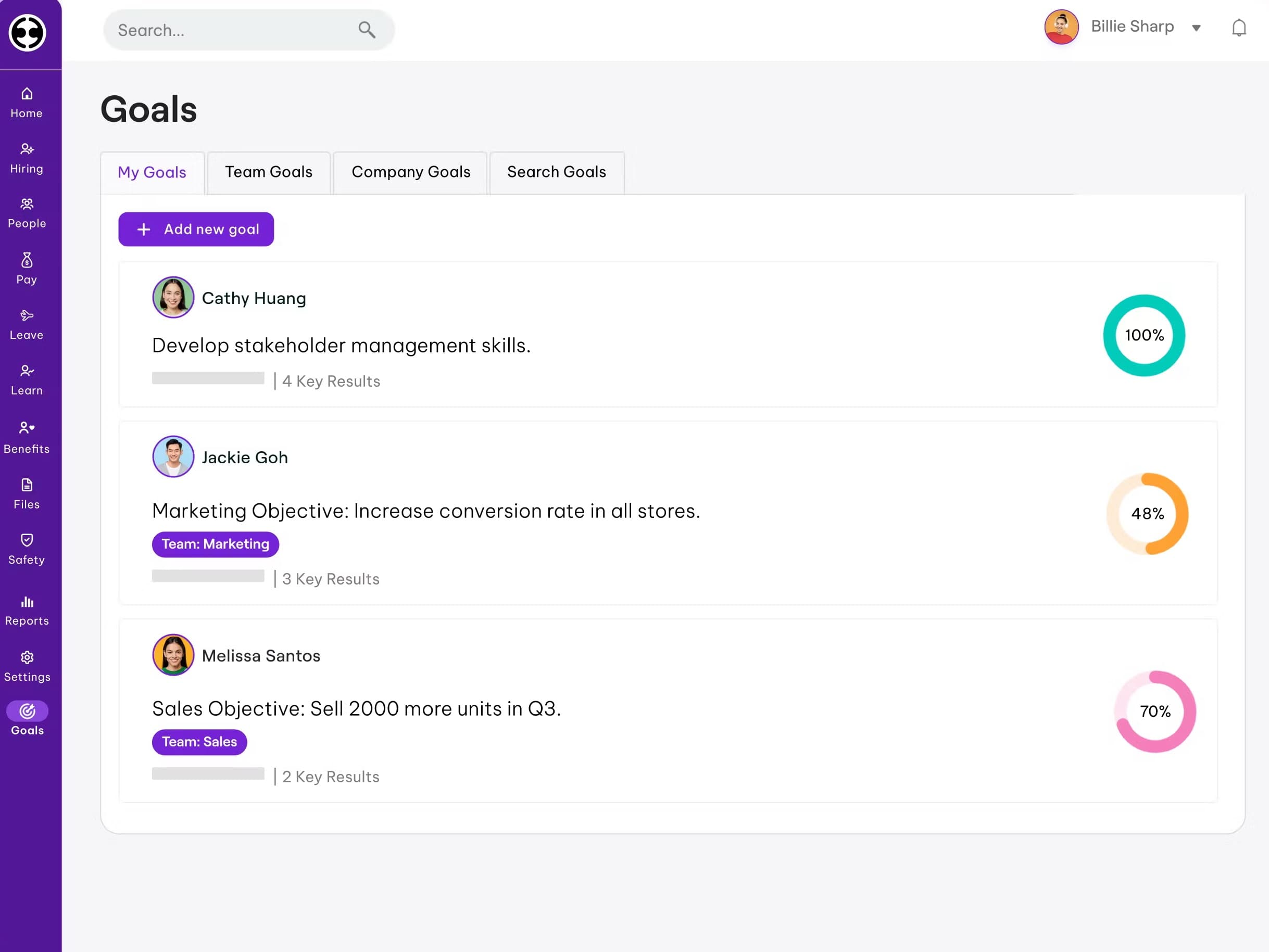
Source: Employment Hero
Why do companies choose Employment Hero?
Deep understanding of Canadian payroll and employment standards
Built-in employee engagement features like wellness, perks, learning and development
Combines HR, payroll, and compliance in a single platform
“My overall experience with Employment Hero has been very positive. I especially appreciate the self-service features, which empower employees to manage their own information and requests.” - Employment Hero Capterra review
User-flagged challenges
Customer support can be slow or difficult to reach
Some payroll and HR features overlap, causing confusion
Reporting features are limited and often require manual work in Excel
5. Remote
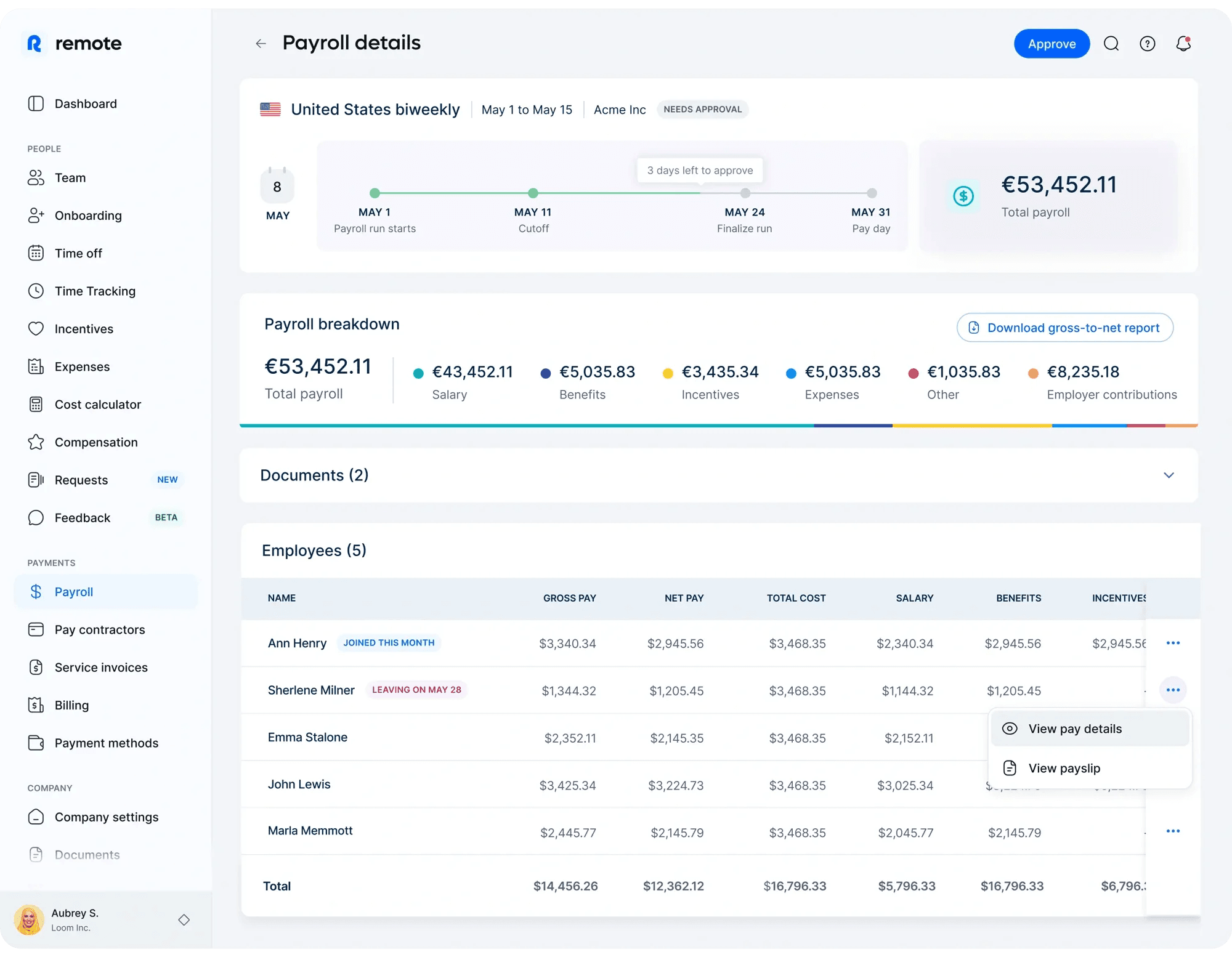
Remote is best known for running its own local entities, which gives businesses more clarity over how employees are hired and paid. In Canada, this means Remote employs staff directly and manages payroll, contracts, and employment compliance without relying on third-party partners.
Remote also works well for companies managing a mix of employees and contractors, with clear ways to store and manage the different documentation.
Source: Remote
Why do companies choose Remote?
Direct Canadian entity for payroll, CPP, EI, and employment compliance
Strong support for managing both employees and contractors
Clear invoicing and payroll workflows that reduce payment delays
“Extremely pleasant and smooth. They automate the onboarding process for employees so things that should feel very tedious and time consuming felt breezy and quick.” - Remote Capterra review
User-flagged challenges
Pricing can feel steep for smaller teams
Support for complex or country-specific issues takes time to escalate
Difficulty seeing how compliance is being followed in the system
6. Multiplier
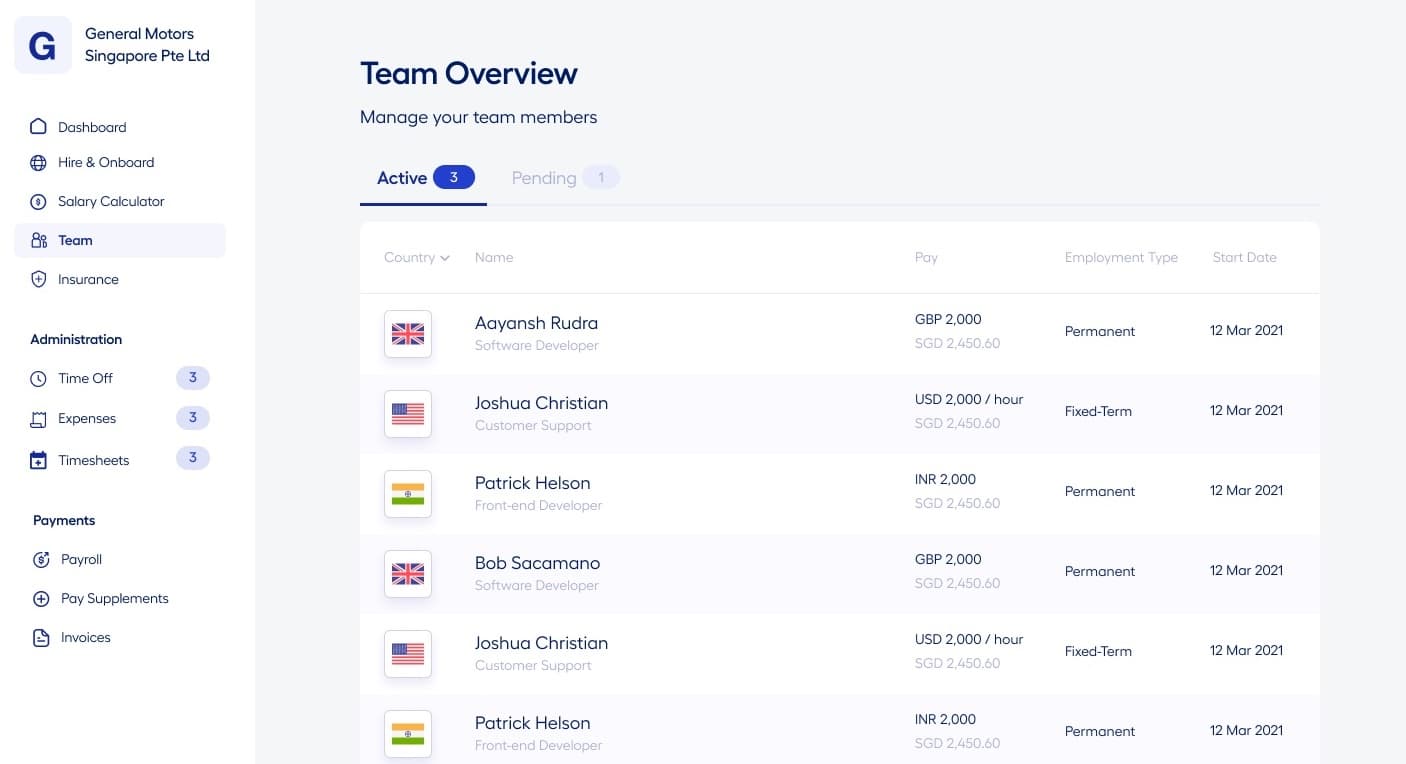
Multiplier has a focus on global hiring and everything that comes with it. This includes everything from onboarding new people and making sure they get paid on time in their currency.
It supports Canadian businesses and has a reach of more than 150 countries. This makes it a great option if you’re not only looking to hire in Canada but build a global team of talent.
On top of this, reviews often rave about the speed and ease of use that the platform offers. This includes onboarding, which some say can be done in mere minutes. This speed makes the platform appealing for busy startups that need to quickly bring people on board without needing to build a whole new entity.
Source: Multiplier
Why do companies choose Multiplier?
Direct entity coverage across 150+ countries
Strong customer service praised for responsiveness
Competitive pricing compared to Deel and Horizons
“It is a complete solution for our international hiring, onboarding & payroll needs. Moreover, the multi-lingual contract coverage is a bonus.” - Multiplier Capterra review
User-flagged challenges
Invoicing and billing practices can feel rigid
Limited transparency around fees makes budgeting harder
Compliance depth isn’t as mature as older players
7. Oyster
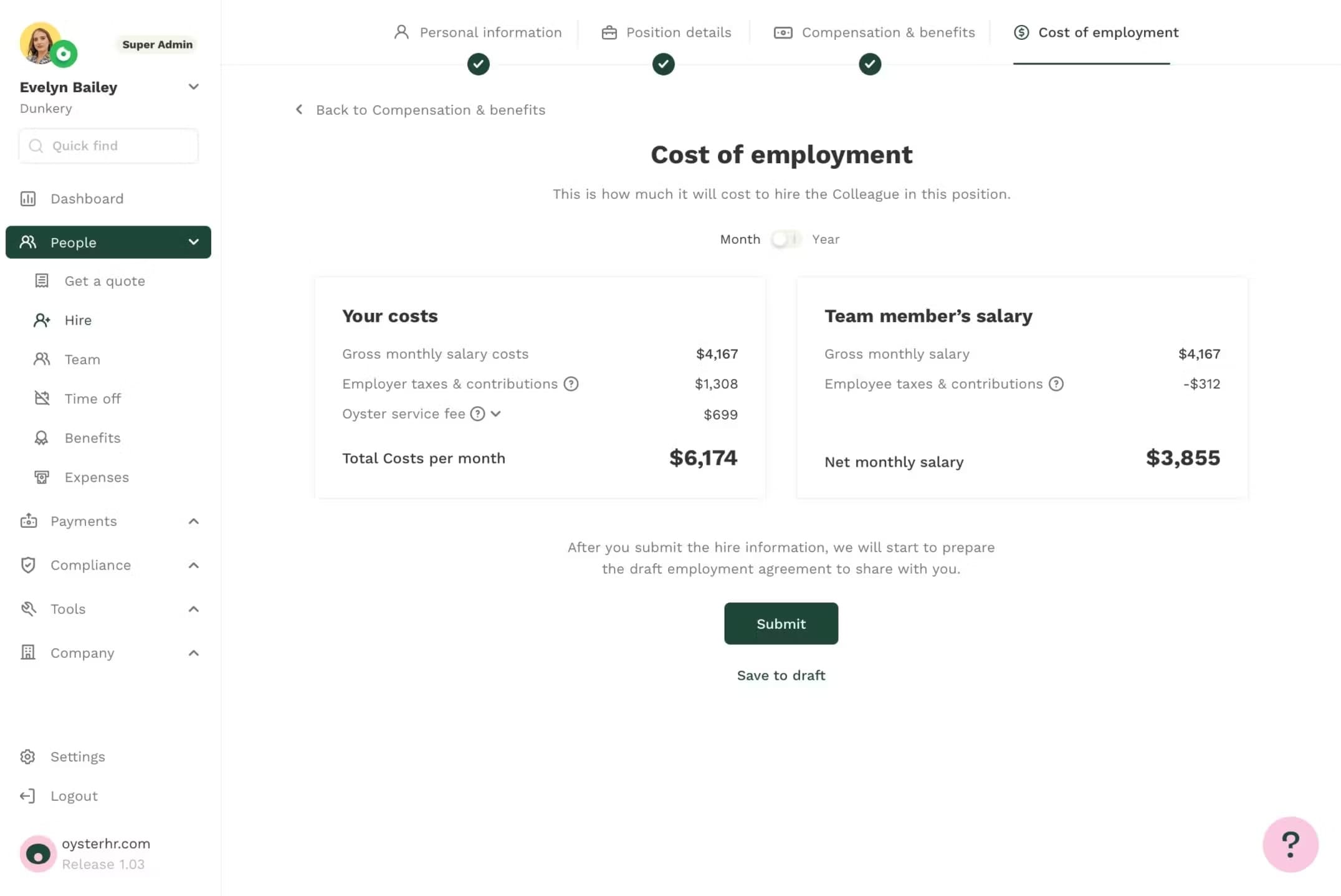
Oyster is a hybrid EOR with coverage in more than 180 countries. It's often described as easy to use, with a simple interface for both employers and employees. This makes it a good choice for small businesses that don’t need anything complex.
Many reviews also highlight the support team as responsive and helpful, particularly during onboarding and when questions arise.
Source: Oyster
Why do companies choose Oyster?
Well-suited to small businesses hiring internationally
The platform is easy to learn and use day-to-day
Support staff are responsive and helpful during the onboarding process
“If you're a small company trying to get started and grow, Oyster offers a great solution for utilizing contractors.” - Oyster Capterra review
User-flagged challenges
Pricing runs higher than some very basic options
Payroll cut-offs can be confusing, with delays for expense reimbursements
Some hiring is managed through local partners, which can slow down communication
8. RemoFirst
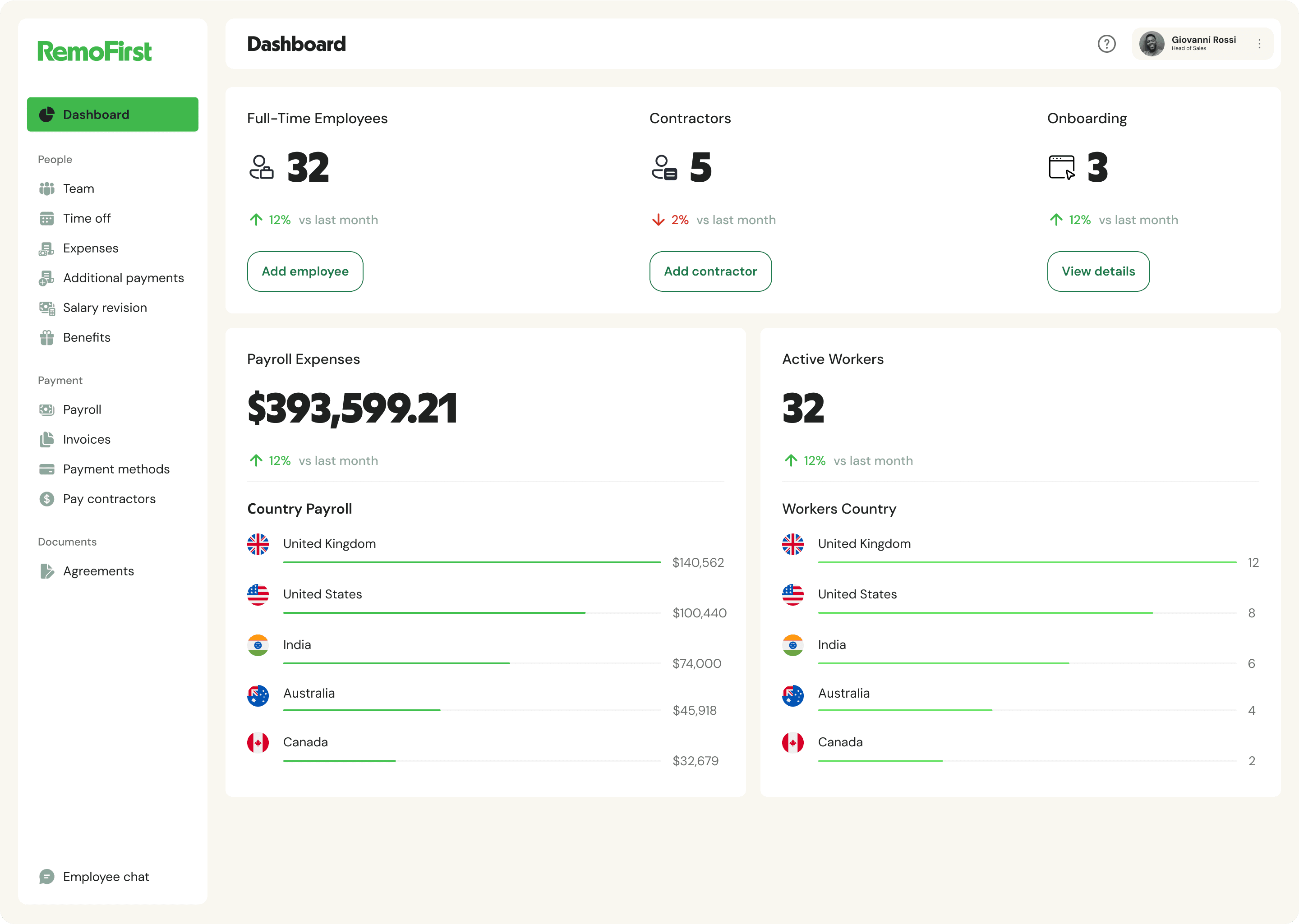
RemoFirst is one of the newer EOR providers, but it has quickly built a reputation for affordability and straightforward service. It supports Canadian requirements like statutory leave, CPP and EI contributions, and parental benefits, and covers more than 185 countries through its network.
Many reviews note that RemoFirst is cheaper than other providers, while still covering their core payroll and compliance needs.
Source: RemoFirst
Why do companies choose RemoFirst?
Competitive pricing compared to larger EORs
Simple platform for payroll, contracts, and bonuses
Great support team that’s responsive and easy to work with
“With RemoFirst we've been able to hire full-time employees in 7 countries with the best pricing across other EORs that we got quotes from.” - RemoFirst Capterra review
User-flagged challenges
Feature set is still developing compared to older providers
Some contractor tools feel limited or buggy
Reporting and dashboard options are basic
9. Skuad
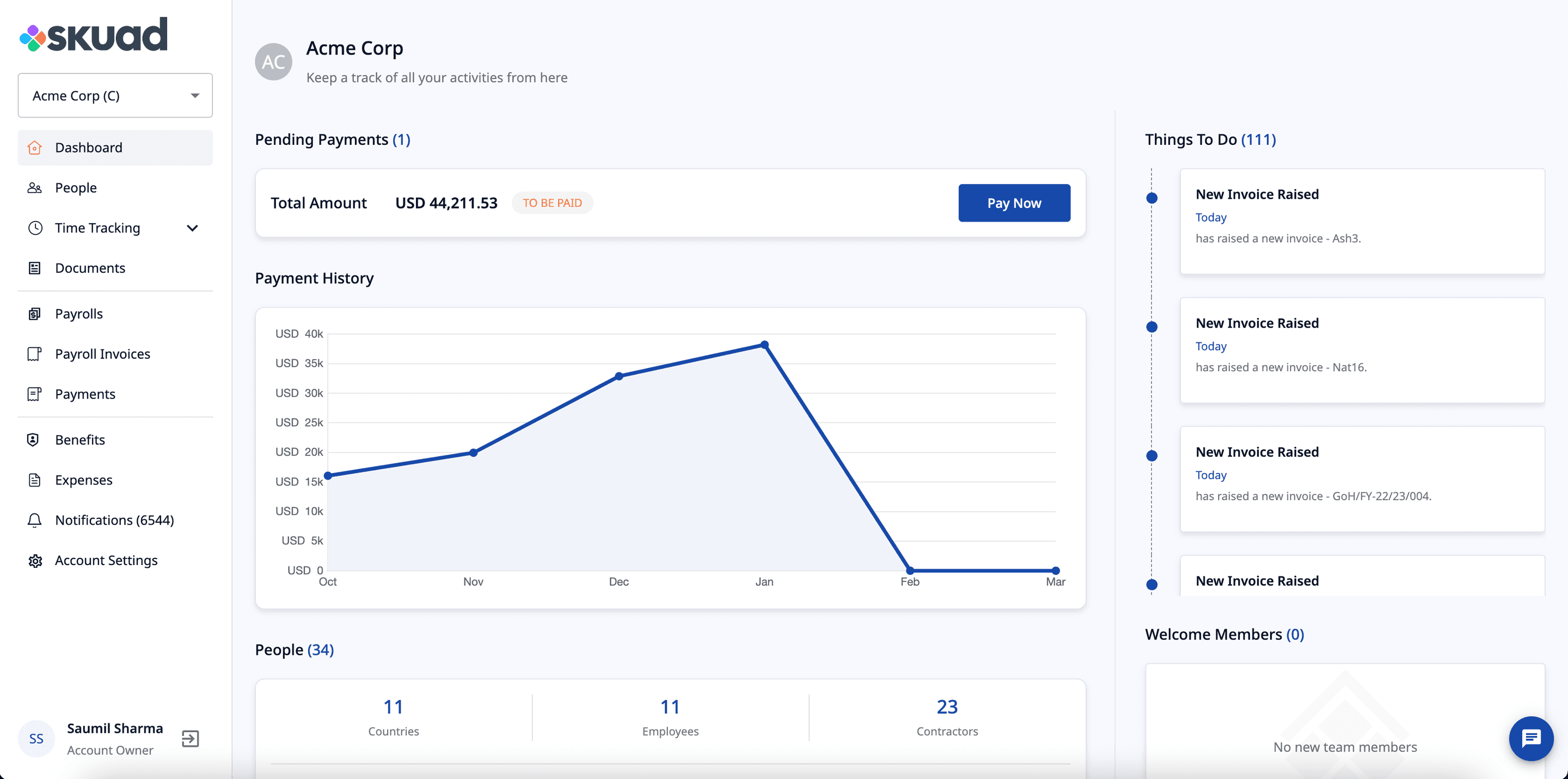
Skuad is unique on this list as it is closely linked to the popular payment system, Payoneer. As a result of this close connection, users say it’s easy to get people set up and paid in their currency without needing to do anything manually or switch systems for payment.
On top of this, the platform uniquely offers a smooth path for employees moving from contractor to full-time employee. This is particularly useful for Canadian companies due to the recent presumption of employee status laws that can quickly move someone from a contractor to an employee if conditions change. It is also helpful if you want to test new markets but not commit to hiring employees.
Source: Skuad
Why do companies choose Skuad?
On-time salary payments across countries and currencies
Easier contractor-to-employee transitions as teams grow
Less manual follow-up around payroll and payments
“I like how straightforward everything is. The platform is clean, organized, and easy to navigate, so I don’t get lost looking for basic things.” - Skuad G2 review
User-flagged challenges
No mobile app, so everything has to be managed on a desktop
Limited visibility into request status or progress tracking
Some updates that changed process aren’t clearly communicated
10. Papaya Global
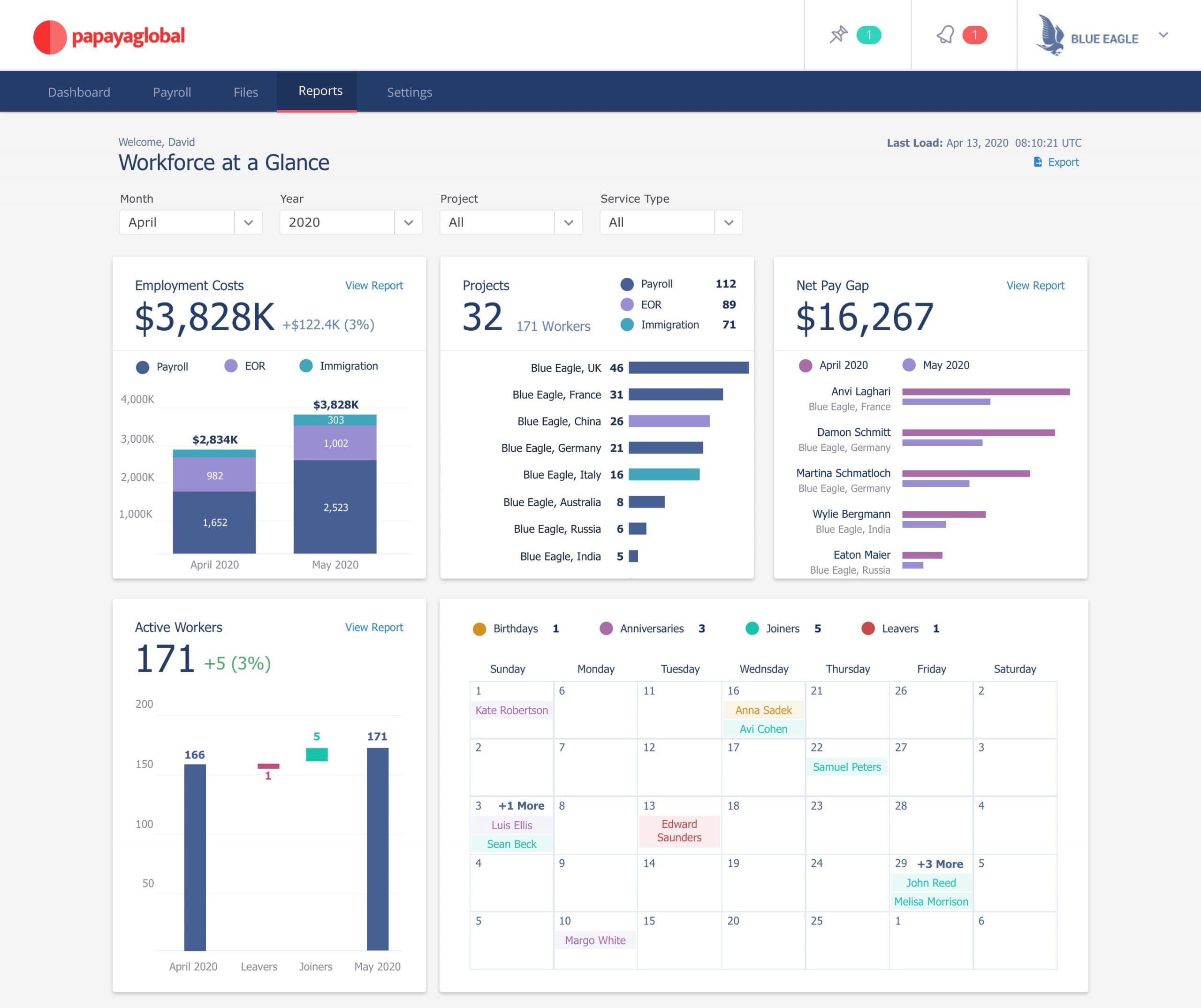
Papaya Global takes an automation-first approach to managing global payroll and compliance. In Canada, Papaya uses in-country partners for its EOR services, rather than running its own local legal entity.
One thing that makes Papaya particularly helpful in Canada is its support for immigration pathways like the Global Talent Stream and LMIA exemptions. This allows businesses to hire local and overseas talent without setting up a Canadian entity.
Source: Papaya Global
Why do companies choose Papaya Global?
Management of equity, stock options, and health insurance
Support for Canadian immigration pathways
Automation reduces manual admin for large, multi-country teams
“Our overall experience has been very positive and Papaya is a platform we regularly recommend to other HR teams.” - Papaya Global Capterra review
Challenges users mention
Invoices and reporting can be disorganized and error-prone
Customer service is inconsistent, especially across time zones
Reviews say fees are high, with one saying they are as “high as an extra salary”
11. HR Blizz
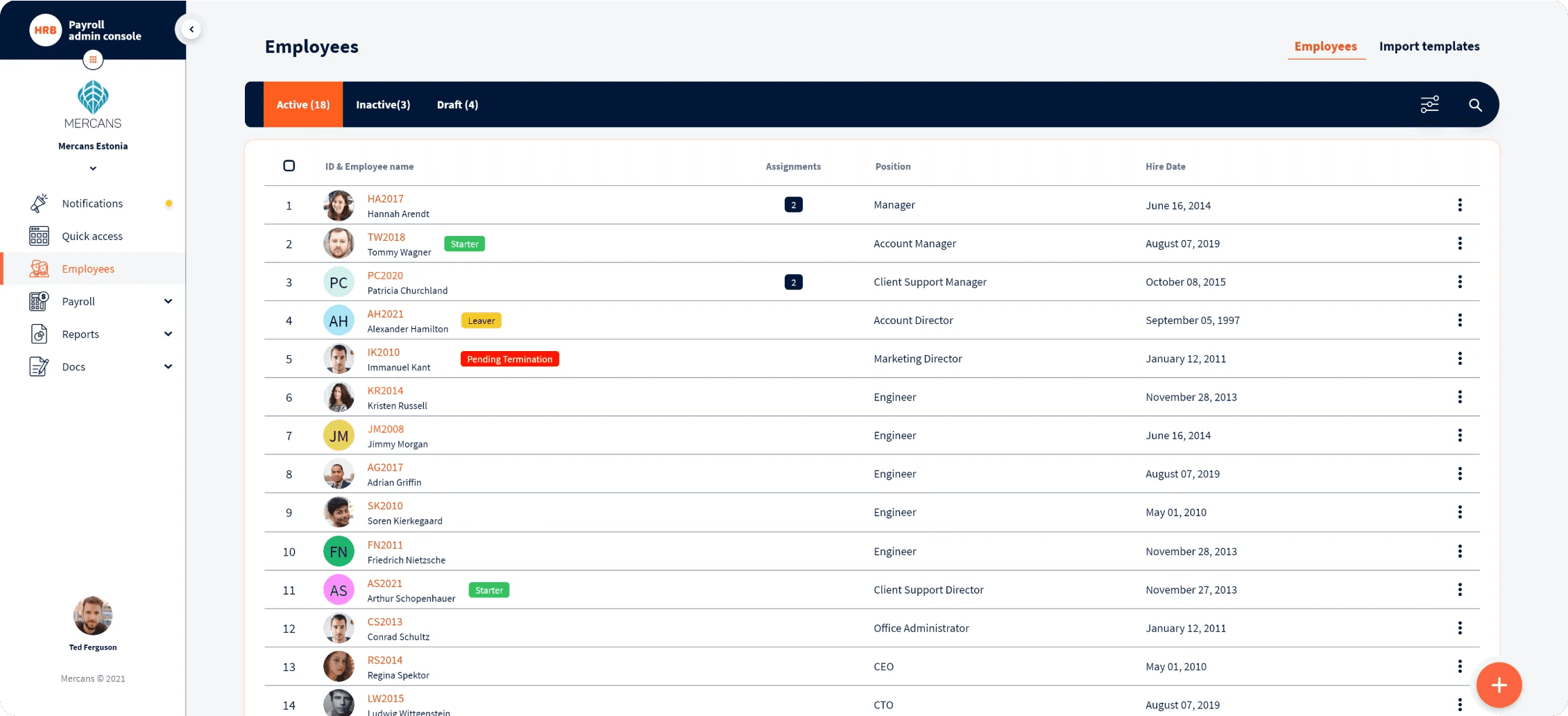
HR Blizz is best known as a global payroll platform. EOR employment is provided through its parent company, Mercans, using Mercans’ in-country teams.
In this setup, Mercans delivers the EOR service, while HR Blizz acts as the underlying payroll and HR software you access. As a result, this offering is generally better suited to larger organizations that want EOR with full global payroll operations, rather than teams looking for a software-based EOR product.
Why do companies choose HR Blizz?
EOR delivered by Mercans’ in-country teams, not third-party partners
Highly automated payroll with real-time access and reporting
Well-suited for large, multi-entity or multi-country organizations
“I like the great UX of HR Blizz software. It helped us make our payroll simple and easy.” - HR Blizz G2 review
User-flagged challenges
Not an EOR software. Instead, it’s a payroll and HR system supported by an EOR service delivered through its parent company.
Limited visibility into the process compared to dedicated EOR tools
Better suited for experienced HR or payroll teams
What to weigh up when selecting an EOR
Choosing an EOR comes down to what will be the best fit for your business. The right provider should align with how you hire, your budget, and the level of support you expect.
When comparing options, these four questions can help you narrow down which option might be best for your business.
Are you hiring in Canada or internationally?
Think about whether you’re planning to bring employees into Canada or hire internationally. If you’re hiring in Canada, you’ll need strong compliance with federal and provincial employment laws, including payroll tax withholding, CPP and EI contributions. If you’re hiring overseas, you’ll need broad country coverage, reliable payroll, and local benefits that meet market standards.
Being clear on this will help you decide whether to focus on local compliance or international reach.
Do you need software or a consulting service?
Some platforms are software-first, designed around automation, integrations, and self-service dashboards. Others are service-led, where you get more hands-on help from local experts around the world.
If you already have an HR team and want control of the process through technology, a software-first option makes sense. If you don’t have any internal resources and have large hiring plans, service-led support can save you time and reduce the risk of mistakes.
How much can you budget?
Most EORs present their pricing as a simple per-employee, per-month fee. However, keep in mind that extra costs like foreign exchange margins, onboarding fees, payroll cut-off charges, or premium support can add to this base price.
Before you commit, think about what matters most for your business. For example, do you need strict cost control, or are you comfortable paying more for speed and flexibility? The right choice isn’t always the cheapest up-front option.
Do you need a direct entity or a partner network?
A direct entity means the provider owns its own local company in the country where you are hiring. This gives you more control, faster onboarding, and stronger compliance since everything is handled in-house.
A partner network means the provider works with third-party companies in each country to employ staff. This often gives you wider global coverage at a lower cost, but communication can be slower, and compliance may feel less consistent.
If you want reliability and long-term stability, look for direct entities. If your priority is reaching many countries quickly and cost-effectively, a partner network can be a great choice.
Recent compliance changes in Canada
Hiring in Canada has become more complex over the past 18 months, with several regulatory changes that directly affect how EORs need to operate. A strong EOR, like Rippling, takes responsibility for managing these changes so you stay compliant and can focus on growing your team.
1. Second additional CPP (CPP2) contributions
In January 2024, Canada added a second pension plan contribution band for higher-income earners. This means employees and employers now pay an extra 4% CPP on higher earnings within the salary band of $71,300 to $81,200.
Here’s how this looks in practice:
Annual earnings (2025) | CPP applied |
|---|---|
$3,500 to $71,300 | The base CPP at 5.95% |
Above $71,300 (up to $81,200) | Additional (on top of the 5.95%) CPP2 at 4% from both the employee and employer, on the top portion only |
Above $81,200 | No CPP deductions at all |
Source: Government of Canada
To see how this affects your payroll, you can run your numbers through the government's payroll deductions calculator.
2. Mandatory reporting of employer-offered dental benefits
From the 2025 tax year, Canadian employers must report whether an employee was eligible for employer-provided dental benefits. This information needs to be reported on the employee’s T4 tax slip (the annual tax form).
Since your EOR is the legal employer in Canada, it will be responsible for issuing the T4 slip and reporting the employee's dental benefit eligibility to the CRA. This means that you need to make your EOR aware if you are offering dental benefits.
3. Presumption of employee status (federal)
In June 2024, Canada now assumes that most paid workers are employees, not contractors. This means the employer must prove that a worker is genuinely a contractor if they want to classify them as one. Getting this wrong can lead to penalties and back pay.
Since the burden of proof is on the employer, your EOR needs to know how your contractor roles work in practice to make sure they qualify as one under Canadian law.
4. Ontario job posting transparency rules
From January 2026, employers in Ontario with 25 or more employees must follow new rules when advertising jobs publicly. The new rules are designed to improve transparency and fairness.
This means that your job ads must:
Include a pay range for the role
Disclose if AI is used to screen or assess candidates
Not require “Canadian experience” as a condition of applying
5. Remote work and province of employment (POE)
In January 2024, Canada updated how payroll tax is calculated for fully remote workers. Instead of using where an employee lives, payroll deductions are now based on the province of the employer’s location that the employee is most closely connected to.
This matters because provincial income tax rates, pensions, and EI deductions vary by province. Since your EOR is the legal employer, it must correctly identify the employee’s province of employment and apply the right deductions.
Choosing the best EOR for your business
Most providers on this list can handle payroll, contracts, and compliance. The difference is in how they connect them, the support you’ll receive, and whether their model fits the way your business operates.
A software-first platform is best if you want control and automation. In contrast, a service-led option is better if you don’t have internal HR resources and need more hands-on support.
Rippling ranked first in my review because it’s the strongest provider that combines HR, payroll, IT, and compliance in one system, while also having a deep understanding of local Canadian employment law.
If you want confidence in Canadian employment compliance and the ability to scale globally, book a demo to learn more about Rippling’s Employer of Record service.
FAQs
What does an employer of record mean in Canada?
Is an EOR a good option for hiring remote employees?
Yes, an EOR is a great solution for businesses hiring remotely. Sometimes, when you want to hire talent internationally, they might be the only person you’re hiring in that area. In that case, it doesn’t make sense to build a new entity in that area. Instead, you can use an EOR to manage the correct tax, payroll, and employment rules for each location.
What benefits can you expect from using an EOR company?
The key benefits include faster international expansion, access to a broader talent pool and simplified payroll processing. An EOR also helps with benefits administration and ensuring compliance with local employment regulations.
Run payroll worldwide faster, simpler, and more reliably
Disclaimer
Rippling and its affiliates do not provide tax, accounting, or legal advice. This material has been prepared for informational purposes only, and is not intended to provide or be relied on for tax, accounting, or legal advice. You should consult your own tax, accounting, and legal advisors before engaging in any related activities or transactions.

Author

Vanessa Kahkesh
Content Marketing Manager, HR
Vanessa Kahkesh is a content marketer for HR passionate about shaping conversations at the intersection of people, strategy, and workplace culture. At Rippling, she leads the creation of HR-focused content. Vanessa honed her marketing, storytelling, and growth skills through roles in product marketing, community-building, and startup ventures. She worked on the product marketing team at Replit and was the founder of STUDENTpreneurs, a global community platform for student founders. Her multidisciplinary experience — combining narrative, brand, and operations — gives her a unique lens into HR content: she effectively bridges the technical side of HR with the human stories behind them.
See Rippling in action
Increase savings, automate busy work, and make better decisions by managing HR, IT, and Finance in one place.