


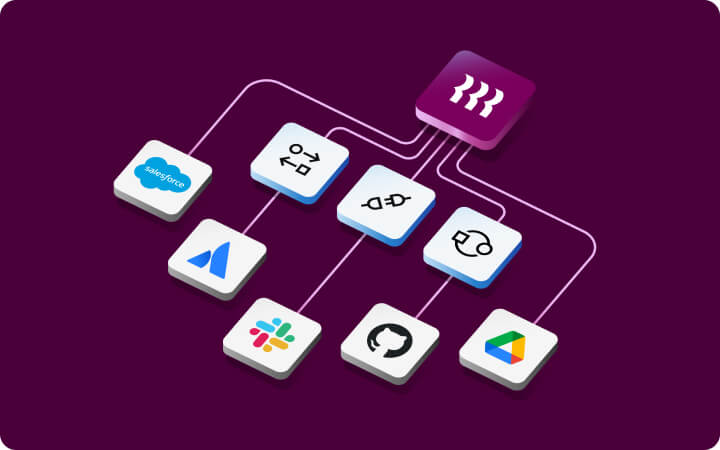






















Source: Cloudpay
The 12 Best Global Payroll Software Providers in Canada (2026)
In this article
Selecting the best global payroll software is more than just an administrative exercise. Once an organization moves beyond the Canada Revenue Agency (CRA) and starts navigating foreign statutory filings, the margin for error disappears. For Canadian businesses that are expanding into other countries, making the right choice can significantly reduce their governance risks.
Because Canadian and international payroll is heavily regulated, many businesses need a global payroll service that doubles as a legal shield. The most effective solutions can help them navigate Permanent Establishment (PE) risk, manage Employer of Record (EOR requirements and Province of Employment (POE) nuances, as well as ensure their international hiring efforts don’t trigger an audit.
To make your search for the right global payroll platform a little easier, we’ve researched 12 leading providers available to Canadian businesses, focusing on:
Global payroll coverage and execution
Compliance and tax risk management
Payments and forward exchange handling
Platform architecture and automation
Operating model transparency
Commercial scalability
Here’s an overview of how the top global payroll providers for Canadian businesses stack up.
Comparison table: Best global payroll services for Canadian businesses
Rank | Platform | Best for | Choose this if |
1 | Rippling | Best overall global payroll platform | You want strong execution, structured compliance controls, and a modern platform that scales internationally |
2 | ADP Global Payroll | Best for enterprise compliance and risk control | You prioritize mature delivery, audit readiness, and traditional enterprise governance |
3 | CloudPay | Best enterprise managed payroll partner | You prefer a managed model with strong payroll governance and central oversight |
4 | Remote | Best for scalable global coverage with structured delivery | You want broad coverage with a consistent, vendor-managed operating model |
5 | TMF Group | Best for traditional managed global payroll | You want fully managed, in-country payroll delivery across complex jurisdictions |
6 | Papaya Global | Best for enterprise-friendly multi-country coverage | You operate across regions and want structured compliance workflows and consolidation |
7 | Auxadi | Best for finance-led managed payroll delivery | You want a service-led model with strong payroll administration and operational oversight |
8 | Multiplier | Best for extensive coverage with developing maturity | You need breadth of coverage and can accept a more vendor-led control model |
9 | BDO Global | Best for established advisory-led payroll delivery | You value traditional compliance handling and established service structures |
10 | Globalization Partners | Best for managed multi-country payroll infrastructure | You prefer a service-led model with established country infrastructure |
11 | Pebl | Best for structured global expansion support | You want managed oversight with strong payment and process controls |
12 | Oyster HR | Best for simpler global payroll needs | You have smaller distributed teams and want a straightforward operating model |
The 12 best payroll software providers for Canada
Based on our full analysis of different global payroll services providers, 12 options rose to the top. In the following sections, we’ll explain how each of these platforms stands out and share some customer reviews that highlight their benefits and challenges.
Here are the platforms we’re going to take a closer look at:
Rippling
ADP Global Payroll
CloudPay
Remote
TMF Group
Paypaya Global
Auxadi
Multiplier
BDO Global
Globalization Partners
Pebl
Oyster HR
1. Rippling
Rippling ranks first because it performs consistently across execution, compliance workflows, payments, and platform automation. It’s a strong fit for Canadian teams that want one system to manage workforce changes and the downstream payroll impacts without stitching together multiple tools.
![[Image 1] Rippling | The 14 Best Global Payroll Software Providers in Australia for 2026](/_next/image?url=https%3A%2F%2Fimages.ctfassets.net%2Fk0itp0ir7ty4%2F6zLaPyXX9GGRKuIVAamhkO%2Fa0cf68fa0e1efe65c24ca3c18e4d459d%2FRippling__1_.png&w=2880&q=75)
Source: Rippling
Rippling’s strength lies in its unified global architecture, which helps to eliminate the latency typical of so many legacy middleware packages. This means it provides a single point of truth for CRA remittances and global tax data without the need for manual reconciliations.
Why companies choose Rippling
Seamlessly merges global payroll with spend management and IT provisioning in one native environment
Helps businesses stay on top of local labour laws and statutory shifts to reduce international liability risks
Highly structured, clearly itemized pricing framework ensures that country expansion follows a consistent, transparent cost logic
"Rippling’s biggest strength is how seamlessly it integrates HR, payroll, and device management in one place. The automation saves a lot of time during onboarding and offboarding, and the interface is clean and easy to navigate". —Rippling Capterra review
User-flagged challenges
Extensive automation requires a structured, multi-phase implementation rather than a simple plug-and-play setup
Total cost can shift as specific enterprise-grade modules are added to the core implementation
2. ADP Global Payroll
ADP Global Payroll is considered by many as the safe bet for large-scale enterprises that put a premium on regulatory certainty and deep multi-country infrastructure. It’s a high-governance engine built for stability in complex global environments.
![[Image 2] ADP Global Payroll | The 14 Best Global Payroll Software Providers in Australia for 2026](/_next/image?url=https%3A%2F%2Fimages.ctfassets.net%2Fk0itp0ir7ty4%2F7cyzEGVLSo2G4PcEksKDRF%2F9c80eff44d0dedcc0fe9fcbea0568a6f%2FADP__1_.png&w=2880&q=75)
Source: ADP Global
ADP Global Payroll offers extensive country coverage, and it’s a native direct engine in most jurisdictions. For a Canadian finance lead, this provides a level of treasury security and direct tax remittance that reduces the risks associated with third-party aggregators.
Why companies choose ADP
Manages tax filings and remittances directly, assuming structured compliance accountability on your behalf
Mature global payment rails handle complex currency movements and foreign exchange (FX) volatility at an enterprise scale
Features a delivery network that ensures operational stability regardless of the local market's complexity
"I like the system's accuracy and dependability, which ensure that payroll procedures are carried out perfectly and on schedule. Additionally, the platform has strong reporting and analytics features, which let me create meaningful reports and monitor important payroll KPIs." —ADP Capterra review
User-flagged challenges
Architecture is strong but less flexible than modern SaaS-first competitors, creating a steeper learning curve
Certain workflow stages remain dependent on vendor-side execution, slowing down real-time visibility
3. CloudPay
CloudPay is the specialist choice for mid-to-large enterprises that require a managed service model with high-control financial oversight. It bridges the gap between traditional outsourcing and modern digital reporting.
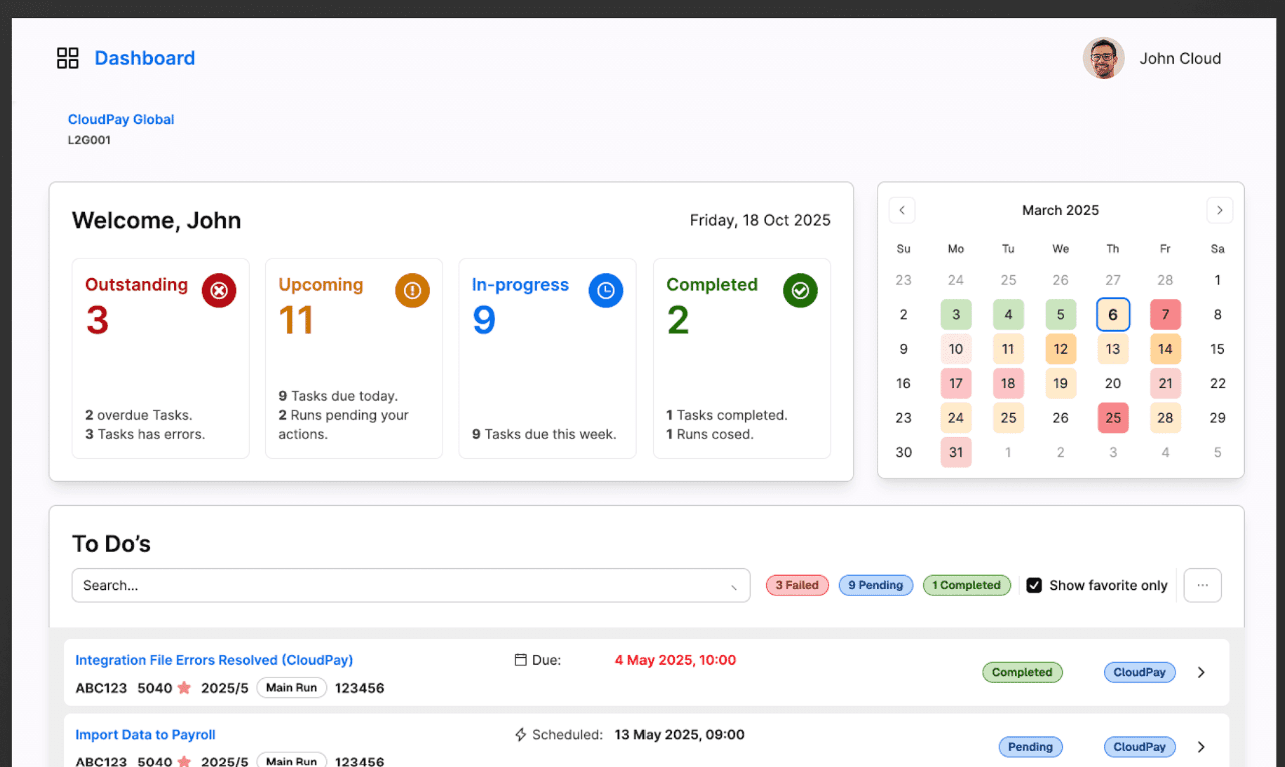
CloudPay offers a highly mature delivery model focused on enterprise-grade payroll and payments. Its advanced FX and multi-currency management are particularly relevant for Canadian firms with complex global funding needs. You trade the self-service speed of an Employer of Record (EOR) for a high-control managed environment that prioritizes gross-to-net (G2N) accuracy and audit-readiness.
Why companies choose CloudPay
Centralized, enterprise-grade funding orchestration that reduces the friction of multi-country disbursements
Configurable general ledger mapping and automated financial handoffs, ensuring payroll data flows seamlessly into ERP systems
A proactive regulatory framework that shields the organization from reactive statutory shocks
"Nice platform for payrolls management" —CloudPay G2 review
User-flagged challenges
The reliance on a service-supported model can introduce execution delays as compared to fully autonomous platforms
Deployment pricing is often bundled with managed service layers, making it harder to determine the precise cost of a global rollout
4. Remote
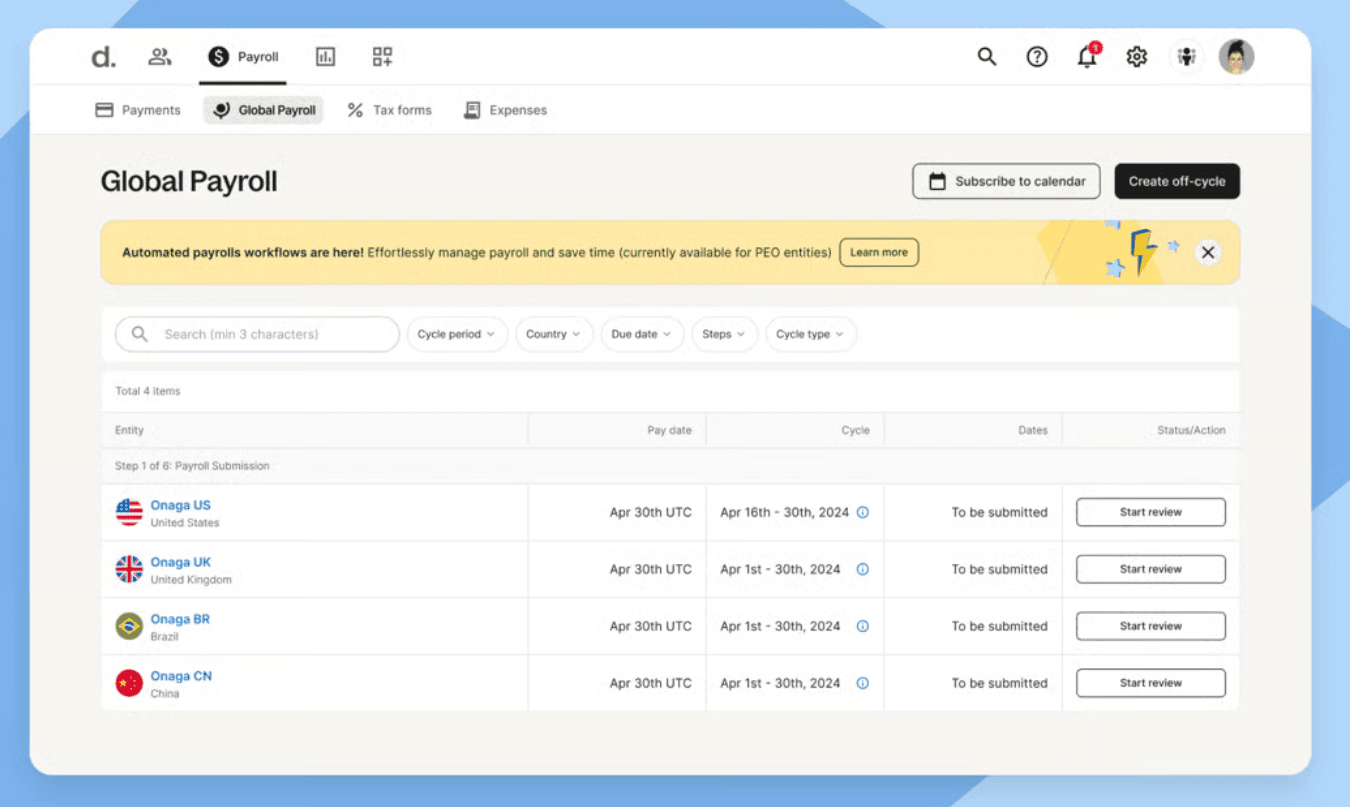
Remote is a talent-first platform designed for the remote-work era, with a heavy focus on the end-to-end employee experience. It’s a reliable choice for Canadian firms that prioritize worker retention and visibility into total rewards in competitive global markets.
Source: Remote
Source: Remote
Remote is focused on the human side of the global payroll equation. While many multi-country payroll software tools treat pay as a purely transactional event, Remote provides the localized benefits and intellectual property protections that move the needle for elite hires.
For a finance team, it offers a standardized pricing structure and a reliable global payout network, though it relies on a hybrid/federated architecture. You trade absolute direct operational control for a premium, low-friction onboarding experience.
Why companies choose Remote
Provides a robust framework for managing worker classification risk, ensuring international hires don't trigger tax audits for the Canadian parent company
Maintains strong data privacy controls, aligned with PIPEDA (Personal Information Protection and Electronic Documents Act) standards
Features clear and standardized implementation pricing, making it easy for Canadian startups to forecast the cost of entry into new regions
"Remote has enabled our team to grow globally, hiring amazing people without the worry and cost associated with creating a legal entity." —Remote Capterra review
User-flagged challenges
The moderate control model means some workflow stages have less transparency than a fully native system of record
While it integrates with major systems, its overall automation depth for complex workforce operations is still emerging
5. TMF Group
TMF Group excels in fully managed, in-country payroll delivery across complex jurisdictions. Its service-led operating model is best suited for organizations that prefer deep local expertise and outsourced control over platform-first automation.
Source: TMF Group
TMF Group features a highly mature delivery model anchored in local statutory alignment. For a Canadian finance lead, this provides a level of high-control delivery and direct tax remittance that reduces the risks of digital-only aggregators.
However, the platform's automation and developer extensibility are notably less contemporary than those of top global payroll competitors. You trade digital speed and one-click integrations for decades of institutional experience and a full-service filing and remittance engine.
Why companies choose TMF Group
Native in-country presence ensures payroll is executed with strict adherence to local labour laws and tax regulations
Features enterprise-grade security and fully documented audit readiness, making it a safe bet for highly regulated industries
Mature global payment rails can handle complex currency movements and FX volatility with high reliability
No user review available
User-flagged challenges
Pricing is often highly fragmented and requires country-by-country negotiation, leading to less predictability during periods of fast growth
The managed model can result in opaque status updates, as users have minimal direct control over the real-time payroll workflow
6. Papaya Global
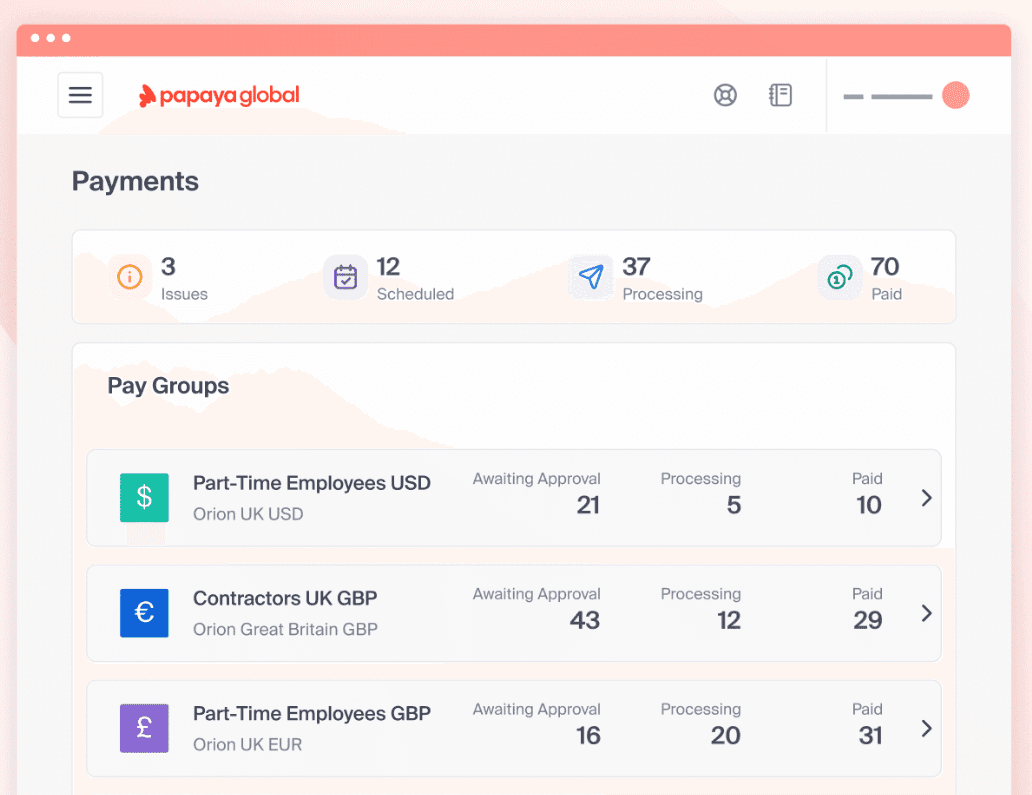
Papaya Global is a sophisticated data-first platform built for organizations that need to unify different payroll streams into a single reporting layer. It’s ideal for Canadian firms that prioritize financial visibility and advanced business intelligence (BI).
Source: Payapa Global
Source: Papaya Global
Papaya Global acts as a high-level digital layer over a global network of local providers. Unlike platforms that force a total migration to their own engine, Papaya is built to consolidate data from various G2N mapping sources and Human Resources Information Systems (HRIS). It gives finance directors a holistic view without the operational trauma of requiring a complete system overhaul. You trade some real-time workflow transparency for great analytics and consolidated reporting.
Why companies choose Papaya Global
Provides a centralized visibility layer that excels at multi-country data consolidation
Provides structured multi-currency payroll funding with centralized coordination across their partner network
Supports a variety of service models, allowing firms to maintain existing local relationships while centralizing governance
"Papaya Global excels in multi-currency payroll management, which is crucial for our international operations. The compliance features ensure we adhere to all local laws and regulations, giving us peace of mind." —Papaya Global Capterra review
User-flagged challenges
Workflow Transparency Gaps: Because execution is often partner-led, there can be lags in real-time status updates from time to time within the platform
Architecture Limitations: The hybrid/federated architecture means the platform functions more as an orchestration layer than a native engine
7. Auxadi
Auxadi delivers high-quality managed compliance execution with mature governance and filing ownership. It features a high-control delivery model designed for mid-to-large enterprises that prioritize local statutory certainty in complex jurisdictions.

Source: Auxadi
Auxadi stands out for its highly mature delivery and deep local statutory alignment. For a Canadian organization, this provides a level of full-service filing and remittance that ensures all local tax obligations are met with institutional precision.
While it offers a strong centralized architecture for reporting, it lacks the developer extensibility and API depth found in modern software as a service (SaaS) competitors. You trade modern automation and self-service depth for a healthy sense of compliance governance.
Why companies choose Auxadi
Native in-country expertise ensures payroll is executed in strict compliance with local labour laws and tax regulations
Features enterprise-grade security and fully documented audit readiness, providing a high degree of regulatory confidence
Provides advanced centralized control for organizations managing many global legal entities
No user review available.
User-flagged challenges
The managed model can lead to opaque status updates, as users have limited direct control over real-time payroll workflows
Minimal API support and basic automation tools may hinder firms seeking deep, custom workforce integrations
8. Multiplier
Multiplier is a specialized compliance engine designed for firms scaling into high-risk jurisdictions where limiting local legal issues is a priority. It intentionally trades broad feature sets for deep, localized employment contract security and direct entity custody.
![[Image 7] Multiplier | The 14 best global payroll services options in Australia](/_next/image?url=https%3A%2F%2Fimages.ctfassets.net%2Fk0itp0ir7ty4%2F6lw9xcF2Q647AsogWVfbTP%2F5adfc9c78f2ed749904b6d11b59ebc19%2FMultiplier__1_.png&w=2880&q=75)
Source: Multiplier
By owning its local legal entities, Multiplier removes the middleman risk that often triggers audit headaches for Canadian firms hiring abroad. While it’s not a full-suite HRIS, it excels at managing the international payroll process with a focus on statutory tax filing and localized benefits.
Why companies choose Multiplier
Reduces the unpredictability of third-party aggregators by employing workers through their locally owned legal structures
Assumes structured compliance accountability, specifically protecting the business against worker misclassification risks
Features a predictable global scaling model with clear and standardized implementation costs
"Dependable partner for expansion into new markets". —Multiplier Capterra review
User-flagged challenges
The dashboard is reliable but utilitarian, lacking the advanced automation and slick UX of its venture-backed SaaS competitors
Its reporting and data export capabilities are basic, which may frustrate finance teams requiring granular data visibility
9. BDO Global Payroll
BDO Global Payroll is a robust choice for mid-to-large Canadian organizations that prioritize a managed service model with strong local statutory alignment. It functions more as a high-governance extension of a firm’s finance team rather than a self-service software platform.
Source: BDO Global
BDO offers a highly mature delivery model that is anchored in its global accounting network. For a Canadian Controller, the value lies in BDO's ability to provide a full-service filing and remittance engine that manages CRA obligations alongside complex foreign tax requirements.
While it offers advanced multi-entity governance, its platform architecture is hybrid/federated, which means it lacks the real-time automation depth of top global payroll SaaS providers. You trade digital agility for the security of a higher-control delivery model and mature audit readiness.
Why companies choose BDO Global Payroll
Leverages an extensive in-country network to ensure payroll is executed with strict adherence to local labour laws
Provides enterprise-grade security and fully documented controls, essential for those firms operating in highly regulated sectors, such as healthcare
Offers a structured reporting layer that consolidates data across multiple jurisdictions for better oversight and leadership
No user review available.
User-flagged challenges
The managed model can result in service-dependent status updates, offering less real-time transparency than modern automated platforms
Implementation and scaling costs are often highly fragmented, requiring specific country-by-country negotiations
10. Globalization Partners
Globalization Partners is a quality Employer of Record (EOR). Its solution is designed for enterprises that value high-level compliance accountability rather than low-cost administration.
![[Image 8] Globalization Partners | The 14 best global payroll services options in Australia](/_next/image?url=https%3A%2F%2Fimages.ctfassets.net%2Fk0itp0ir7ty4%2F5PeqZJbeL5Dcgq5uGjlWDP%2F96c7112ac21776c142297e916f5847b9%2FGP__1_.png&w=2880&q=75)
Source: Globalization Partners
Globalization Partners focuses on mature delivery and a structured risk mitigation framework. For Canadian firms expanding into regions with volatile regulatory environments, Globalization Partners assumes a structured compliance accountability, reducing local legal risk.
While its platform offers strong reporting capabilities, the operating model is primarily managed, which may feel restrictive for teams accustomed to self-service global payroll software. This may mean trading a higher total cost of ownership for institutional-grade data privacy and PIPEDA compliance.
Why companies choose Globalization Partners
Provides a robust liability structure that manages complex international employment risks directly
Features structured funding workflows and strong FX support to ensure accurate international disbursements
Maintains enterprise-grade security frameworks suitable for public or highly regulated Canadian organizations
"Amazing working with G-P" —Globalization Partners Capterra review
User-flagged challenges
International costs may be subject to variable country pricing, making long-term budgeting for a distributed team less predictable
As a managed model, users have limited status visibility into real-time payroll stages compared to tech-native platforms
11. Pebl
Pebl (formerly Velocity Global) is a high-governance platform built for enterprises that require a blend of modern software and deep in-country expertise. It remains an ideal candidate for Canadian firms that demand high reliability in G2N calculations.
![[Image 9] Pebl (formerly Velocity Global) | The 14 best global payroll services options in Australia](/_next/image?url=https%3A%2F%2Fimages.ctfassets.net%2Fk0itp0ir7ty4%2F44uVKQMC3pdKd2vtQxK5AG%2F4a571dd67e4826507dc912c40d95747a%2Fpbl__1_.png&w=2880&q=75)
Source: Pebl Pebl distinguishes itself with strong automation and controls and a native/direct engine approach in many key markets. For a Canadian finance lead, the platform's transition to a more AI-driven model (via its new platform architecture) offers great reporting capabilities and improved operational speed.
While it remains a primarily managed model for many jurisdictions, it provides a more contemporary interface than traditional global accounting firms. You trade premium bundled pricing for high-level compliance and a proven track record in complex global markets.
Why companies choose Pebl
Assumes structured compliance accountability, helping reduce the middleman risk often found in federated payroll models
Features a mature payment compliance framework that ensures secure and timely global disbursements
Provides comprehensive integration with HR and finance systems, enabling more efficient data flow within the home office
"Pebl (formerly Velocity Global) is able to handle the different complexities and variety specific to each country where we have existing employees of record. They're able to handle and stay on top of the countries' implementing rules and regulations so we can stay compliant to the labor laws." —Pebl G2 review
User-flagged challenges
Contracts can be rigid with multi-year/service-locked terms that may not suit firms requiring extreme scaling flexibility
Implementation and service costs can be variable, depending on the complexity of the specific international jurisdictions involved
12. Oyster
Oyster HR is a talent-first platform designed for the remote-work era, specifically tailored for Canadian firms that prioritize worker retention and benefits visibility in a competitive global market. It’s an effective solution for organizations moving beyond simple contractor hiring to full-time international employment.
![[Image 10] Oyster | The 14 best global payroll services options in Australia](/_next/image?url=https%3A%2F%2Fimages.ctfassets.net%2Fk0itp0ir7ty4%2FokDTANlABCY79sBlAICIx%2F4f5fe99fe46bc74526a765a0cf147ad1%2FOyster.png&w=2880&q=75)
Source: Oyster HR
Oyster leans into the total rewards side of global expansion. While many multi-country payroll software tools treat payments as a purely backend transaction, Oyster focuses on the localized benefits and cultural fluency required to retain elite hires.
For a Canadian finance team, it offers a highly structured pricing model and a reliable payout network, though it operates on a partner-reliant calculation model rather than a native engine. You trade direct operational custody for a premium, low-friction onboarding experience that stays aligned with PIPEDA privacy standards.
Why companies choose Oyster
Employee-focused interface, making it exceptionally simple for global teams to manage their own expenses and statutory benefits
Oyster Academy, which provides the deep regulatory insights required for Canadian firms to hire in new territories without a massive in-house HR department
Highly structured onboarding process with clear, standardized implementation pricing, making it easier for startups to budget for headcount growth
"My experience with Oyster has been positive overall. It’s a reliable solution that I’d recommend to others." —Oyster Capterra review
User-flagged challenges
Reliance on local partners can lead to reactive compliance monitoring and variable support speeds in niche markets
Finance teams may find the limited status visibility frustrating when attempting to track specific G2N payroll stages in real time
Governance first: 5 steps for selecting your global payroll architecture
Choosing an international payroll software for a Canadian organization is less about considering the range of features offered and more about how much liability your finance team is willing to retain. As you scale beyond the CRA mandate, consider using these five criteria to stress-test any shortlist you create.
1. Verify the source of truth for calculations
Ask the providers whether they use a native or direct engine or if they’re reliant on external partners. A native engine performs calculations directly within the software, whereas partner-reliant models pass data to local third-party providers. Native engines tend to generate better real-time visibility and experience lower latency.
2. Audit the compliance accountability structure
Don’t assume that every platform will help mitigate your local legal risk. Some payroll providers operate on a shared accountability model, while others assume structured compliance accountability, where they take full responsibility for statutory filings and local labour laws. It’s essential to verify who’s liable if a provincial or international tax filing is missed or rejected.
3. Demand PIPEDA and data residency clarity
Under the Personal Information Protection and Electronic Documents Act (PIPEDA), Canadian businesses must ensure that employee data, including Social Insurance Numbers (SINs) and banking details, is handled with enterprise-grade security. Ensure your global payroll solution provides audit-ready documentation and complies with both federal and provincial privacy mandates, such as Quebec's Law 25.
4. Evaluate treasury orchestration and FX reliability
International payroll can involve significant FX risk. Review the platform's funding workflows and their payment orchestration capabilities. The best global payroll software platforms provide transparent, traceable payment rails that allow you to fund payroll in Canadian dollars while ensuring employees receive the correct local currency amounts without any hidden fees.
5. Stress-test commercial scalability
Many global payroll providers offer low entry costs and variable country pricing models or opaque implementation fees. Together, these can increase your costs as you expand, especially if you move into complex regions like the APAC or EMEA. Try to find a predictable global scaling model with clearly itemized costs to avoid budget blowouts during periods of rapid expansion.
Conclusion: Moving from admin to strategy
For Canadian firms, the transition to global payroll management marks a shift from simple administration to complex governance. The providers ranked in this review, led by Rippling, each offer different trade-offs between platform automation and managed service depth.
Choosing the right international payroll solutions requires a cold-eyed look at your internal capacity and willingness to manage risk. If you prioritize a unified system of record and high-velocity automation, a platform-first architecture may be your preferred choice. If you require institutional-grade stability and fully outsourced tax remittances, an enterprise-managed model may be the safer path to choose.
Ready to audit your global payroll architecture?
If your current cross-border payroll relies on manual workarounds and fragmented data, it’s a potential liability. Book a custom demo with Rippling to see how a unified system of record can eliminate G2N latency and automate your Canadian and international compliance.
FAQs
What is the best global payroll software in Canada?
Based on our review of global payroll providers, Rippling is currently the top-ranked global payroll management platform because it offers a unified architecture and supports CRA remittances/workflows.
Does global payroll software ensure PIPEDA compliance?
Not all international payroll providers are equal. You must verify that your provider adheres to PIPEDA, which governs how personal employee data is collected and stored in Canada.
How does a native engine differ from partner-reliant payroll?
A native engine, like the one used by ADP Global Payroll, calculates taxes directly within the software. Partner-reliant models, such as Oyster, outsource the actual G2N calculations to third-party local providers, which can increase data latency.
Can I manage both Canadian and US employees on one platform?
Yes. Modern multi-country payroll software is designed for North–South expansion, allowing Canadian firms to manage Single Touch Payroll equivalents and CRA filings alongside US-based tax requirements in one interface.
Disclaimer
Rippling and its affiliates do not provide tax, accounting, or legal advice. This material has been prepared for informational purposes only, and is not intended to provide, and should not be relied on for tax, legal, or accounting advice. You should consult your own tax, legal, and accounting advisors before engaging in any related activities or transactions.
Rippling editorial policy: Rippling puts our customers (and prospective customers!) first. The Rippling team is committed to providing information supported by product data, expert insights, and real customer feedback to inform all of our content. All of our content is reviewed by product experts for accuracy and freshness.

Author
The Rippling Team
Global HR, IT, and Finance knowhow directly from the Rippling team.
See Rippling in action
Increase savings, automate busy work, and make better decisions by managing HR, IT, and Finance in one place.