

























Pay transparency laws require employers to disclose salary ranges to job applicants or current employees, or both. As of 2025, states with active pay transparency laws include California, Colorado, Connecticut, Hawaii, Illinois, Maryland, Minnesota, Nevada, New York, Rhode Island, and Washington. New York City and several other municipalities have their own ordinances. Laws vary significantly: some require ranges in every job posting, others only at the applicant’s request, and some require employers to disclose ranges to existing employees upon request. The federal Salary Transparency Act has been introduced but not yet passed.
Pay Transparency Laws by State: A Guide for Employers
Take compliance busywork off your plate
Watch a quick walkthrough on how a PEO can simplify multi-state compliance, payroll taxes, and required training as laws change.
In this article
Pay transparency laws are changing fast. What started as a handful of state-level statutes has grown into a nationwide movement, with employers in nearly every region now required to disclose salary information to job applicants, current employees, or both. As of 2026, 18 states plus Washington, D.C. have enacted statewide pay transparency laws—and more are on the way.
Pay transparency legislation requires employers to disclose salary information to job candidates and current employees, making workplaces more transparent and equitable. While laws vary significantly by jurisdiction, they generally require employers to do one or more of the following:
Salary information: Some states require employers to disclose wage ranges but with different requirements for when and how. Some states require a range to be included in the job listing, while others don’t require disclosure until after the first interview, at the applicant’s request, or upon hire.
Total compensation: Some states require disclosure of more than just the pay range, including benefits, bonuses, commission, and other components of the full compensation package.
Remote employees: Some states require transparency for remote job postings, while others only require it for hybrid or in-office roles.
California was the first U.S. state to adopt pay transparency legislation—in 2018—and the movement has accelerated dramatically since. As of 2026, 18 states plus D.C. have active or upcoming pay transparency laws on the books, with additional states actively considering legislation.
At the federal level, the Salary Transparency Act and Pay Equity for All Act were introduced in Congress in 2023. If passed, they would require all US employers to disclose wage ranges in all employment opportunities and prohibit asking about salary history. Neither law has passed as of this writing, but the legislative pressure continues to build.
For employers, the patchwork of state and local laws can be difficult to navigate—especially for companies with employees across multiple states or remote workers who may be subject to the laws of states other than where the employer is headquartered. Below, we cover pay transparency laws in all 50 states and DC so you can make sure you follow the right rules for where your workers are based.
US pay transparency laws by state
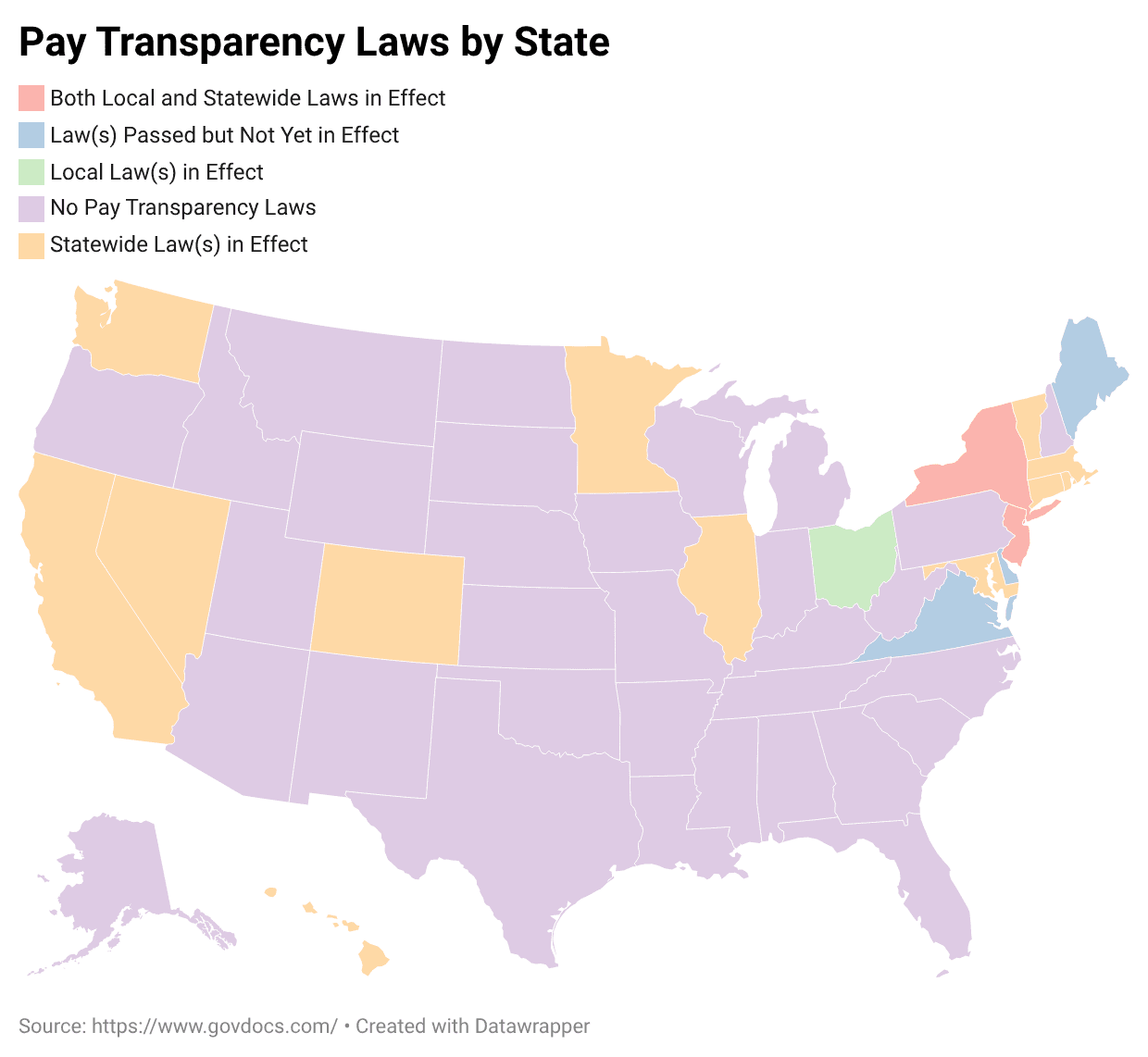
The following states have enacted pay transparency laws requiring employers to disclose salary ranges under certain circumstances. Effective dates and specific requirements vary, so employers should review each jurisdiction’s requirements carefully.
California
Date Effective | Requirements | Who does this apply to? | Consequences of non-compliance |
|---|---|---|---|
Jan. 1, 2023 | Salary information: Employers must disclose the salary range in all job postings. Employers may not ask a job applicant about their salary history. Employers must disclose a position’s salary range to current employees upon request. Remote employees: Employers must disclose salary information in job postings for jobs that can be done remotely. | Employers with at least one employee must disclose salary ranges to their current employees upon request. Employers with at least 15 employees, with at least one working in California, must meet all the other requirements of the law. | Civil penalties are between $100 and $10,000 per violation. |
Colorado
Date Effective | Requirements | Who does this apply to? | Consequences of non-compliance |
|---|---|---|---|
Jan. 1, 2021Updates effective Jan. 1, 2024 | Salary information: Colorado’s Equal Pay for Equal Work Act (first enacted in 2021) was updated in 2023 to require all employers to post, advertise, and notify all employees of all job opportunities (not just promotional ones) and disclose pay scales, job descriptions, and the date the application window is expected to close in all job listings. The compensation posting requirements do not apply to either (1) jobs to be performed entirely outside Colorado or (2) postings entirely outside Colorado. Total compensation: The law requires employers to list benefits and any other compensation (such as bonuses or commissions) in addition to the salary information. | All employers with at least one employee in Colorado | Fines range between $500 and $10,000 per violation. |
Connecticut
Date Effective | Requirements | Who does this apply to? | Consequences of non-compliance |
|---|---|---|---|
Oct. 1, 2021 | - Salary information: During the hiring process, employers must disclose the salary range for a position in the earliest of these situations: 1. At the applicant’s request 2. Prior to or at the time the applicant is made an offer of compensation Employers must also disclose salary information to their current employees at their request or whenever they change positions. Employers may not ask about an applicant’s pay history unless it is voluntarily disclosed. | Employers with at least one employee in Connecticut | An employee or job applicant can bring a civil action against an employer who violates the law within two years of the violation. They can seek compensatory and punitive damages, plus costs. |
Hawaii
Date Effective | Requirements | Who does this apply to? | Consequences of non-compliance |
|---|---|---|---|
Jan. 1, 2024 | Salary information: Employers must include a salary range or hourly wage rate in job postings that accurately reflects what they expect to pay for the role. | This applies to employers with at least 50 employees. The law provides that disclosure requirements don’t apply to: - Public employee positions whose compensation is determined under a collective bargaining agreement -Internal transfers or promotions | Employers accused of violating the law can face civil action for compensatory and punitive damages, plus costs. |
Illinois
Date Effective | Requirements | Who does this apply to? | Consequences of non-compliance |
|---|---|---|---|
Jan. 1, 2025 | Salary information: Employers must include the wage scale they reasonably expect to pay for a position in the job posting. Total compensation: They must also include a general description of any benefits included in the total compensation, including bonuses, stock options, and other incentives. Remote employees: The Illinois law applies to any positions that will be physically performed, at least in part, in Illinois or will be physically performed outside of Illinois, but the employee reports to a supervisor, office, or work site in Illinois. | Employers with at least 15 employees | Fines range between $500 and $10,000 per violation. |
Maryland
Date Effective | Requirements | Who does this apply to? | Consequences of non-compliance |
|---|---|---|---|
Oct. 1, 2024 | Salary information: Employers must include a wage range and general description of benefits in all public and internal job postings. Employers must also provide the wage range to applicants before discussing compensation. Salary history ban: Employers may not seek or rely on salary history to screen applicants or set pay. | All employers engaged in business in the State of Maryland with at least 15 employees. | Civil penalties of up to $300 for a first violation and up to $600 for subsequent violations. The Maryland Attorney General may enforce the law. |
Nevada
Date Effective | Requirements | Who does this apply to? | Consequences of non-compliance |
|---|---|---|---|
Oct. 1, 2021 | Salary information: Employers must provide salary information to applicants for any role they interview for. They must also provide salary information to current employees seeking a promotion or internal transfer if they request it and one of these conditions is true: - They applied for the new position. - They completed an interview for the new position. - They received an offer for the new position. | All employers in Nevada | Employees and job seekers can bring civil action against employers. The Labor Commission may also impose fines of $5,000 per violation, plus investigation and attorney costs. |
New York
Date Effective | Requirements | Who does this apply to? | Consequences of non-compliance |
|---|---|---|---|
Sept. 17, 2023 | Salary information: Employers must disclose salary ranges for positions that can or will be performed in New York. Remote employees: The law applies to jobs that can be performed in New York or will be performed outside of New York but report to a supervisor, office, or work site in New York. | All private New York employers with four or more employees (note that the law doesn’t specify whether this is total employees or employees in New York State) | Fines up to $1,000 for the first violation, up to $2,000 for the second violation, and up to $3,000 for the third and subsequent violations |
Rhode Island
Date Effective | Requirements | Who does this apply to? | Consequences of non-compliance |
|---|---|---|---|
Jan. 1, 2023 | Salary information: Employers must disclose salary ranges for job applicants’ and current employees’ positions if: - They request it - For applicants, before discussing an offer of compensation. - For current employees, at the time of hire or before they move to a new position. Employers are prohibited from seeking the wage history of an applicant. | Employers with at least one employee in Rhode Island | Fines range between $1,000 and $5,000. |
Washington
Date Effective | Requirements | Who does this apply to? | Consequences of non-compliance |
|---|---|---|---|
Jan. 1, 2023 | Salary information: All job postings must include salary information. For internal job transfers and promotions, employers must disclose salary ranges at the employee’s request. Total compensation: Job postings must also include a general description of benefits and information about any other compensation (bonuses, stock options, commissions, etc.). Remote employees: Washington’s law applies to any company outside of Washington that might hire Washington-based employees. The law prohibits employers from avoiding disclosure by stating in job postings that they don’t accept applicants from Washington. | Employers with 15 or more employees who engage in business in Washington or recruit for jobs that could be filled by Washington-based employees | Employers may be ordered to pay damages to employees, plus 1% interest per month. Additionally, employers may be charged fines of up to $500 for a first violation and up to $1,000 or 10% of damages (whichever is greater) for repeat violations, plus fees, interest, costs, and other relief. |
New and recently enacted pay transparency laws
Since 2023, a wave of new states have joined the pay transparency movement. The following states have passed laws that are now active or will take effect in the near term:
District of Columbia – effective June 30, 2024
Hawaii – effective January 1, 2024
Illinois – effective January 1, 2025
Maryland – effective October 1, 2024
Massachusetts – effective October 29, 2025
Minnesota – effective January 1, 2025
New Jersey – effective June 1, 2025
Vermont – effective July 1, 2025
Maine – effective July 28, 2026
Virginia – effective July 1, 2026
Delaware – effective September 26, 2027 (upcoming)
As of this writing, several more jurisdictions across the U.S. have some form of pay transparency law under consideration, and the trend shows no sign of slowing.
States considering pay transparency
Many additional states have introduced pay transparency legislation or considered bills in recent sessions without yet enacting a law. These include Alaska, Kentucky, Michigan, Missouri, Montana, New Jersey (now passed), Oregon, South Dakota, West Virginia, and Wisconsin. Employers in these states should monitor legislative developments closely, as laws can take effect with relatively short implementation windows.
Alaska
Date Effective | Requirements | Who does this apply to? | Consequences of non-compliance |
|---|---|---|---|
None yet - this bill was proposed in the Alaska legislature in 2021 but has not yet passed. | Salary information: Employers must disclose the salary range in all job postings. Employers may not ask a job applicant about their salary history. | Employers with at least one employee | Fines range between $100 and $2,000 per violation. |
District of Columbia
Date Effective | Requirements | Who does this apply to? | Consequences of non-compliance |
|---|---|---|---|
None yet—the bill has been proposed as part of the 2023 legislative session. | Salary information: Employers must include salary ranges in job postings. Total compensation: Job postings must also include a description of benefits, including bonuses, stock options, equity, and any other compensation. | Private employers with 25 or more employees | Fines range between $1,000 and $20,000 per violation. |
Kentucky
Date Effective | Requirements | Who does this apply to? | Consequences of non-compliance |
|---|---|---|---|
None. An amendment to existing Kentucky employment law was introduced in 2023 but hasn’t moved forward. | Salary information: The amendment would require employers to include salary information in job postings. Total compensation: It would also require them to include benefits and other compensation. | The bill doesn’t specify beyond “employers.” | No consequences for non-compliance are included in the draft bill. |
Maine
Date Effective | Requirements | Who does this apply to? | Consequences of non-compliance |
|---|---|---|---|
None yet—Maine introduced this legislation in 2023, but it hasn’t passed. | Salary information: Maine’s draft bill would require all employers to disclose salary information, but the exact requirements depend on how many employees they have: - Those with 10 or more employees would be required to include pay ranges in all job postings. - Those with fewer than 10 employees must provide the pay range for an open position to any applicant upon request. - All employers must provide the pay range to a current employee for that employee’s own position upon request. | All employers in Maine, but there are different requirements based on the number of employees they have | The draft bill, as written, doesn’t yet specify any consequences for non-compliance. |
Massachusetts
Date Effective | Requirements | Who does this apply to? | Consequences of non-compliance |
|---|---|---|---|
Oct. 29, 2025 | Salary information: Employers must include a pay range for all covered job postings, including positions, transfers, and promotions. Employers must also provide the pay range to an applicant for employment or to an employee who is offered a promotion or transfer. | Employers with 25 or more employees in Massachusetts. | Warning for first offense; fine of up to $500 for second offense; fines of up to $7,500 (unintentional) or $15,000 (intentional) for third and subsequent offenses. Criminal charges may apply on third or subsequent offense. |
Michigan
Date Effective | Requirements | Who does this apply to? | Consequences of non-compliance |
|---|---|---|---|
Jan. 1, 2025 | Salary information: Employers must disclose a starting salary range or fixed pay rate in all job postings. The range must be set in good faith. Employers must also provide a salary range to current employees upon request and to new hires before they start. Total compensation: Employers must include a general description of benefits and other compensation in job postings. | Employers with 30 or more employees in Minnesota. | The Minnesota Department of Labor and Industry enforces the law. Penalties can include remedial action and fines up to $10,000 per willful violation. |
Missouri
Date Effective | Requirements | Who does this apply to? | Consequences of non-compliance |
|---|---|---|---|
None yet—this bill was proposed during Missouri’s 2023 legislative session but stalled in committee. | Salary information: Employers must disclose salary ranges to job applicants at the earliest of these: 1. When the applicant requests it 2. When a job offer is made Employers must also provide salary ranges to current employees who are applying for a transfer or promotion if both of these are true: 1. The employee has completed an interview or been offered a transfer or promotion. 2. The employee has requested the salary information. | The proposed bill doesn’t include any specific language about who it applies to other than “employers.” | Fines range between $1,000 and $5,000. |
Montana
Date Effective | Requirements | Who does this apply to? | Consequences of non-compliance |
|---|---|---|---|
None yet—the state legislature considered a bill during its 2023 session, but it didn't pass. | Salary information: Employers must include salary or wage information in job postings. Total compensation: Employers must also include descriptions of benefits and other compensation offered for the role. | Employers with 15 or more employees | Fines range between $500 and $10,000 per violation. |
New Jersey
Date Effective | Requirements | Who does this apply to? | Consequences of non-compliance |
|---|---|---|---|
June 1, 2025 | Salary information: Employers must include the hourly wage or salary range, or fixed rate of pay, in all job postings. Total compensation: Employers must also include a general description of benefits and other compensation in job postings. | Employers with 10 or more employees in New Jersey. | Civil penalties: $300 for first violation, $600 for second, and $300 per day for subsequent violations. Aggrieved parties may also bring civil action for compensatory damages and costs. |
Oregon
Date Effective | Requirements | Who does this apply to? | Consequences of non-compliance |
|---|---|---|---|
None yet—the Oregon legislature considered this bill during its 2023 session but shelved it. | Salary information: Employers would be required to include pay ranges in job postings. Total compensation: They would also be required to state any benefits included in the total compensation for the role. | Employers in Oregon | $1,000 fine for the first violation, with the fine increasing by $1,000 for each subsequent violation, up to $10,000 |
South Dakota
Date Effective | Requirements | Who does this apply to? | Consequences of non-compliance |
|---|---|---|---|
None yet—the bill was introduced during South Dakota’s 2023 legislative session but didn’t pass. | Salary information: Employers must include hourly or salary ranges in all job postings for new positions, transfers, and promotions. Total compensation: They must also include a general description of any benefits and other compensation for the role. | Private employers with 100 or more employees | A $500 fine for each violation |
Vermont
Date Effective | Requirements | Who does this apply to? | Consequences of non-compliance |
|---|---|---|---|
July 1, 2025 | Salary information: Employers must disclose the compensation or a range of compensation in all job postings and upon request to current employees. The salary range must represent the employer’s good faith estimate. Salary history ban: Employers may not request an applicant’s compensation history. | All employers with at least 5 employees in Vermont. | The Vermont Attorney General may enforce the law and seek civil penalties. Individual employees may also bring a private right of action for compensatory damages. |
Virginia
Date Effective | Requirements | Who does this apply to? | Consequences of non-compliance |
|---|---|---|---|
None yet—the bill passed Virginia's State Senate in 2023 but was held in the House Commerce and Energy Committee. | Salary information: The law, if passed, would have required employers to provide a pay range to prospective employees upon request and before discussing compensation during the hiring process. | All employers in Virginia | Fines range between $1,000 and $10,000 or actual damages, whichever is greater. |
West Virginia
Date Effective | Requirements | Who does this apply to? | Consequences of non-compliance |
|---|---|---|---|
None yet—the bill was introduced in the West Virginia House of Delegates in 2023. | Salary information: Employers must provide salary and wage information to job candidates who request it, and they can't discriminate against candidates who ask for compensation information. Total compensation: Employers must also provide benefits and other compensation details upon request. | Any person, firm, or corporation employing an employee | Employers who violate the law could be sued by their employees for compensatory and punitive damages, plus costs. |
Local pay transparency laws
In addition to state laws, several cities and counties have their own pay transparency requirements. These local ordinances often predate or exceed their state equivalents:
New Jersey (Jersey City)
Date Effective | Requirements | Who does this apply to? | Consequences of non-compliance |
|---|---|---|---|
April 13, 2022 | Salary information: Employers must disclose salary ranges in postings for jobs, transfers, and promotions. Total compensation: They must also include a description of the benefits included in the total compensation for the role. | Employers with five or more employees in Jersey City and a place of business there | Fines of up to $2,000 per violation |
New York (Ithaca)
Date Effective | Requirements | Who does this apply to? | Consequences of non-compliance |
|---|---|---|---|
Sept. 1, 2022 | Salary information: Employers must publish salary ranges in job, transfer, and promotion postings. The requirement applies to all positions for which the standard work location will be in the City of Ithaca. | Employers in the City of Ithaca with four or more employees | The Ithaca law is a bit vague, but employers who violate it may be liable for “money damages and any other remedy available at law,” according to Section 215-9.5 of the Ithaca City Code. |
New York (New York City)
Date Effective | Requirements | Who does this apply to? | Consequences of non-compliance |
|---|---|---|---|
Nov. 1, 2022 | Salary information: Employers must include salary ranges in job postings for positions that can or will be performed in NYC. Total compensation: Job postings must also include an overview of benefits included in the total compensation. Remote employees: The law applies to remote jobs if they can be performed in NYC. | Employers with four or more employees where at least one of them is in New York City | No penalty for a first violation if it’s corrected within 30 days. Otherwise, you could receive fines of up to $250,000 for an uncorrected first violation or repeat violations. |
New York (Westchester County)
Date Effective | Requirements | Who does this apply to? | Consequences of non-compliance |
|---|---|---|---|
Nov. 6, 2022 | Salary information: Employers must include salary information in job postings. Remote employees: The law applies to remote jobs that can be performed in Westchester County. | Any employer posting a job that can be performed in Westchester County | Fines up to $3,000, depending on the employer’s size, good faith, the gravity of the violation, and whether it’s a first or repeat offense |
Ohio (Cincinnati)
Date Effective | Requirements | Who does this apply to? | Consequences of non-compliance |
|---|---|---|---|
March 13, 2020 | Salary information: Employers must disclose salary ranges to job applicants after extending them a job offer if the applicant requests the information. Employers are prohibited from inquiring about the salary history of an applicant for employment. | Employers with 15 or more employees in Cincinnati | Job applicants can take legal action against employers who violate the law for up to two years after the violation to seek compensatory damages and costs. |
Ohio (Toledo)
Date Effective | Requirements | Who does this apply to? | Consequences of non-compliance |
|---|---|---|---|
Nov. 1, 2022 | Salary information: Employers must disclose salary ranges to job applicants after extending them a job offer if the applicant requests the information. Employers are prohibited from inquiring about the salary history of an applicant for employment. | Employers with 15 or more employees in Toledo | Job applicants can take legal action against employers who violate the law for up to two years after the violation to seek compensatory damages and costs. |
States without pay transparency laws
The majority of U.S. states still have no statewide pay transparency law, though many have considered legislation in recent sessions. The following states have no active pay transparency requirements at the state level as of 2026 (note: some may have local ordinances):
Alabama
Arizona
Arkansas
Florida
Georgia
Idaho
Indiana
Iowa
Kansas
Kentucky
Louisiana
Michigan
Mississippi
Missouri
Montana
Nebraska
New Hampshire
New Mexico
North Carolina
North Dakota
Ohio
Oklahoma
Oregon
Pennsylvania
South Carolina
South Dakota
Tennessee
Texas
Utah
West Virginia
Wisconsin
Wyoming
Similar but not quite the same: Salary history bans
Salary history bans are adjacent to pay transparency laws and are increasingly common. These laws prohibit employers from asking job applicants about their past or current compensation and preclude using that history to set starting pay. Originally part of the growing movement following the #MeToo era, salary history bans now exist across more than 20 states and several major cities.
Employers in these jurisdictions can typically ask about pay expectations but not actual salary history. The following states (or jurisdictions within them) have salary history bans for private employers:
Alabama: Employers cannot refuse to hire, interview, promote, or employ a job applicant based on the applicant’s decision not to provide a salary history.
California: All private and public employers are prohibited from seeking a job applicant’s pay history.
Colorado: Employers cannot ask about a job applicant’s salary history or use it to determine their pay.
Connecticut: Employers cannot ask about a job applicant’s salary history.
Delaware: Employers cannot screen job applicants by their salary histories or ask them about it during the hiring process. They can only confirm salary history after an offer is extended.
District of Columbia: Employers cannot ask candidates about their salary histories.
Hawaii: Employers cannot ask about a job applicant’s salary history.
Illinois: Statewide, employers cannot ask about a job applicant’s salary history, including benefits or other compensation.
Maine: Employers cannot ask about a job applicant’s salary history until after a job offer has been made.
Maryland: Statewide, employers cannot ask job applicants for their salary histories, but they can confirm if voluntarily provided after an offer is made.
Massachusetts: Employers cannot ask job applicants for their salary histories, but can confirm if volunteered after a job offer is made.
Minnesota: Employers are prohibited from requesting or considering salary history when making hiring or compensation decisions.
Missouri (Kansas City only): Employers with six or more employees cannot ask for or rely on job applicants’ salary histories to make hiring decisions or set compensation.
Nevada: Employers cannot ask job applicants about their salary histories or refuse to hire applicants who don’t provide one.
New Jersey: Employers cannot screen job applicants based on their salary histories.
New York: Employers cannot seek job applicants’ salary histories.
Ohio (Cleveland, Cincinnati, Columbus, and Toledo only): Employers with 15 or more employees in these cities are prohibited from asking job applicants about their wage or salary histories.
Oregon: Employers cannot ask about a job applicant’s salary history until after an employment offer is made.
Pennsylvania (Philadelphia and Lehigh County only): No employer may ask job candidates for their pay histories in Philadelphia. Lehigh County agencies cannot seek pay history from applicants.
Rhode Island: Employers cannot ask job applicants for their salary histories or rely on them when setting pay.
Vermont: Employers cannot ask job applicants for their pay histories.
Virginia: State agencies cannot ask applicants for their salary histories (effective July 1, 2026 for private employers).
Washington: Employers cannot ask job applicants for their salary histories.
Stay compliant with US pay transparency laws with Rippling
Worried about staying on top of US pay transparency laws? Easily stay compliant with Rippling’s all-in-one workforce management platform. When you make one change in Rippling, that change works across functions—it’s the same across payroll, time and attendance, onboarding, performance management, and any other apps you use within our unified platform. What does that mean for you and your team? You have a single source of truth for up-to-the-minute employee information. It also means that your team doesn’t have to reenter information across systems when an employee gets promoted or moves to a different city to work remotely. From changing pay transparency policies to security permissions, Rippling triggers automatic updates to employee information in a single flow.
Stay compliant with US pay transparency laws
Frequently asked questions
What are pay transparency laws and which states currently have them?
Do pay transparency laws apply to remote job postings?
Yes, and this is one of the most important compliance nuances for modern employers. If a job can be performed remotely from a state with a pay transparency law, most legal guidance suggests the posting must include a salary range. Colorado’s law explicitly applies to remote roles that could be performed by a Colorado resident. California’s law applies to any employer with 15 or more employees with at least one in California. New York’s law applies to any position that will be or can be performed in New York. Employers who post jobs as ‘remote, except Colorado’ to circumvent pay transparency requirements risk reputational damage and potential regulatory scrutiny.
What are the penalties for violating pay transparency laws?
Penalties vary by state. Colorado’s Equal Pay for Equal Work Act allows employee lawsuits for actual damages, back pay, and attorney’s fees, plus civil penalties for job posting violations. New York City fines range from $250 for a first violation to $250,000 for repeated offenses. California’s civil penalty is $100 to $10,000 per violation, with the Civil Rights Department able to conduct audits. Illinois employers face penalties of $500 to $10,000 per violation. Beyond fines, public enforcement actions and negative press coverage can significantly damage employer brand, especially among candidates evaluating offers.
Are salary history bans different from pay transparency laws?
Yes, they are related but distinct. Pay transparency laws require employers to proactively disclose salary ranges. Salary history bans prohibit employers from asking candidates about their past compensation. Many states have both, but they operate independently. Salary history bans are more widespread: over 20 states and numerous cities have enacted them, including California, Colorado, Connecticut, Delaware, Hawaii, Illinois, Maine, Maryland, Massachusetts, Nevada, New Jersey, New York, Oregon, Vermont, and Virginia. Pay transparency requirements are newer and more limited in geographic scope, but expanding rapidly.
What counts as a 'good faith' salary range under pay transparency laws?
Most pay transparency laws require employers to post a ‘good faith’ salary range, meaning the range must genuinely reflect what the employer expects to pay, not an artificially wide band posted to satisfy the technical requirement. Colorado’s guidance suggests a range should reflect the actual anticipated pay for the role at that point in time. Posting $40,000 to $400,000 for a role with a real target of $90,000 to $110,000 may satisfy the letter of the law but could trigger regulator attention and candidate backlash. Regularly reviewing posted ranges against actual offer data is a recommended compliance practice.
Do pay transparency laws require employers to share ranges with existing employees?
Several states require employers to share pay range information with current employees, not just candidates. Colorado requires employers to include the pay range in any internal job posting or promotional opportunity. California requires employers with 15 or more employees to provide an employee’s current position pay range upon request. Illinois (effective 2025) requires ranges to be shared with employees seeking a promotion or transfer. New York and Washington have similar provisions. Employers operating in multiple transparency-law states should develop a consistent internal policy for handling employee pay range requests.
How should employers prepare job postings to comply with pay transparency laws?
Best practices for compliant job postings include: identifying all states where the role could be performed, including remote-eligible states; applying the broadest applicable transparency requirement to the posting; establishing a genuine pay range tied to your compensation bands before posting; including the range in the posting body, not just in a footnote or on request; auditing existing postings on job boards quarterly; and training recruiters on what they can and cannot say about compensation in interviews. Many employers now use a single nationwide-compliant posting format to simplify compliance.
How can HR software streamline pay transparency compliance?
Managing pay transparency compliance across multiple states requires maintaining up-to-date pay bands, flagging which job postings need ranges, and tracking whether internal promotion or transfer requests triggered disclosure obligations. HR platforms like Rippling can centralize compensation data, automate the inclusion of pay ranges in job requisitions based on the employee’s work state, and provide audit trails for compliance documentation. As pay transparency laws continue to expand, automated compliance will increasingly be the only practical approach for employers with distributed workforces.
Disclaimer
Rippling and its affiliates do not provide tax, accounting, or legal advice. This material has been prepared for informational purposes only, and is not intended to provide or be relied on for tax, accounting, or legal advice. You should consult your own tax, accounting, and legal advisors before engaging in any related activities or transactions.

Author

Vanessa Kahkesh
Content Marketing Manager, HR
Vanessa Kahkesh is a content marketer for HR passionate about shaping conversations at the intersection of people, strategy, and workplace culture. At Rippling, she leads the creation of HR-focused content. Vanessa honed her marketing, storytelling, and growth skills through roles in product marketing, community-building, and startup ventures. She worked on the product marketing team at Replit and was the founder of STUDENTpreneurs, a global community platform for student founders. Her multidisciplinary experience — combining narrative, brand, and operations — gives her a unique lens into HR content: she effectively bridges the technical side of HR with the human stories behind them.
Hubs
See Rippling in action
Increase savings, automate busy work, and make better decisions by managing HR, IT, and Finance in one place.