HR teams in the UK operate within a complex regulatory environment. The Equality Act 2010, UK GDPR rules around automated decision-making, and regular payroll updates, such as changes to statutory payments, all add pressure to day-to-day HR operations. The latest generation of AI-driven platforms is rising to help organisations meet these challenges.
AI HR software solutions are human resources platforms that leverage artificial intelligence to automate HR tasks. These systems also analyse workforce data and improve decision-making across hiring, payroll, and employee management.
In the UK, the appeal of these systems goes beyond automation. Many organisations are now exploring AI-driven HR tools to help them manage compliance, workforce planning, and increasingly complex payroll rules.
AI in HR has evolved quickly over the past decade. Early tools focused largely on recruitment automation, screening CVs, ranking candidates, and filtering applicant pipelines. Today, the scope is much broader. Modern HR platforms apply artificial intelligence to workforce analytics, organisational planning, employee engagement monitoring, and a wide range of HR process automation.
To make your search for the right HR AI platform easier, we’ve reviewed and scored leading HR platforms in the UK to see how effectively they apply AI across real HR workflows. Our analysis focuses on:
AI capabilities
Workflow automation
Governance controls
Compliance adaptability
Platform integrations
For a more detailed look at how we scored each platform, you can review our full spreadsheet of ratings here.
Below is a snapshot of the best AI for HR software UK businesses depend on and how the platforms compare.
Comparison table: The best AI HR software for UK businesses
Rank | Platform | Best for | Choose this if |
1 | Rippling | All-in-one workforce automation | You want HR, payroll, IT, and finance connected in one system |
2 | Workday | Enterprise workforce analytics | You operate a large organization that needs advanced people analytics |
3 | Oracle | Enterprise HR infrastructure | You need highly structured HR governance and reporting |
4 | SAP SuccessFactors | Global human capital management | You run multinational HR operations and need enterprise HR capabilities |
5 | UKG | Workforce management and scheduling | Your workforce includes hourly employees or complex shift patterns |
6 | Dayforce | Payroll and workforce analytics | You want payroll, workforce data, and compliance tools integrated |
7 | ADP | Payroll infrastructure | Your primary concerns are payroll accuracy and compliance |
8 | HiBob | Employee engagement and culture | You prioritize engagement analytics and employee experience |
9 | Remote | Global hiring infrastructure | Your organization hires employees internationally |
10 | BambooHR | HR systems for growing companies | You want a simple HR platform for small to mid-sized teams |
11 | Paylocity | HR and payroll automation | You want integrated payroll and HR workflows |
12 | Paycor | HR analytics and workforce tools | Your HR team heavily relies on workforce analytics |
13 | Employment Hero | Canadian HR platform | You want HR software designed specifically for Canadian companies |
14 | Rise | HR and payroll for Canadian businesses | You want a Canada-focused payroll and HR system |
The 13 best AI in HR providers for UK businesses
Based on our comprehensive analysis of AI solutions for HR, 13 options emerged as the top choices. In the following sections, we’ll explain how each of these platforms stands out and share some customer reviews that highlight their benefits and challenges.
Here are the solutions we’re going to take a closer look at:
Rippling AI
SAP Success Factors HCM
Workday
Oracle AI for HCM
UKG Pro
Dayforce AI
ADP Assist
G-P
Bob AI
Personio AI
Zellis HCM Cloud
Remote
IRIS Cascade HR & Payroll
Rippling AI takes a different approach to AI in HR than many competing systems. Instead of layering AI tools on top of a traditional HR platform, Rippling connects HR, payroll, IT, and finance infrastructure inside a single workforce management system. That architecture allows automation and workforce intelligence to operate directly across employee lifecycle workflows.
Source: Rippling AI
That architectural change is important. In practical terms, many HR processes that typically require coordination across multiple tools can run on a single platform. Hiring a new employee, for example, can automatically trigger payroll setup, software provisioning, device allocation, and onboarding tasks. The system relies on automation rules tied to employee data changes rather than separate workflow tools.
Rippling has also invested heavily in workflow automation. HR teams can build logic-based workflows that respond to employee status changes, approvals, or policy triggers. As a result, compensation adjustments, role changes, or department transfers can automatically trigger updates across multiple systems.
Another advantage is the platform’s unified employee data model. Because HR, payroll, and IT data sit within the same environment, workforce insights can be generated without combining reports from different tools. HR teams can analyse compensation trends, workforce structure, and organisational changes from a single system.
For companies scaling quickly, that consolidation often reduces operational complexity. Running several disconnected HR systems tends to create the opposite effect.
Why companies choose Rippling
Unified workforce platform connecting HR, payroll, IT, and finance
Strong workflow automation that reduces manual HR administration
Integrated employee data across systems for better workforce insights
“My overall expertise with Rippling has been great since it help me save time by automating over 79% of manual processes such as tax filing, expense and spend management.” —Rippling Capterra review
User-flagged challenges
SAP SuccessFactors HCM is widely used by large organisations managing global workforces. The platform combines traditional HR infrastructure with AI-supported workforce planning and analytics tools designed for enterprise environments.
Source: SAP SuccessFactors HCM
One area where SuccessFactors stands out is in workforce planning. HR teams can model future workforce requirements, analyse skills gaps, and forecast hiring needs based on historical workforce data. Artificial intelligence tools support these projections by identifying patterns in employee mobility, retention trends, and internal talent pipelines.
Recruitment and talent development are also core parts of the platform. SuccessFactors uses AI to recommend training programmes, identify internal candidates for new roles, and support succession planning across leadership teams. The emphasis here is on strategy rather than on operations.
For organisations undergoing large HR transformation initiatives, these capabilities can be particularly valuable. The platform is often adopted as part of broader digital transformation programmes where HR infrastructure needs to connect with finance, operations, and enterprise planning systems.
Why companies choose SAP SuccessFactors
Advanced workforce planning and organisational modelling
AI-supported talent development and succession planning
Strong integration with the wider SAP enterprise ecosystem
"Intuitively simple. Comfortable design; not overwhelming. A central hub for other pertinent applications; one stop shop." —SAP Capterra review
User-flagged challenges
Workday positions itself primarily as a workforce intelligence platform rather than a traditional HR system. Artificial intelligence within the platform focuses heavily on analysing workforce data and supporting strategic decision-making.
Source: Workday
Large organisations often adopt Workday for its analytics capabilities. The platform can analyse internal employee data alongside external labour market information, helping organisations forecast hiring needs and identify emerging skills shortages.
Machine learning models also support talent management and performance analysis. HR leaders can identify patterns in promotion rates, retention trends, and employee development pathways. These insights are often used to guide executive-level workforce planning decisions.
Workday’s focus remains primarily analytical rather than operational. HR teams typically interpret the system's insights and translate them into policy or operational changes themselves. For organisations focused on long-term workforce planning, this approach can work well. For smaller HR teams hoping automation will significantly reduce administrative workload, the benefits may feel less immediate.
Why companies choose Workday
Advanced workforce analytics and predictive planning tools
AI models analysing employee performance and retention trends
Strong enterprise reporting and workforce modelling capabilities
"Solution is user-friendly with good integrations and a modern look and feel". —Workday Capterra review
User-flagged challenges
Oracle AI for HCM approaches AI in HR from a governance and enterprise management perspective. Rather than focusing primarily on automation, the platform emphasises compliance oversight, reporting accuracy, and workforce data integration.
Source: Oracle
This positioning reflects Oracle’s traditional enterprise customer base. Many organisations operating in regulated sectors require HR systems capable of meeting strict reporting and auditing standards. Oracle’s AI tools help monitor workforce activity, flag potential compliance issues, and support reporting processes.
Artificial intelligence is also used within recruitment and talent management workflows. AI-assisted screening tools can help HR teams identify suitable candidates and analyse skills alignment across internal talent pools.
Another strength lies in its enterprise integration. Large organisations often rely on Oracle’s technology stack across finance, enterprise resource planning, and operational systems. Oracle HCM Cloud can connect workforce data with those systems, allowing HR information to feed directly into broader organisational planning.
For enterprises already using Oracle infrastructure, this integration layer can make HCM Cloud a natural extension of existing systems.
Why companies choose Oracle HCM Cloud
Strong governance and compliance oversight
Enterprise-scale workforce data integration
AI tools supporting recruitment and talent management
“Easy to use with a clear outline of what needs to be done.” - Oracle Capterra review
User-flagged challenges
UKG Pro is best known for human capital management and scheduling technology. Over time, the platform has expanded into a broader HR system that combines payroll, workforce analytics, and employee management tools within a single environment.
Source: UKG
Artificial intelligence within UKG is used largely to support workforce planning and operational decision-making. Machine learning models analyse scheduling patterns, labour demand, and workforce productivity metrics to help managers plan staffing levels more effectively.
This is particularly useful in industries with large hourly workforces. Retail, hospitality, healthcare, and logistics organisations often deal with fluctuating staffing demand and complex scheduling requirements.
The platform also includes analytics tools that allow HR teams to monitor workforce trends, such as absenteeism, overtime patterns, and labour cost fluctuations. These insights can help organisations adjust staffing models or identify operational inefficiencies.
Another advantage is the system’s strong workforce scheduling capabilities. UKG’s scheduling tools can incorporate workforce availability, labour regulations, and operational demand into automated scheduling recommendations. For organisations managing large or complex workforces, operational visibility is valuable.
Why companies choose UKG
Strong workforce management and scheduling capabilities
AI-supported labour forecasting and staffing optimisation
Workforce analytics tools for operational workforce planning
"Solid all‑in‑one HR and payroll platform for growing teams". —UKG G2 review
User-flagged challenges
Dayforce AI positions itself as a real-time workforce management platform that connects payroll, scheduling, time tracking, and HR administration within a single system.
Source: Dayforce
Artificial intelligence plays an important role in operational workforce planning. Machine learning models analyse labour demand, scheduling data, and workforce activity to help organisations predict staffing needs and manage labour costs more effectively.
This approach makes the platform particularly relevant for businesses with large operational workforces. Retail chains, hospitality groups, and healthcare providers often deal with fluctuating staffing requirements and complex labour regulations. Dayforce’s real-time workforce visibility allows managers to adjust schedules while monitoring the financial impact of staffing decisions.
The platform’s architecture also contributes to this visibility. Payroll, scheduling, and workforce data are stored in the same system, allowing HR and operations teams to analyse labour trends without consolidating information across multiple tools.
While the platform includes broader HR capabilities, its main strength lies in operational workforce management.
Why companies choose Dayforce
Real-time workforce scheduling and payroll integration
AI-supported labour forecasting and staffing optimisation
Strong visibility into labour costs and operational workforce data
"Overall, Dayforce was a highly efficient tool for tracking and analyzing workforce data. It effectively managed various aspects of staff attendance and shift organisation, contributing to a smoother reporting process." —Dayforce Capterra review
User-flagged challenges
ADP has long been associated with payroll processing and workforce administration. That heritage continues to shape how the platform approaches AI and HR automation.
Source: ADP
Rather than focusing heavily on predictive analytics, ADP integrates artificial intelligence into payroll validation, compliance monitoring, and workforce reporting workflows. Machine learning models analyse payroll data to identify anomalies, flag potential compliance issues, and reduce the risk of payroll errors.
For many organisations, payroll accuracy remains the most critical HR function. Errors can lead to financial penalties or employee dissatisfaction, particularly in regulated payroll environments. ADP’s AI tools, therefore, tend to prioritise operational reliability rather than experimentation with advanced analytics.
The platform also includes workforce reporting dashboards that allow HR teams to analyse payroll costs, compensation patterns, and workforce distribution across departments.
For organisations where payroll accuracy and regulatory compliance are the primary priorities, ADP’s reliability and long-standing payroll infrastructure remain significant advantages.
Why companies choose ADP
Established payroll infrastructure with strong compliance capabilities
AI-supported payroll validation and anomaly detection
Workforce reporting tools for payroll and compensation analysis
"Great for small or medium-sized businesses, and packed with features". —ADP Capterra review
User-flagged challenges
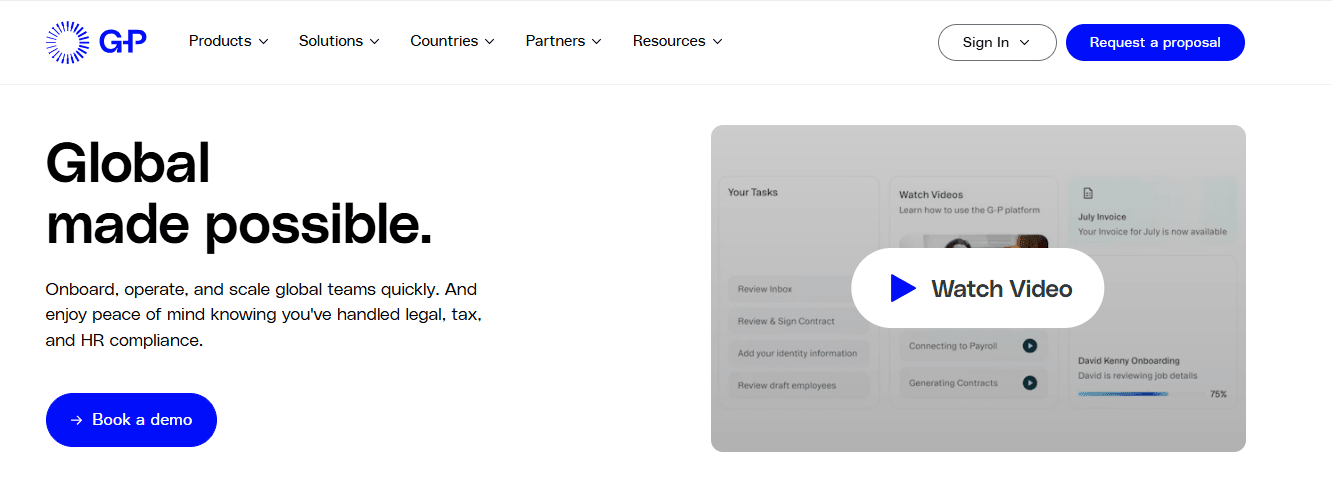
G-P, formerly known as Globalization Partners, focuses on helping companies hire employees internationally without establishing local legal entities. The platform operates as an employer of record (EOR), managing employment contracts, payroll, and compliance obligations on behalf of organisations expanding into new markets.
Source: G-P
The model exists to solve a very specific problem. Hiring employees across multiple countries introduces a wide range of legal and payroll complexities. Employment classification rules, tax reporting requirements, and local labour regulations can vary significantly across jurisdictions. G-P’s platform attempts to simplify this process by tracking regulatory changes and guiding HR teams through compliant hiring workflows.
Artificial intelligence within the platform supports compliance monitoring and workforce administration. The system can analyse regulatory updates and flag potential risks associated with international employment arrangements.
Its global payroll management is another key capability. Organisations can onboard international employees, manage employment contracts, and process payroll payments through a single platform. This reduces much of the administrative overhead that normally accompanies international hiring.
For companies entering new markets or building distributed teams across several countries, an employer-of-record model can significantly simplify workforce expansion.
Why companies choose G-P
Employer of record infrastructure for international hiring
Global payroll and compliance management tools
Simplified workforce expansion into new markets
"It's so easy to use and navigate around. I have multiple contractors on the portal from different geographies and it's easy to track their invoices." —G-P Capterra review
User-flagged challenges
HiBob, often simply referred to as Bob, has built its reputation on employee engagement and workplace culture tools. Unlike many traditional HR platforms that emphasise compliance or payroll infrastructure, HiBob places greater emphasis on transparency, feedback, and employee participation.
Source: HiBob
The platform’s philosophy differs slightly. Artificial intelligence within HiBob supports workforce analytics and employee sentiment analysis. The system analyses engagement surveys, performance data, and employee feedback to help HR teams identify patterns across the organisation.
Managers can use these insights to better understand employee satisfaction levels, potential retention risks, and broader team performance dynamics. While these analytics tools don’t directly automate HR processes, they provide visibility into workforce trends that can otherwise remain difficult to measure.
The platform also emphasises usability. Employees and managers can access performance reviews, feedback tools, and organisational data through a simplified dashboard designed to encourage participation across teams.
For organisations prioritising employee engagement and internal transparency, HiBob offers a more culture-focused HR platform than many traditional systems.
Why companies choose HiBob
Strong focus on employee engagement and workplace culture
Workforce analytics highlighting sentiment and feedback trends
Modern interface designed to encourage employee participation
"What stands out most to me about HiBob is how well it balances modern employee experience with practical HR operations." —HiBob G2 review
User-flagged challenges
Personio is widely used by growing organisations that need structured HR processes without the complexity of large enterprise systems. The platform combines HR administration tools with recruitment, performance management, and workforce analytics features.
Source: Personio
One of Personio’s main strengths is its structured approach. Artificial intelligence in Personio primarily focuses on recruitment workflows and HR reporting. Candidate screening tools help HR teams manage hiring pipelines more efficiently, while analytics dashboards provide visibility into recruitment performance and workforce trends.
Another advantage is the platform’s structured workflow design. Personio encourages organisations to standardise HR processes, such as onboarding, employee evaluations, and recruitment management. For companies scaling quickly, this structure can help maintain consistency as teams expand.
The platform also includes reporting dashboards that enable HR leaders to track workforce metrics such as employee turnover, recruitment pipeline activity, and engagement trends.
For organisations moving away from spreadsheets or fragmented HR systems, Personio often provides a more organised foundation for workforce management.
Why companies choose Personio
Structured HR workflows that support growing teams
AI-supported recruitment screening and hiring analytics
Clear workforce reporting dashboards
"It has a very simplistic interface which is a big positive for us, the reporting features work well, and the ATS module is very detailed and has a lot of advanced features." —Personio Capterra review
User-flagged challenges
Zellis is a UK-based HR and payroll platform designed primarily for organisations operating within the UK regulatory environment. The system combines payroll processing, workforce administration, and HR analytics tools within a framework built around UK employment regulations.
Source: Zellis
Artificial intelligence in Zellis focuses mainly on payroll automation and workforce reporting. Payroll systems must operate within strict regulatory frameworks, and the platform uses data analysis tools to help organisations maintain payroll accuracy and compliance.
Another strength lies in its focus on UK-specific payroll requirements. Organisations handling PAYE reporting, statutory payments, and pension obligations often need HR software that closely aligns with local payroll rules. Zellis addresses this need through built-in payroll and compliance workflows.
The platform also provides analytics tools that allow HR teams to analyse workforce data and payroll trends across departments.
For organisations operating primarily in the UK, a locally aligned payroll and HR system can reduce some of the complexity associated with global HR platforms.
Why companies choose Zellis
Payroll infrastructure aligned with UK regulatory requirements
Workforce analytics and HR administration tools
Payroll automation supporting large organisations
No reviews available for this product.
User-flagged challenges
Remote focuses on helping organisations hire, pay, and manage employees across international markets. The platform combines global payroll, contractor management, and employer-of-record services within a single workforce infrastructure.
Source: Remote
This infrastructure addresses a common challenge for companies operating across borders.
Artificial intelligence in Remote primarily supports compliance monitoring and operational workflows related to international employment.
Managing distributed teams often involves navigating different labour regulations, tax rules, and employment contracts across jurisdictions. Remote’s platform automates parts of that process by providing standardised workflows for onboarding, payroll processing, and workforce documentation.
The system also includes infrastructure for managing both contractors and full-time employees globally. HR teams can generate compliant contracts, process payments in multiple currencies, and track workforce documentation through a centralised platform.
For companies building distributed teams or expanding into international markets, the platform’s global employment infrastructure can simplify much of the administrative work involved in cross-border hiring.
Why companies choose Remote
Global payroll and workforce management infrastructure
Employer-of-record services for international hiring
Simplified onboarding and payment workflows for distributed teams
"Remote has a no nonsense approach. They operate balancing professional and practical, to best service both the employees and the employers." —Remote Capterra review
User-flagged challenges
IRIS is a UK-focused HR and payroll platform that combines workforce administration tools with payroll processing and HR analytics. The system is designed primarily for organisations that need an HR software that is aligned with UK employment regulations.
Source: IRIS
Artificial intelligence on the platform is primarily used for reporting and workflow automation. HR teams can track workforce metrics such as absence rates, employee turnover, and payroll costs through built-in analytics dashboards.
One of IRIS’s key selling points is its alignment with UK payroll and HR compliance requirements. Organisations managing statutory payments, PAYE reporting, and pension contributions often need HR systems capable of handling these regulatory processes. Cascade integrates payroll and HR data to simplify many administrative tasks.
The platform also supports employee lifecycle management, including recruitment, onboarding, performance management, and absence tracking.
For organisations operating primarily in the UK, a system designed around local employment frameworks can reduce the complexity of adapting global HR platforms.
Why companies choose IRIS Cascade
HR and payroll tools aligned with UK employment regulations
Integrated workforce analytics and HR administration
Payroll infrastructure designed for UK organisations
“All of the features that you'd want from a HR management tool are there and for the HR department the access and reporting are all critical features that work well.” - IRIS Capterra review
User-flagged challenges
Choosing the right AI HR software: Key factors to consider
Choosing AI HR software in the UK is rarely just a technology decision. In practice, it becomes an operational one. The platform a company selects ultimately shapes how an organisation’s employee data, payroll processes, compliance obligations, and workforce planning are managed.
That’s why most organisations evaluate HR platforms based on several practical factors rather than AI features alone. Let’s explore some of them.
Integration with existing systems
Many companies already rely on accounting platforms, collaboration tools, or legacy payroll software. HR systems that integrate smoothly with these tools tend to reduce operational friction rather than create additional administrative work.
Automation capability
AI in HR is frequently marketed around predictive analytics and data insights, but the real efficiency gains often come from automation. Platforms that embed automation into onboarding workflows, employee record updates, and payroll administration can significantly reduce routine HR workload.
Workforce analytics
Larger organisations frequently use HR platforms to analyse workforce data, identify retention risks, and support hiring or organisational planning decisions. For these teams, predictive analytics and workforce modelling tools may be just as valuable as operational automation.
Compliance adaptability
This is particularly important in the UK market. Payroll reporting requirements, statutory payments, and employment regulations change regularly. HR systems designed to adapt to regulatory updates can help reduce compliance risks.
Scalability
Organisations often stick with their HR systems for a long time, so they usually look for platforms that can support workforce growth without requiring a complete system replacement later.
Laying the foundation for future growth
Ultimately, the best AI HR platform depends on how HR operates inside the organisation. Structure, scale, and priorities all influence the choice.
For organisations looking to combine HR, payroll, IT, and automation in a single platform, Rippling offers one of the most unified workforce systems currently available. Why not book a demo to see how Rippling can support your HR software needs?
FAQs
AI HR software refers to human resources platforms that use artificial intelligence to support HR operations. These systems can automate administrative tasks, analyse workforce data, and assist HR teams with decision-making related to hiring, workforce planning, and employee engagement.
Common AI applications in HR software include recruitment screening, workforce analytics, payroll validation, and employee lifecycle automation.
What is the best AI HR software in the UK?
The best AI HR software in the UK depends on organisational priorities. Some platforms, such as Rippling, provide an all-in-one workforce management system that connects HR, payroll, and IT operations. Enterprise platforms, such as Workday or SAP SuccessFactors, focus more heavily on workforce analytics and strategic planning tools.
Other platforms specialise in specific areas such as payroll, workforce management, or global hiring.
How much does AI HR software cost?
Pricing for AI HR software varies widely depending on company size, workforce complexity, and the modules needed. Some platforms offer tiered subscription pricing designed for small and mid-sized businesses. Enterprise HR systems typically provide customised pricing based on employee headcount and the number of required features or integrations.
Because pricing structures change frequently, organisations usually need to request quotes directly from vendors.
Artificial intelligence in HR is commonly used to automate administrative tasks and analyse workforce data. Examples include screening job applicants, identifying workforce trends, predicting employee turnover risks, and automating HR workflows such as onboarding or payroll validation.
In many cases, AI helps HR teams interpret workforce data more quickly and reduce manual administrative work.
Is AI HR software safe to use?
AI HR software can be used safely when organisations apply appropriate oversight and governance. Because HR systems process sensitive employee data, organisations must ensure that their platforms comply with data protection regulations, such as the UK GDPR. Companies should also monitor how AI tools are used in recruitment or employee decision-making to reduce the risk of algorithmic bias.
When implemented carefully, AI HR platforms can support HR teams without replacing human oversight in workforce decisions.
Disclaimer
Rippling and its affiliates do not provide tax, accounting, or legal advice. This material has been prepared for informational purposes only, and is not intended to provide or be relied on for tax, accounting, or legal advice. You should consult your own tax, accounting, and legal advisors before engaging in any related activities or transactions.