













Newsletter
By clicking "Apply now," you agree to the use of your data in accordance with Rippling's Privacy Notice, including for marketing purposes.
Unlock business-critical insights and delegate tedious tasks to AI built for HR, Payroll, IT, and Finance.
Learn more
Get engineer-built custom apps in Rippling to automate any business process you have.
Learn more

Employer of Record
Hire globally without entities

Global Payroll
Pay employees anywhere

Global Contractors
Pay contractors anywhere

Contractor of Record
Mitigate contractor risk

Global HRIS (Human Resource Information System)
Run global HR in one place

Global HR Advisor
Get localized HR expertise

Global Benefits
Manage benefits anywhere

Global Spend
Save everywhere you operate

Customer Stories


Barry’s empowers their workforce with a scalable HR solution

Forterra automates busywork to drive impact

Chess.com creates a frictionless people process

Clay grew 5x by automating 80% of its onboarding tasks

Blank Street Coffee saves 40 hours by automating open enrolment

Rippling gave Andros automation superpowers


EN
Canada (EN)


Australia (EN)
Canada (FR)

France (FR)

Germany (DE)

Ireland (EN)

United Kingdom (EN)

United States (EN)
EN
Canada (EN)
Australia (EN)
Canada (FR)
France (FR)
Germany (DE)
Ireland (EN)
United Kingdom (EN)
United States (EN)
EN
Canada (EN)
Australia (EN)
Canada (FR)
France (FR)
Germany (DE)
Ireland (EN)
United Kingdom (EN)
United States (EN)
Five ways to become a “systems thinker” and level up your HR skills in less than 5 minutes
HR teams are getting crushed under manual work, disconnected tools, and workflows held together by duct tape and color-coded spreadsheets.
The teams that break out?
They all share one emerging skill: Systems thinking.
And it’s quietly replacing the old “I can fix anything” HR mindset.
So WTF is “systems thinking” and how can you build the muscle? That’s what we’re diving into today…
👥 ICYMI: We’re launching an exclusive HR Community, The People Project! We’re bringing together the best minds in HR and offering exclusive events, content, and discussion forums. We’d love to have you — apply to join here.
Key takeaways:
The new HR superpower: How to build a systems thinking mindset
Action audit: Automate that one annoying notification (you’ll thank yourself next Monday)
Community perk: Exclusive peer-to-peer roundtable
Hot link: HR is ‘often sidelined’ when it comes to workplace AI transformation
“Being good at HR” used to mean you:
Knew where every file lived
Remembered who changed departments last quarter
Could untangle onboarding problems with your eyes closed
Somehow kept payroll, ATS, and HRIS aligned without blowing a fuse
But modern orgs are global, fast-moving, and automated.
Brendan Woodruff, VP People at Chess.com, scaled from 100 → 650+ employees with zero IT by leaning hard into one mindset:
“If only this system did X automatically… then we’d never touch it again.”
This is systems thinking. Just seeing how everything connects — and making it work without manual lift.

Systems thinking is the skill of understanding how processes, data, and decisions connect — and designing them so they run without manual involvement.
It’s not…
❌ Manually updating org charts, job profiles, and reporting lines every time someone moves
❌ Re-uploading candidate data into offer letters, then re-uploading the same data into payroll
❌ Sending IT reminders to disable access after a termination
Those are traits of the old HR identity — what Brendan calls “administrative investigation.”
The new identity? Designing systems so you never have to investigate anything again.
It’s..
✅ Creating logic so that an employee’s move updates every downstream system automatically
✅ Letting candidate data flow end-to-end across recruiting → HRIS → payroll
✅ Building expiration alerts that notify the right people at the right time
Chess.com brings 600+ people to an in-person meetup each year.
🌏 Different nationalities.
🛫 Different travel rules.
🛃 Different visa requirements.
In the old HR approach, this means weeks of manual emails, passport collection, document drafting, and inevitable mistakes.
So Brendan thought:
“If only this system collected passport data and sent travel/visa letters automatically… then we’d never touch it again.”
Brendan’s systems-thinking approach for when someone registers:
Auto-send survey for passport + citizen data → Store data for future years → Auto-generate travel letter / visa letter → Route each letter based on country + rules → Ping traveler + managers when complete
That single workflow eliminates hundreds of tasks that HR used to touch manually.
This isn’t “automation.”
It’s a totally different way of thinking.

How do you start flexing this muscle? Here are 5 under 5-minute ways to get started.
Ask your team: “What’s one thing you did this week that was painfully manual?”
Then turn it into: “If only [X] happened automatically…”
Capture 10 statements. Prioritize 2. Build 1. This gives you your automation roadmap.
Pick one process, like onboarding, promotions, or offboarding. Document:
Where data is created
Where it needs to go
Where humans manually move it
Wherever a human moves data → replace with logic.
Think about how to turn one repeated task into a trigger-based workflow. Example from Chess.com:
⚡ Trigger: Referral hire hits 90 days
📕 Rules: If US → US payroll; if global → global payroll; if unsupported → notify third party
📤 Output: Bonus routed automatically to correct payroll
Don’t boil the ocean. One workflow is a win.
Grab any message you send more than twice a week (“Your I-9 is due,” “Please approve PTO,” “New hire starts tomorrow”).
Set up an automated Slack or email trigger for it.
Congratulations! You just deleted a recurring chore forever.
Create a “Systems Wins” Slack channel. Celebrate every automation, no matter how small. Every time someone eliminates a manual step, they post the before vs. after + time saved.
This creates momentum and shifts your culture from “doing work” to “designing systems.”

When you’re leading talent for a $20B business with 200 brands, 31 manufacturing facilities, and 19,000 employees, HR isn’t a support function — it’s one of the most powerful levers a company has.
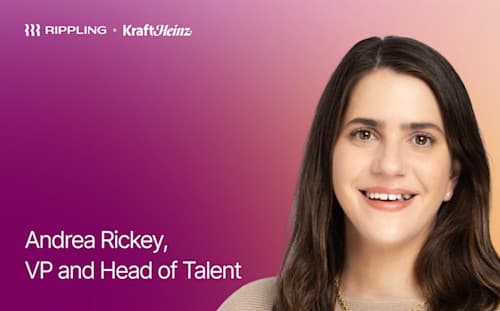
In this session of Built to Scale, Andrea Rickey, VP & Head of Talent for Kraft Heinz North America, takes us inside how she’s modernizing talent across one of the world’s most iconic companies. Andrea has been promoted 15 times in 11 years, and she’s now responsible for the full talent ecosystem at Kraft Heinz.
You’ll learn:
How HR evolves from a support function to strategic business partner
Inside Kraft Heinz’s "talent to value" toolkit to drive business growth
How AI + skills-based hiring are rewriting high-volume talent acquisition
Career lessons from Andrea’s rise from trainee to Vice President
HR is ‘often sidelined’ when it comes to workplace AI transformation
Landmark study shows less than half of U.S. workers have a quality job
New FMLA ruling puts HR on notice about expectant fathers’ leave rights
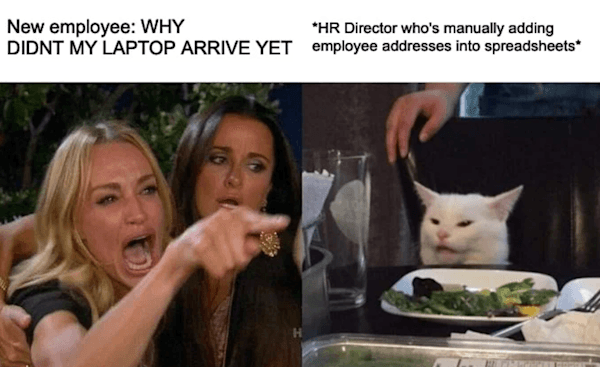

99% of automation advice is BS. This isn’t.
3 ways to automate hiring in under 10 minutes. No technical expertise required.
Take mobile security off silent + Dude, where’s my laptop? 💻
Executives want BYOD productivity — IT gets the security risk. Learn how to build a clear, scalable MDM plan with policies, roles, workflows, and must-have training.
Apply to join the community! If you're applying to the community to get access to an exclusive event, make sure to add the referral code so we can fast-track your acceptance and invite.
If you're accepted, we'll send an email to let you know. Once accepted, your membership unlocks priority invites to events, vetted peer discussions, and premium content resources.
By clicking "Apply now," you agree to the use of your data in accordance with Rippling's Privacy Notice, including for marketing purposes.