

























For employees, it depends on their situation. If they plan to stay and find the terms acceptable, then accepting a retention bonus certainly has value. If they’re planning to leave regardless, it may not be in anyone's best interest. Employees should review the terms of the bonus offer to ensure they understand the terms before signing.
What is a retention bonus? Complete guide for employers

In this article
If you’re running a business or leading an HR department, it’ll come as no surprise that the competition for top talent is fierce. Regardless of industry, there’s a heavy demand for the best people. Why? Because to build a winning team, you need great players.
Retention bonuses are one of the most effective ways to keep the employees who produce results, inspire others and move your business forward in your company. By eliminating the disruption, cost and effort involved in bringing someone new up to speed, retention bonuses are an investment in continuity and long-term success.
In this article, we’ll cover what you need to know about retention bonuses, including:
What is retention pay (and is it the same as a retention bonus)?
How does a retention bonus work?
How much should a retention bonus be?
We’ll also discuss when and why you should use one, as well as how to set up an effective program within your organization.
What is a job retention bonus?
A retention bonus (sometimes called a stay bonus) is a type of incentive compensation offered to key employees to encourage them to remain with a company for a specific period. While you can offer a retention bonus at any time, they are typically used at critical times, such as mergers, changes in leadership, or key product launches. They can also be part of your organization’s overall compensation philosophy. From an HR and organizational perspective, a retention bonus is a strategic way to keep your most important people in place.
Businesses can offer retention bonuses as a flat rate or a percentage of an employee’s pay. In both cases, the amount is taxable.
Is a retention bonus the same as retention pay?
Retention bonuses and retention pay are not quite the same thing. A retention bonus is commonly paid as a lump sum, whereas retention pay is usually a structured incentive that’s paid out in installments. Retention bonuses also differ from performance bonuses, which are based on meeting specific goals.
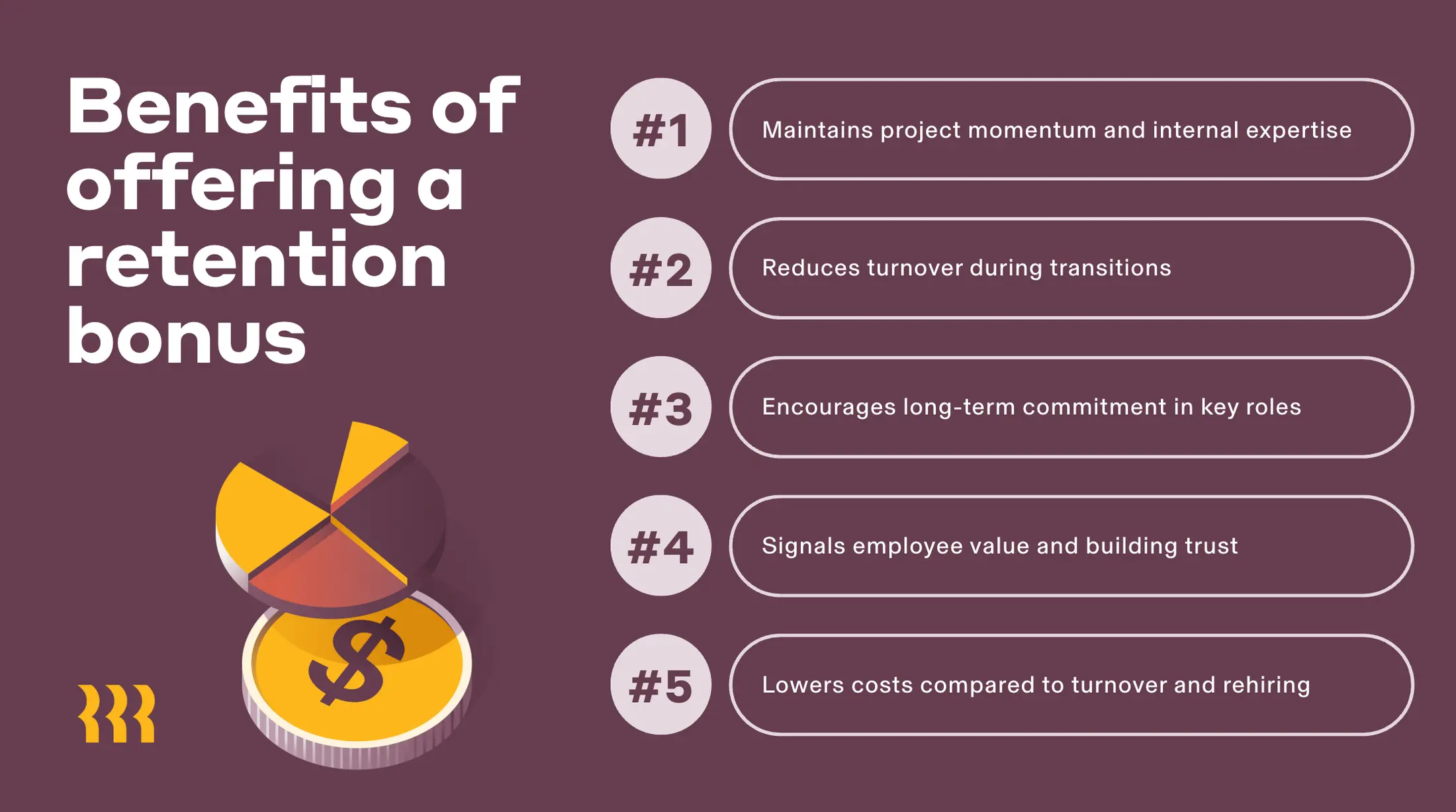
Benefits of offering a retention bonus
While the primary purpose of retention bonuses is to retain top talent, they come with these additional benefits:
Maintains project momentum and internal expertise
If you’re in the middle of a big project, the last thing you need is to lose critical talent before completion. A well-timed retention bonus can keep key employees and their expertise around until the project wraps and hopefully even longer.
Reduces turnover during transitions
Losing staff during transitions can have a significant impact on productivity and morale. For companies undergoing mergers and other major changes, offering retention bonuses can help retain employees during these transitions.
Encourages long-term commitment in key roles
They’re called key roles for a reason. Employees in these positions have a significant impact on your organization, and maintaining consistency is crucial. Retention bonuses can go a long way towards keeping your top talent in place.
Signals employee value and building trust
By recognizing key employees with a retention bonus, you’re showing that you value their contributions. This leads to increased trust, which is another reason employees tend to stay.
Lowers costs compared to turnover and rehiring
Finding the right person, bringing them on board, training them, and waiting for them to gel with your team is costly and time-consuming. And, after all that, what happens if they’re not a good fit? Instead of reinventing the wheel, a well-timed retention bonus is a far more efficient use of your company's resources to retain your best people.
How retention bonuses work
Retention bonuses can help keep valuable employees from leaving your company, especially at critical times. You identify the employee you want to retain and offer them a payment to remain with your company for a set period.
For example, after identifying a key employee you want to retain, you offer them a financial incentive, such as $10,000, to stay with your company for an additional year. If the employee accepts the offer, they will sign an agreement and be contractually obligated to remain with your organization until the end of the agreed-upon date. If they leave before the contract expires, they’re usually responsible for paying back the bonus, sometimes with interest.
The structure and mechanics of retention bonuses typically follow a similar blueprint. After you identify the key employee, determine the amount of the bonus based on these factors:
Employee’s salary
Importance of their position
Cost to replace them
You can offer the employee the payment in one of these ways:
Lump sum payment at the start of the agreement
Installments paid throughout the agreement’s timeframe
Lump sum payment at the end of the agreement
Each payment method has its own benefits. For instance, an upfront payment gives the employee an immediate financial incentive, whereas a back-loaded payment is an effective motivator. Some employees may prefer to receive their bonus in installments, combined with their paychecks.
In most cases, companies formalize the terms of retention bonuses in a detailed written agreement. Specific terms ensure that everyone is on the same page and legally bound to uphold their end of the agreement. Typical contracts spell out:
Bonus amount
Payment structure and schedule
Duration of the agreement
Consequences and penalties for the employee breaching the agreement
Implications of the employer terminating the agreement
Impact of changing business conditions
Retention bonus timelines aren’t open-ended. Typical agreements range from 12 to 36 months, which is usually enough time for organizations to manage challenging business situations, replace top talent, or complete important projects. A well-thought-out timeline will provide enough time to accomplish your goals without feeling too restrictive for the employee.
When should employers offer a retention bonus?
Keeping your top talent is far less costly than replacing them, and there are several situations where a retention bonus can head off poorly timed departures that could negatively impact your business. You should use retention bonuses strategically and proactively rather than as a last-minute fix. Here are six common scenarios when you should consider offering a retention bonus:
Mergers and acquisitions
The mere possibility of a merger or acquisition can create a climate of uncertainty and concern within your organization. In the case of actual M&A activity, your best employees may seek out other opportunities, and competitors may start poaching anxious talent. A well-structured retention bonus keeps critical employees in their roles during significant changes. This helps smooth the transition, protects company knowledge, and retains consistency with important business partners and other stakeholders.
Critical project completion
When’s the worst time to lose top talent? Right in the middle of a critical project. Nothing can derail things faster. Retention bonuses ensure stability during major undertakings, like launching a product, by retaining key employees and their expertise. Tie bonus payments to major deliverables and milestones.
Preventing key employee loss
You cannot understate the value of long-term employees. They carry with them institutional knowledge, important relationships inside and outside the company, and help motivate your team. If they start looking for new challenges, you can motivate them to stay with training and development programs and sweeten the deal with a retention bonus.
Succession planning or retirement
When a critical employee plans to leave or retire, you can’t just wait around for a qualified candidate to show up. You’ve got to be proactive in identifying and training a suitable replacement. If you’re working against the clock, a retention bonus can motivate the departing employee to stay a little longer, giving you more overlap for training and knowledge transfer. These situations can be a bit tricky, as your key talent has already decided to leave and may initially discount the idea. But with the right offer, you may be able to convince them to stay long enough to support a seamless transition.
Economic uncertainty or market volatility
Turbulent times, such as economic downturns or periods of industry volatility, can make employees nervous, and nervous employees may start looking for more secure positions. Retention bonuses can calm those nerves and send a message that no matter the circumstance, you’re in it to win it–and remain committed to your employees.
High-demand skill shortages
When things are booming, many industries, like data science and cybersecurity, face serious talent shortages. Retaining your best people can be a challenge if your competitors are trying to lure them away with highly competitive compensation packages. Retention bonuses help you stay competitive without changing your current pay structure. They’re fast, flexible, and give you more time to work on a long-term incentive plan.
Retention bonus vs. other incentives
Retention bonuses aren’t the only incentives that you can offer top talent. There are several other alternatives that you can choose, and, depending on the situation, they may be a better option. Here’s how the most popular compensation incentives compare to retention bonuses:
Retention bonus vs. signing bonus
Retention bonuses are typically used on short notice as an emergency measure to retain key personnel from leaving your organization. This helps stabilize your workforce and maintain existing strengths.
A signing bonus is a one-time, upfront payment offered to new hires as an incentive to accept a job offer. It's a more proactive measure that helps attract new talent. They appeal to potential hires who might be considering roles with your competitors. They’re common in candidate-driven markets, such as technology and healthcare, or for specialized roles. Signing bonuses help make up for what a candidate might walk away from, such as bonuses or unvested equity.
Retention bonus vs. performance bonus
Retention bonuses reward loyalty, whereas performance bonuses reward results and achievements. One retains talent, the other motivates them to perform at higher levels.
Companies use performance bonuses to meet and exceed sales targets, complete projects, and achieve other organizational goals. These bonuses are part of your company's existing compensation strategy, and you can pay them quarterly or annually. They help drive performance and success, both individually and for your company.
Retention bonus vs. stock options
In many cases, a retention bonus is offered as a lump sum, but you can spread it out over the length of the contract or offer it at the end. Stock options differ in that they’re a long-term incentive that can pay the employee big dividends if the company does well.
Retention bonuses are the right choice when you need to lock in talent for a short period. Stock options are for the long game. Depending on the vesting schedule, they motivate employees to stay for a longer period. Vesting schedules typically span several years, during which employees gradually earn access to a portion of their stock over time. For the organization, there’s no upfront monetary hit. But the value of this incentive is directly tied to the price of the stock and your employee’s belief in the company.
Tax and compliance considerations regarding retention bonuses
In the UK, retention bonuses are considered part of an employee’s earnings and are subject to the same deductions as regular pay, including Income Tax and National Insurance contributions (NICs). The payment must be processed through your company’s payroll and reported via PAYE, along with any other bonuses or incentive payments.
Unlike a salary increase, which changes an employee’s ongoing pay, a retention bonus is a one-off payment that requires immediate tax and NIC deductions at the time it’s made. Employers should ensure their payroll systems are set up to calculate these correctly, including any employer NIC liabilities.
You’ll also need to consider any contractual obligations or “clawback” terms – where employees may be asked to repay part of their bonus if they leave the company within a specified period of time – in line with UK employment law.
To prevent misunderstandings or potential disputes, document all the details of the retention bonus in writing. Your retention bonus agreement should clearly specify:
The amount being awarded and whether it’s fixed sum or a percentage of salary
Any conditions for payment, such as continued employment to a specific date
Clawback provisions, if the company requires the employee to pay back some or all of their retention bonus if they leave the company before a specific date
Make sure your HR, finance, and legal teams are aligned from the outset so that the bonus is set up, taxed, and recorded correctly from day one.
How to structure an effective retention bonus program: 5 tips
An effective retention bonus program is more than throwing money at a problem. It needs to be well-thought-out and legally compliant while motivating talent to stay for the right reasons. Here are five tips to keep you on track:
1. Define clear objectives and eligibility
What are your goals, and who is going to get you there? Consider the reasons for offering retention bonuses, whether it’s to keep key personnel during times of upheaval and change or to hold on to top talent when your competitors are nipping at your heels.
Next, create your eligibility criteria. You might base it on:
Role criticality
Individual performance
Tenure with the company
Be sure that whatever criteria you use will hold up under scrutiny. Ensure you apply them equally. If the eligibility criteria are vague or uneven, you might face legal consequences and resentment from employees who feel the process is biased towards certain members of your team.
2. Determine bonus amounts
It’s a delicate dance between offering an enticing bonus and not stretching your finances to the breaking point. Typically, bonus amounts are based on an employee’s current pay, what competitors are paying for a similar position, and the most significant factor: the cost of replacing the employee.
In its 2024 report on resourcing and talent planning, the CIPD revealed that hiring a new senior manager costs an average of £2,000 in recruitment costs alone. Factoring in the additional costs associated with hiring a new team member – like onboarding, training and the impact of on team productivity – will help ensure the bonus amount you offer is a worthwhile investment.
3. Create a retention agreement
Your retention agreement spells it all out. Include details like the bonus amount, payment schedule, timelines, and consequences of violating the agreement’s terms. You’ll also need to cover areas such as payback terms, and any confidentiality obligations. The text should be clear and reviewed by your legal team to ensure that both parties are protected and the agreement complies with all applicable laws.
4. Align with payroll and HR systems
Retention bonuses can be difficult to manage. Will your HR and payroll systems be able to process them efficiently? To avoid problems, check with your relevant teams to ensure they can manage the complex details of retention bonuses, including specific tax rules, payment schedules, reporting requirements, and compliance obligations.
Retention bonuses can also impact benefits. Coordinate with your benefits people to see what impact the bonus might have on insurance coverage or retirement contributions. And finally, ensure that your company’s systems can create documentation for compliance reviews and audits.
5. Communicate the value
Some employees may not understand what a retention bonus is or the value that it adds to their existing compensation. Explain how it supports their career objectives in addition to boosting their pay. Lay out how it works, when they can expect payments, and their obligations. Avoid making it feel like a last-minute attempt to keep them from leaving. Frame it as a thoughtful investment in their future with your organization.
Common pitfalls to avoid when offering retention bonuses
Even a well-intentioned retention bonus program can have unintended consequences. Here’s how to avoid costly mistakes:
Offering to the wrong employees
Effective employee retention bonuses are offered to the right employees at the right time. Handing out bonuses without a clear strategy doesn’t work. You want to keep your critical talent, not just firehose bonuses to low-impact employees who aren’t even thinking about leaving. Targeting key team members who are flight risks is a far better use of your HR dollar. Before offering a retention bonus, ask yourself how critical the employee is and if losing them would significantly impact your business.
Poor communication
As with any offer and agreement, clarity is key. Outline, in plain-spoken language, who is eligible, what the employee will get, what’s expected, and any other important details. Clear, detailed communication reduces confusion amongst your team and prevents misunderstandings.
No link to business goals
Clearly outline why you’re offering the retention bonus. Explain to your team how your bonus program is supporting your organization’s goals. It might be finishing a big project, navigating a complex merger, or supporting the company during a downturn. Employee retention bonuses offered without a clear reason may be perceived as favoritism and can negatively impact your team’s engagement and motivation.
Failing to address root causes of retention problems
A retention bonus won’t fix a broken workplace. If your employees are considering leaving due to toxic management, outdated technology or burnout, a bonus will only treat the symptoms, not the disease. Even a generous bonus won’t be enough to keep them. Use retention bonuses to give you the time to tackle the issues that have employees running for the exits.
Manage retention bonuses easily and compliantly with Rippling
You’ve worked hard to build a strong team, and in uncertain times, you want to keep your top performers. Retention bonuses offer a simple, effective way to hold on to key talent when you can’t afford to lose them.
Rippling handles incentive payments, like retention bonuses, with ease. Rippling gives you a centralised system for managing everything related to your workforce, from compensation, headcount planning, and benefits administration, to onboarding, payroll, and employee spend. And it’s built on a single source of truth: your employee data.
With Rippling, you can automate bonus payouts directly within payroll, ensuring timely and accurate incentive payments. Create pay types tailored to your exact needs by choosing from defaults like tips or bonuses or customising unique pay types on a one-off or recurring basis. Plus, Rippling centralises employment agreements, giving you complete control and easy access to contracts across your workforce.
Rippling payroll software is intuitive and reliable. With 600+ integrations, automated and accurate tax calculation and filing, and a dedicated mobile app for employees, it’s a comprehensive solution. You can also track the ROI of your retention programs, ensuring your investments drive real results.
Rippling offers a seamless data pipeline that consolidates all payroll and workforce functions into a single, easy-to-use platform. When combined with Rippling’s suite of benefits management and time and attendance solutions, it simplifies and accelerates your entire payroll process.
FAQs about retention bonuses
Should your employees accept a retention bonus?
What is the average retention bonus?
The average employee retention bonus varies depending on a number of factors, but generally most bonuses are 10-25% of their annual salary (not including overtime and other extras). Employees with specialised skills or who are critical to your operations are usually at the higher end of the scale and above.
Easily hire, pay and manage your workforce
Disclaimer
Rippling and its affiliates do not provide tax, accounting or legal advice. This material has been prepared for informational purposes only, and is not intended to provide, and should not be relied on for tax, legal or accounting advice. You should consult your own tax, legal and accounting advisors before engaging in any related activities or transactions.
The Rippling Company Card is issued by Fifth Third Bank, N.A., Member FDIC, and Celtic Bank, Member FDIC, pursuant to a licence from Visa® U.S.A. Inc. Visa is a trademark owned by Visa International Service Association and is used under licence. All trademarks are the property of their corresponding owners.

Author

Vanessa Kahkesh
Content Marketing Manager, HR
Vanessa Kahkesh is a content marketer for HR who is passionate about shaping conversations at the intersection of people, strategy and workplace culture. At Rippling, she leads the creation of HR-focused content. Vanessa honed her marketing, storytelling and growth skills via roles in product marketing, community building and startup ventures. She worked on the product marketing team at Replit and was the founder of STUDENTpreneurs, a global community platform for student founders. Her multidisciplinary experience – combining narrative, brand and operations – gives her a unique lens into HR content: she effectively bridges the technical side of HR with the human stories behind them.
Hubs
See Rippling in action
Increase savings, automate busywork and make better decisions by managing HR, IT and Finance in one place.