
























You might think someone’s a contractor because they send invoices or work part-time. But local authorities may see them as an employee. And if that happens, you may face back-pay. The safest move is to double-check the rules in every country before you bring anyone on.
The 14 Best Global Payroll Software Providers in Australia (2026)
In this article
An increasing number of Australian companies are hiring internationally, and that’s changing how their payroll needs to work. Traditional AU-only payroll software can’t keep up with the complexities of paying teams in multiple countries the way a solid global payroll solution can.
To put together this list, I reviewed a wide range of global payroll services. I used the same scoring system for every provider, weighing up global coverage, compliance capabilities, customer satisfaction, and pricing transparency. From that, I narrowed it down to the 20 platforms that make international payroll genuinely easier, not just possible.
A quick note on transparency: You'll see Rippling on this list. However, I applied the same criteria to every platform using public data and hands-on testing. So, the scores reflect performance, not partnerships. You can view the full results here.
Here’s an overview of my findings:
Global payroll software | Score (out of 5) | Coverage | Best for | Platform type |
|---|---|---|---|---|
1. Rippling | 4.76 | 185+ countries | Mid to large companies needing unified AU and global payroll | All-in-one workforce management |
2. Deel | 4.51 | 130+ countries | SMBs needing fast, compliant multi-country payroll | HR, payroll, and IT |
3. Remote | 4.47 | 100+ countries | Remote-first teams managing payroll worldwide | HR and payroll |
4. Skaud | 4.36 | 70+ countries | Scale-ups hiring in emerging regions | Hiring and payroll |
5. RemoFirst | 4.30 | 150+ countries | Startups wanting a simple global payroll setup | HR and payroll |
6. Gusto | 4.10 | 120+ countries | Small businesses paying international contractors | HR and payroll |
4.05 | 160+ countries | Enterprises automating multi-country payroll | HR and payroll | |
4.01 | 50+ countries | Large enterprises managing complex global payroll | All-in-one HCM | |
9. Cloudpay | 4 | 130+ countries | Multinationals standardising payroll globally | Payroll |
10. Multiplier | 3.93 | 150+ countries | Fast-growing companies hiring quickly in new markets | Hiring and payroll |
11. Neeyamo | 3.92 | 180+ countries | Enterprises needing deep long-tail country coverage | Hiring and payroll |
12. Oyster HR | 3.92 | 30+ countries | Small-to-mid businesses expanding overseas | HR and payroll |
3.92 | 200+ countries | Enterprises needing integrated AU and global payroll | HCM and payroll | |
3.84 | 140+ countries | Global enterprises requiring robust payroll compliance | Payroll module within a larger HR platform | |
15. UKG One View | 3.79 | 160+ countries | Large companies consolidating payroll data worldwide | Payroll module within a larger HR platform |
16. Ramco Payce | 3.76 | 150+ countries | Large firms with a focus on automating global payroll | Payroll |
17. Workday | 3.69 | 100+ countries | Global enterprises wanting centralised payroll control | HR, payroll, and finance |
18. Paychex | 3.65 | 90+ countries | SMEs expanding into select global markets | HR and Payroll |
19. Paylocity | 3.61 | 80+ countries | Mid-market companies expanding into global operations | HR, payroll, and IT |
20. ELMO | 3.48 | AU, NZ, UK | SMEs focused on compliant payroll across AU, NZ, and the UK. | HR and payroll |
11 best global payroll services for Australian businesses
From the full list of 20, these are the top performers that consistently came out on top in testing and scoring. Below, I break down what each one does well, where it could improve, and how real customers rate their experience.
Rippling
Deel
Remote
Skaud
RemoFirst
Gusto
Papaya Global
SAP SuccessFactors
Cloudpay
Multiplier
Neeyamo
1. Rippling
If you’ve looked into global payroll at all, Rippling probably isn’t new to you. And there’s a good reason for that. Rippling’s payroll system is part of a broader, unified platform that manages everything from HR and compliance to payroll and IT. It also offers an Employer of Record (EOR).
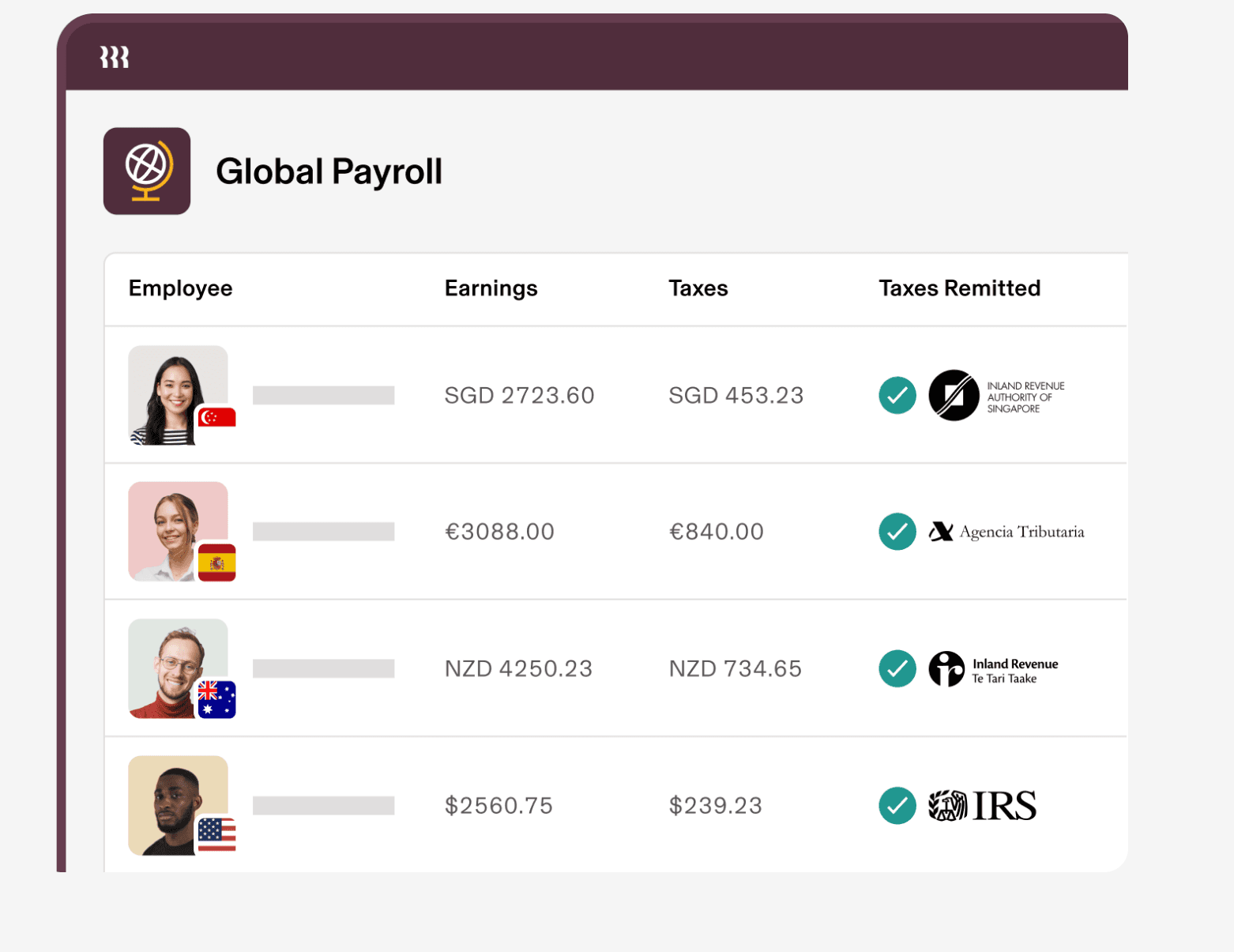
Its global payroll solution lets you pay employees and contractors in over 185 countries through the same platform you use to manage local Australian payroll.
Rippling's design focuses on scalability. You can start with local payroll and expand to new countries in minutes with no integrations, no separate systems, and no manual uploads. It automates and tracks everything in one place. This can make a big difference if your business juggles multiple entities and currencies.
Source: Rippling
Why businesses choose Rippling
- Unified payroll for Australia and 185+ countries in one system
- Automated compliance with country-specific tax and employment laws
- Real-time exchange rates and multi-currency support
- Deep integration across HR, finance, and IT tools
"Rippling is a solid payroll company. No major complaints, it serves our needs and has lots of options available. You pay for what you need and don't pay for what you don't, and it has support for multiple companies/EINs on one account." - Rippling Capterra review
Top concerns raised by users
Pricing varies depending on modules; global payroll is quoted separately
Some users find the initial setup complex due to the platform’s breadth
Custom reporting options could be more flexible for specific payroll metrics
Is Rippling the right choice for you?
Rippling is best for mid-to-large Australian companies that want a single, connected system for managing payroll and compliance across their entire global workforce. If you’re scaling into multiple regions and want to handle HR, payroll, and compliance in one place, Rippling is one of the few platforms that can genuinely do it all.
2. Deel
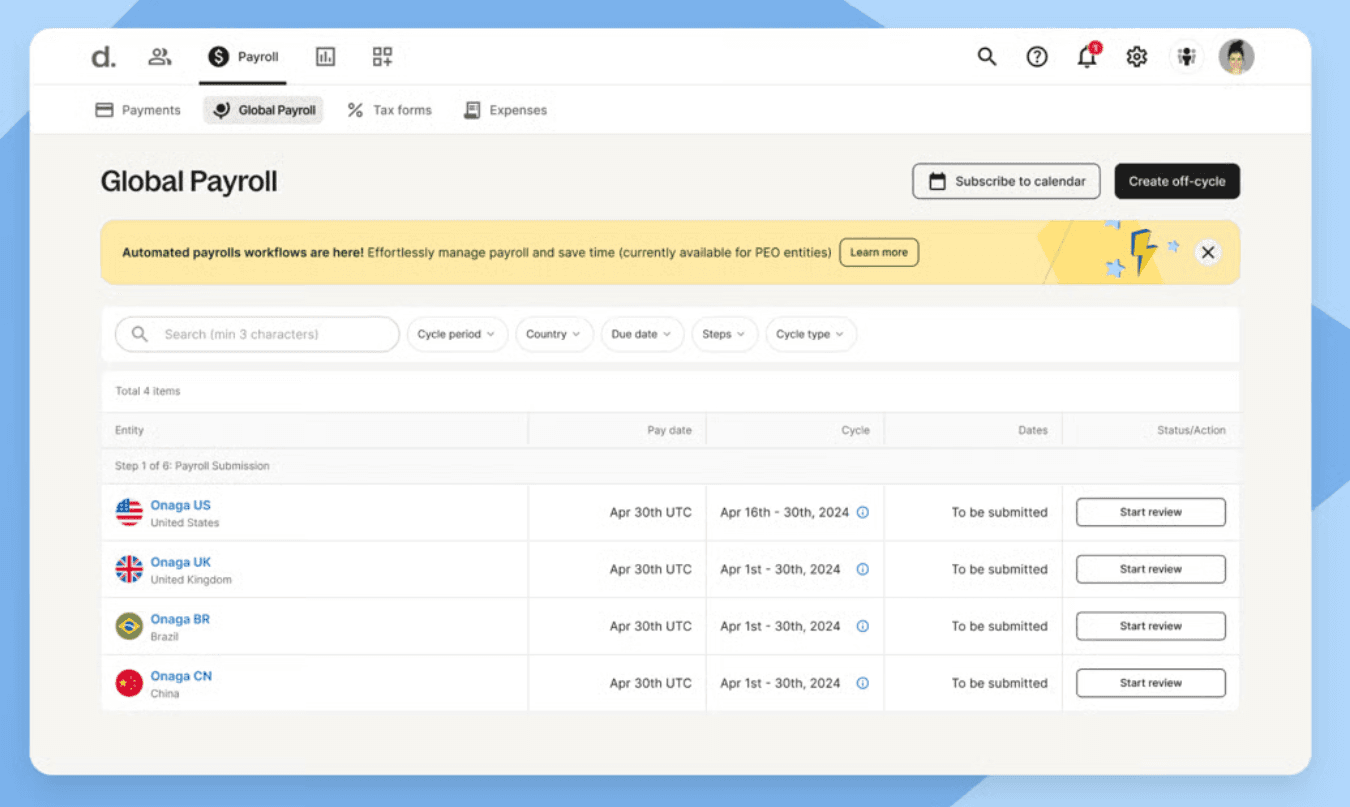
Deel’s global payroll services can help you consolidate and run payroll for employees in multiple countries through a single system. The platform supports local tax compliance and does salary calculations for you. It also manages statutory deductions and facilitates secure international payments in several currencies.
Deel’s international payroll solution links to other parts of its ecosystem. For example, HR administration, expenses, and time-off management. You can check out payroll data for all countries in one dashboard, generate payslips, and access real-time reporting.
Source: G2
Why businesses choose Deel
- Run payroll across 130+ countries in one platform
- Automatic gross-to-net, local tax, and contribution handling
- Pay employees in more than 120 currencies
- Integrations with systems like Workday, UKG, SAP, BambooHR, HiBob
"Deel has saved me a lot of time with payroll, contracts, and compliance. It’s particularly helpful for managing remote employees and contractors worldwide, and it reduces the stress of dealing with local regulations. While there are a few areas that could be streamlined, the platform overall has been reliable and trustworthy." - Deel Capterra review
Top concerns raised by users
Pricing for international payroll is quote-based and varies by country
Implementation timelines can extend for multi-country rollouts
Some payroll coverage relies on Deel’s local partner network
Is Deel the right choice for you?
Deel might be best for small to mid-sized Australian businesses expanding internationally that want a fast and compliant way to pay their entire global workforce. It can be a good fit for teams prioritising reliable payroll processing and visibility across multiple countries.
3. Remote
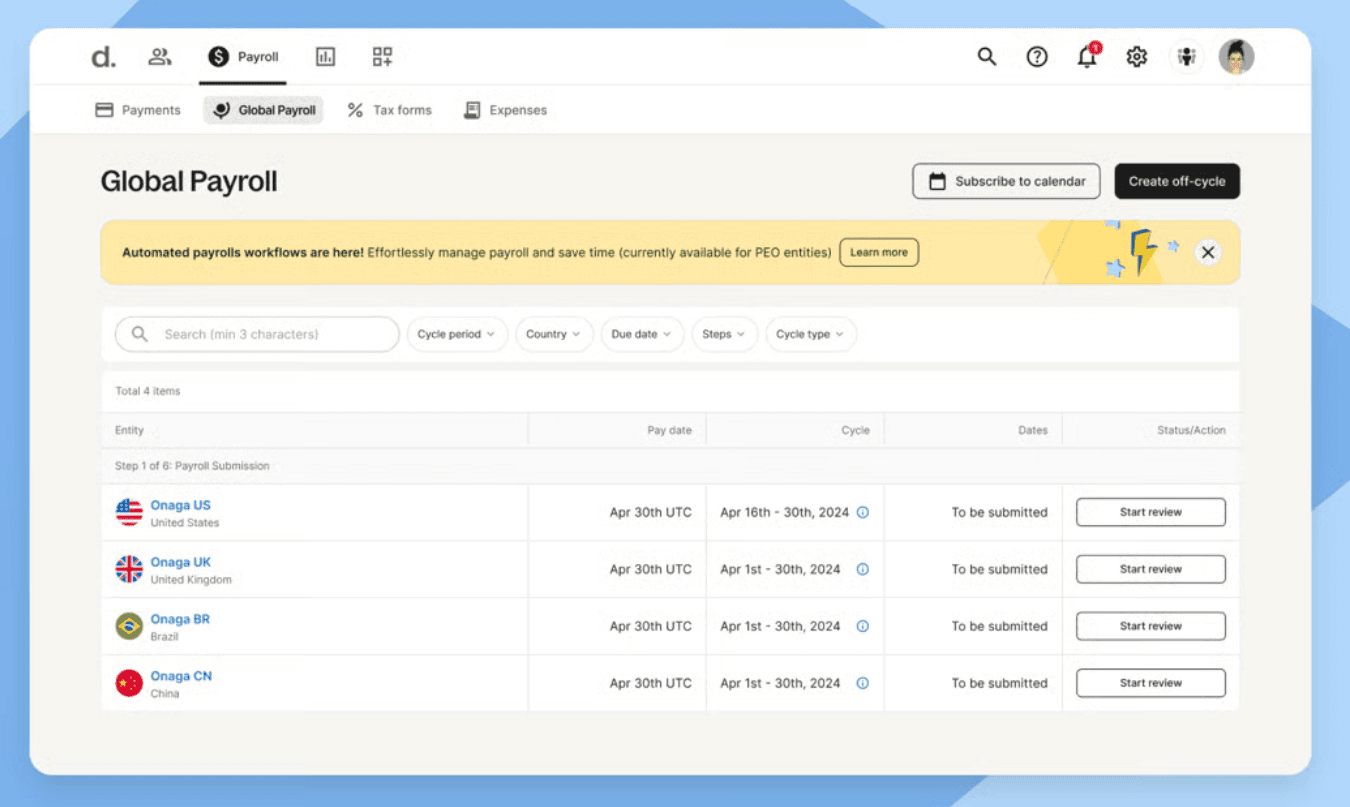
Remote’s international payroll services aim at businesses that employ people across multiple countries and want a central, compliant way to manage pay runs. It supports payroll in more than 100 countries. Remote also takes care of local taxes, social contributions, and statutory benefits. You can pay staff in their local currency and see every country’s payroll data in one dashboard. The system also enables you to run reports for finance or compliance audits.
Remote's global payroll solution sits within its broader employment platform. This also includes EOR services, contractor management, and benefits administration. Aussie businesses can use it to run payroll for their own entities overseas. Or, where they don’t have a legal presence, through Remote’s in-country entities.
Source: Remote
Why businesses choose Remote
- In-house payroll delivery managed by local experts in 100+ countries
- Local-currency payments with full visibility into exchange rates
- Easy-to-navigate interface
- Transparent pricing model with self-serve setup
"Remote's portal is super easy to use, requires literally no training. When I've needed specific help, the people at Remote have been quick and helped to solve my problem. I would definitely recommend Remote." - Remote Capterra review
Top concerns raised by users
Reporting and customisation options could be more flexible
Payroll timelines vary depending on country regulations
Can get expensive with a growing team
Is Remote the right choice for you?
Remote can work best for remote-first and globally distributed Australian companies that want a compliant way to pay employees and contractors around the world. It can be a good fit for teams that value transparency, full visibility, and local payroll expertise delivered by in-country specialists.
4. Skaud
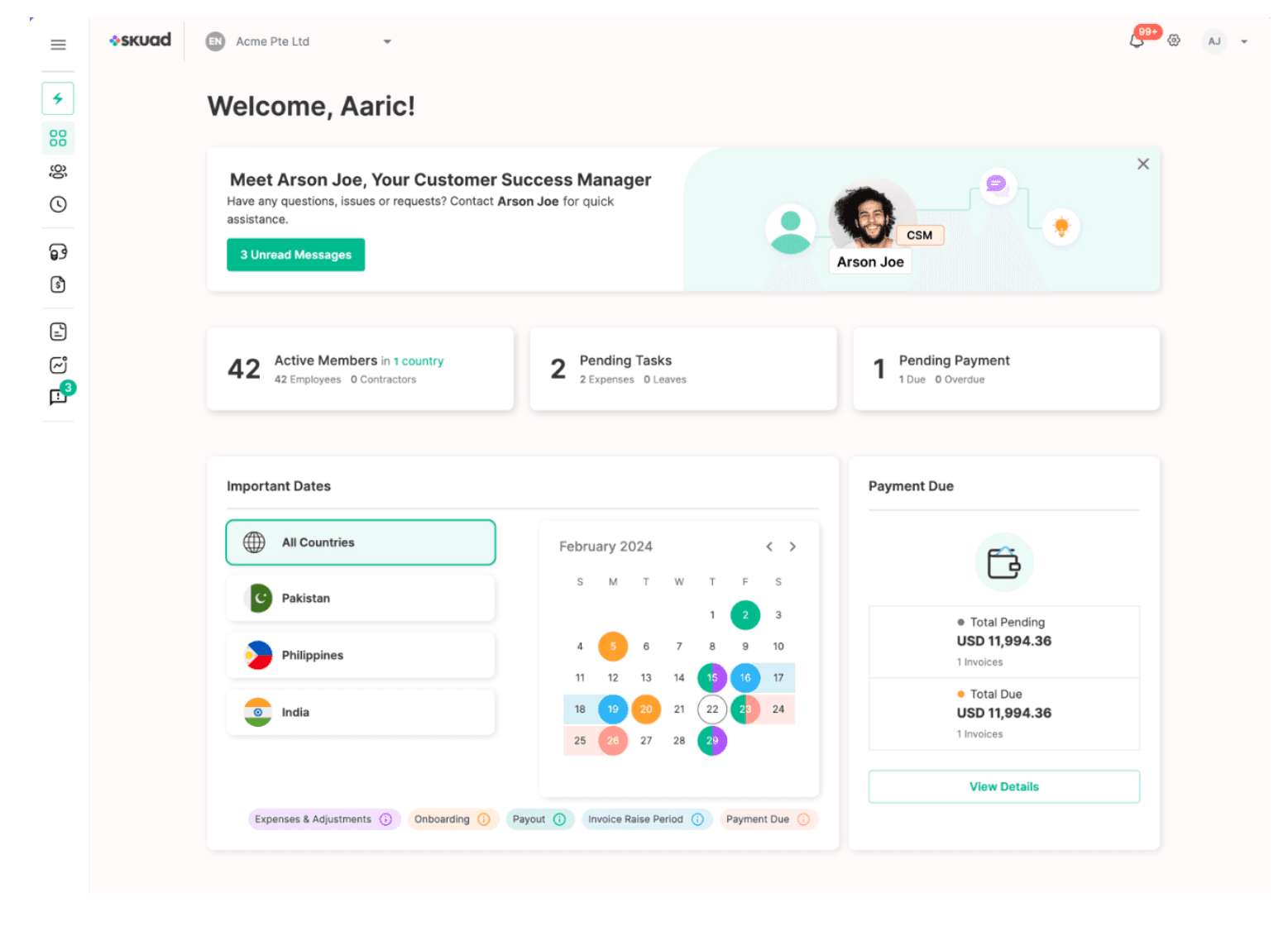
Skuad’s global payroll services help companies pay employees and contractors in 160+ countries and 70 currencies. I was impressed by Skuad's strong presence across emerging regions, like Asia-Pacific, the Middle East, and Africa. The platform puts payroll calculations, tax deductions, and statutory contributions on autopilot. It also takes care of compliance with local employment laws. You can find every country’s payroll data, costs, and pay cycles in a single dashboard. So, tracking and approving payments across regions is easy.
Beyond global payroll management, Skuad covers hiring and onboarding. Skuad stands out for its focus on essential payroll and HR workflows rather than unnecessary 'frills'. It’s a practical option for teams without large in-house HR or finance departments.
Source: G2
Why businesses choose Skuad
- Extensive global coverage and currencies
- Dedicated account managers available 24/5 in every supported region
- Transparent, fixed pricing model with no hidden fees
"My overall experience has been excellent. Since the company began managing the service through Skuad, I haven’t had a single issue with my payroll. Everything has been handled promptly and professionally." - Skuad Capterra review
Top concerns raised by users
No mobile app for on-the-go international payroll management
Occasional slow response times for complicated queries
Payroll reporting and analytics lack detail
Is Skuad the right choice for you?
Skuad can be best for small to mid-sized Australian businesses hiring internationally that want an easy-to-learn global payroll solution focused on the essentials. It’s often a strong fit for teams expanding into new markets that seek straightforward workflows and predictable pricing.
5. RemoFirst
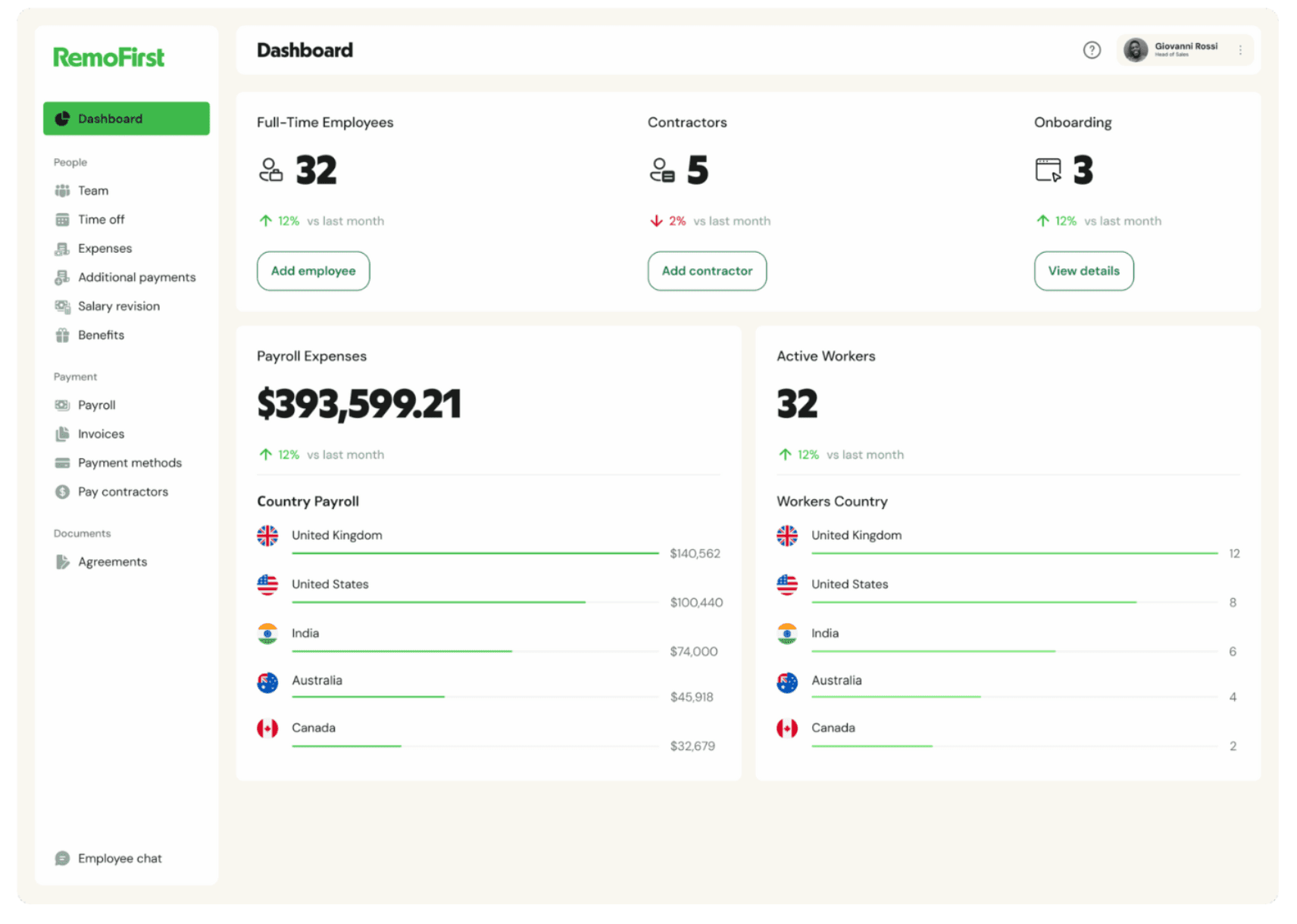
RemoFirst focuses on making international hiring and global payroll operations simple for businesses. It lets you pay employees and contractors in more than 180 countries, while taking care of local tax calculations and deductions, and statutory benefits, automatically. What I liked most about RemoFirst is its straightforward pricing and service-first model. Every customer gets a dedicated account manager.
RemoFirst isn't just a global payroll provider. The platform also covers essentials like contracts, benefits, and onboarding, but without the bloat of larger enterprise tools. It’s a lightweight but capable option that removes much of the friction that comes with paying global employees.
Source: People Managing People
Why businesses choose RemoFirst
- Easy-to-use platform with straightforward pay runs
- Dedicated account manager providing hands-on support for every customer
- Payroll coverage in 180+ countries
"With Remofirst, we've been able to hire full-time employees in 7 countries with the best pricing across other EORs that we got quotes from. We offer them health insurance and pay them in local currencies, which has been so great and easy for our team." - RemoFirst Capterra review
Top concerns raised by users
Limited integrations with other HR and finance systems
Some users find the interface less polished than larger competitors
Basic reports and analytics
Is RemoFirst the right choice for you?
RemoFirst may be best for small to mid-sized Australian companies expanding overseas that want a reliable way to run payroll without a steep learning curve. It can be a strong fit for teams that rate personal support and straightforward functionality above fancy enterprise features.
6. Gusto
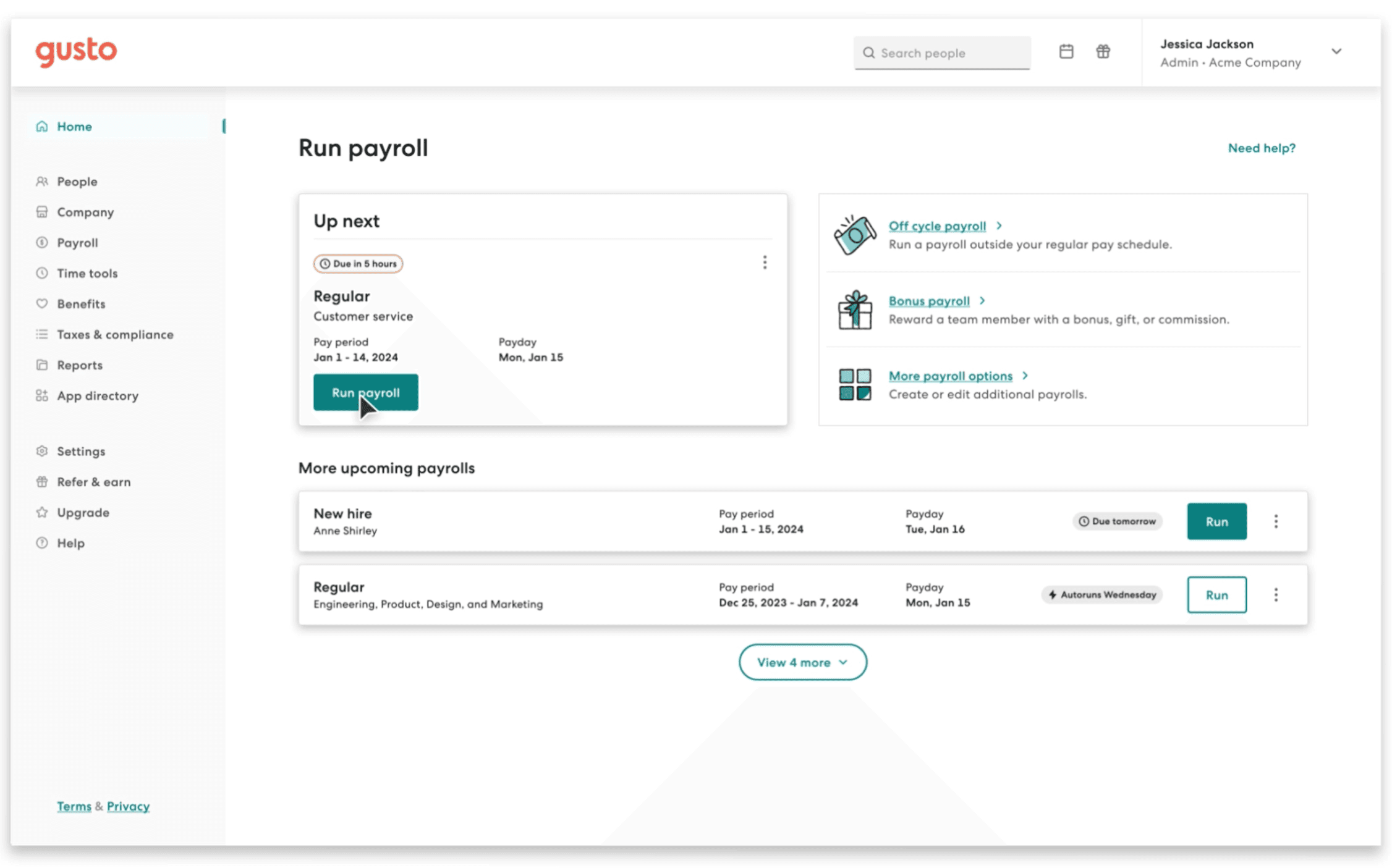
Gusto has built a reputation as one of the more user-friendly payroll systems for small businesses. And its global payroll services extend that same simplicity to international teams. Gusto lets you pay contractors in over 120 countries, in their local currency, directly from your Gusto dashboard. It handles international payroll processing for employees through its EOR network.
With Gusto, the setup is quick, the interface is intuitive, and the pricing is transparent. It also includes features like benefits, onboarding, and time tracking. But its real strength lies in how simple it makes global expansion. Essentially, it offers an easy, affordable bridge between local payroll and global hiring for Australian businesses.
Source: Gusto
Why businesses choose Gusto
- Pay international contractors directly in 120+ countries
- Offers built-in HR tools like onboarding, benefits, and time tracking
- Simple, intuitive interface made for small businesses
"Gusto is a user-friendly and efficient payroll and HR platform, especially for small to mid-sized businesses. It simplifies payroll processing, automates tax filings and integrates benefits management, making it an all-in-one HR solution." - Gusto Capterra review
Top concerns raised by users
Full employee payroll is only available via EOR (not direct processing)
Customer support can slow down during busy periods
Limited integrations outside the US
Is Gusto the right choice for you?
Gusto is usually best for small Australian businesses paying international contractors. It offers a simple, affordable way to manage payments through one platform. It may be a good choice for teams taking their first steps into global hiring.
7. Papaya Global
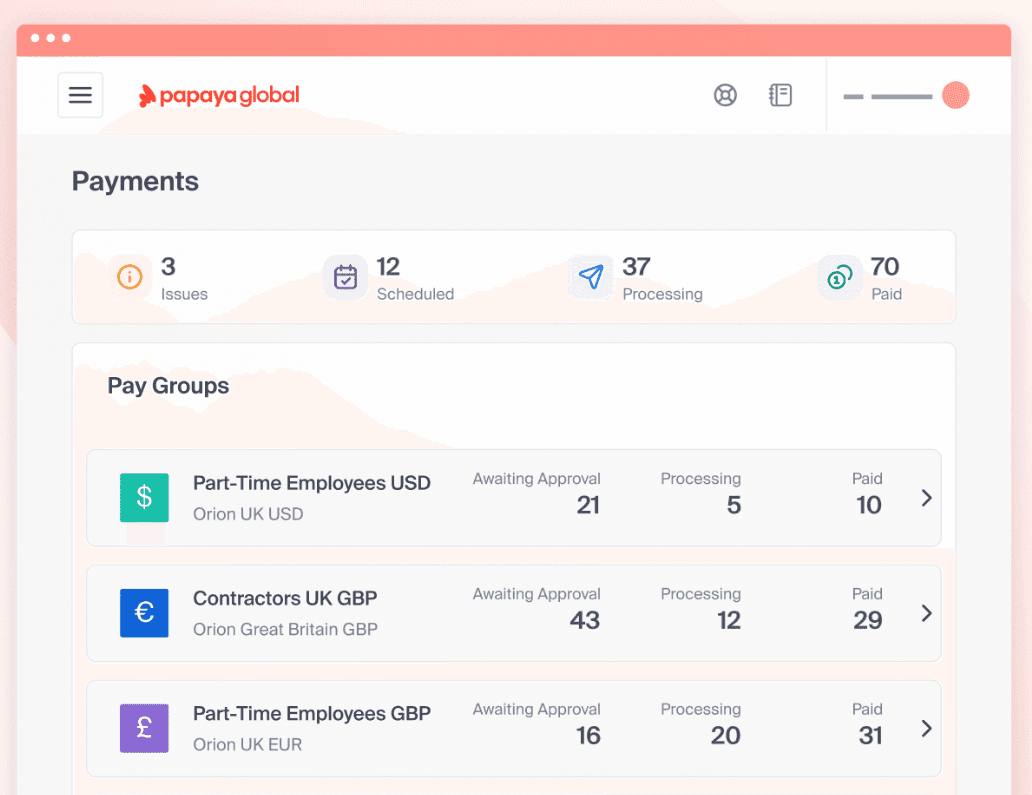
Papaya Global’s international payroll platform supports payroll and payments in 160+ countries. It can process salary calculations, statutory deductions and cross-border payments in local currencies. I found it to be a very automation-driven solution focusing largely on technology. Papaya uses AI and machine learning to flag errors, track payroll trends, and make compliance reporting from one region to another simpler.
Papaya feels like a solution built for scale. For large Australian companies with many entities or contractors overseas, its pairing of automation and control can be a time saver.
Source: Payapa Global
Why businesses choose Papaya Global
- Pays in more than 160 countries with AI-powered automation
- Real-time data insights and anomaly detection for payroll accuracy
- Unified solution for workforce management
"Using payroll as a classic example, there could be no better way to explain how easy it is for Papaya Global’s Workforce OS to manage employees in different countries. I also like it because it matches WorkBurdens and payment cycles for the several types of employees, without any gaps." - Papaya Global Capterra review
Top concerns raised by users
Onboarding and implementation can take a while for multi-entity setups
Reporting dashboards may need configuration to meet specific business needs
No publically visible pricing
Is Papaya Global the right choice for you?
Papaya Global can work best for mid-to-large Australian companies managing global payroll and workforce operations in several countries. If your business has multiple entities, uses a mix of overseas contractors and employees, and needs help to unify these workflows, Papaya could be an option.
8. SAP SuccessFactors
SAP SuccessFactors is a global payroll provider that offers tight control, audit trails, and deep finance links. SAP’s payroll engine supports localisations across 50+ countries. Where a native localisation doesn’t exist, SAP’s certified Global Payroll partner network fills the gap. It also supports local Aussie payroll, managing STP reporting and superannuation. Plus, it slots into SAP’s time, absence, and finance stack.
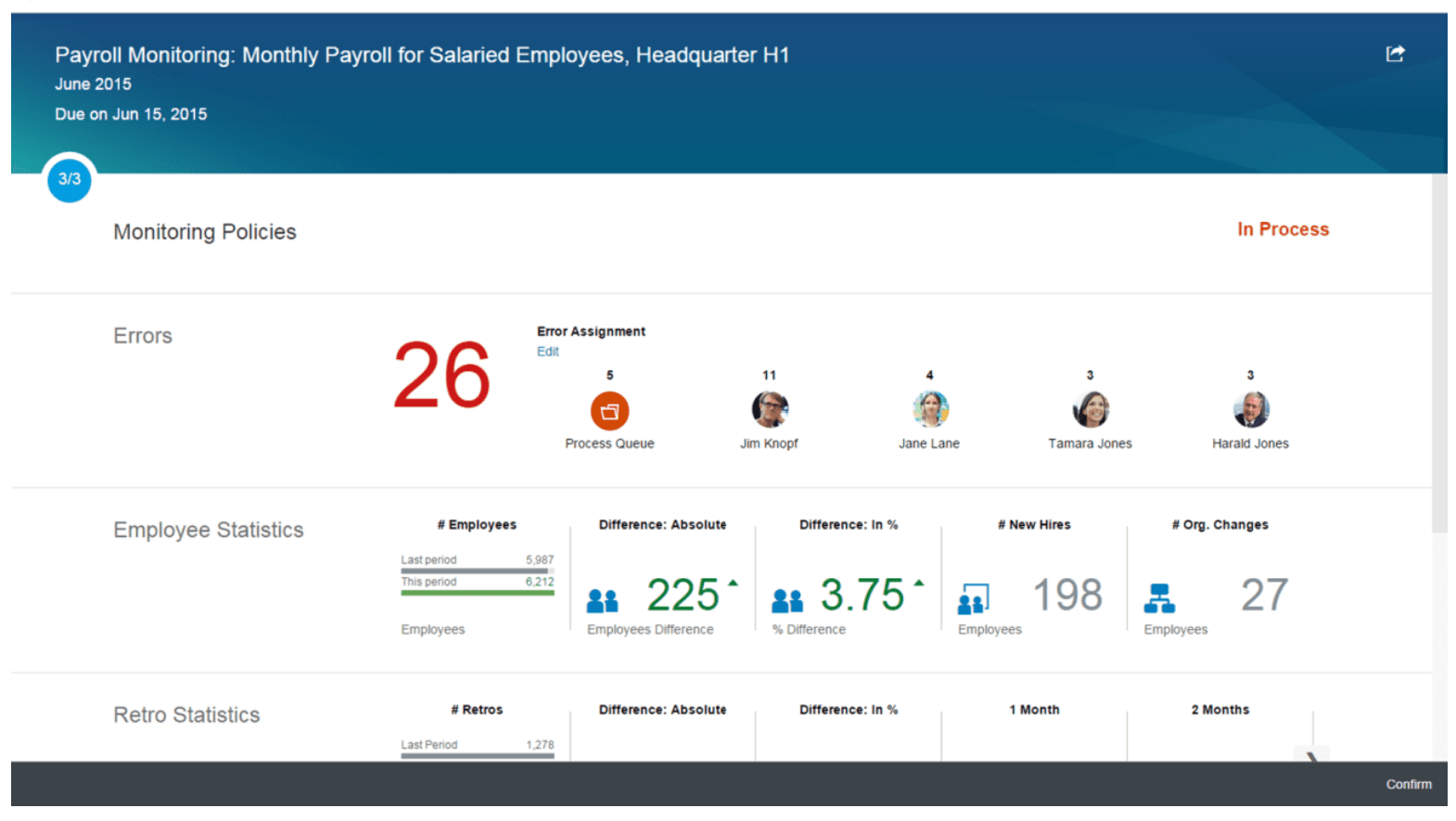
What stood out for me was the Payroll Control Center. This is a command-style workspace that brings potential issues to the surface before payday. If you run a larger team, this pre-pay visibility avoids post pay run chaos.
Source: SAP SuccessFactors
Why businesses choose SAP SuccessFactors
- Native payroll localisations plus certified global partner network
- Pre-pay validation, issue tracking, and audit-ready workflows
- Good integration with SAP Time, HR, and Finance
"Perfect Payroll and legal reporting which allows for large multi-regional countries payroll handling and support for legal regulations compliance with regulatory and reporting requirements." - SAP SuccessFactors Capterra review
Top concerns raised by users
Implementation can be long and complicated
It's not user-friendly (typically requires a partner with SAP expertise)
Pricing isn't readily available and can be higher than mid-market tools
Is SAP SuccessFactors the right choice for you?
SuccessFactors is best for large and complex Australian enterprises that need very strict controls. It typically suits businesses that need to do more than just get a basic pay run out the door. If your priority is auditability and standardisation across borders, it can be a good fit.
9. Cloudpay
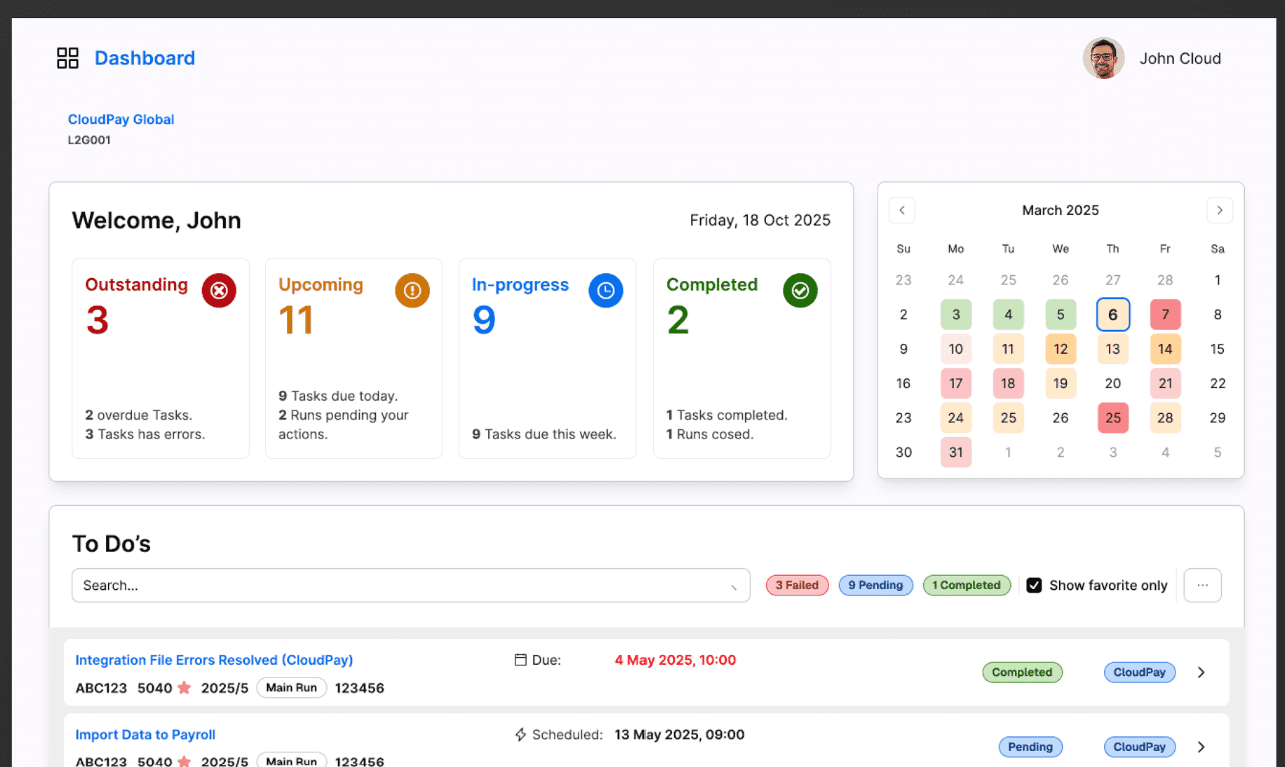
CloudPay aims at large businesses that want to unify global payroll, payments, and compliance under one roof. It supports payroll in more than 130 countries, connecting payroll processing, treasury, and analytics into one cloud-based system. IT doesn't outsource execution to partners. CloudPay manages payroll centrally while working with local specialists to ensure accuracy and global compliance.
What I liked best about CloudPay is its focus on payments and automation. It connects payroll directly to payment delivery through CloudPay NOW. This is a built-in payments solution that lets employees access their wages faster. It also ensures that money moves securely across borders.
Source: Cloudpay
Why businesses choose Cloudpay
- Payments in more than 110 currencies
- Rich analytics and reporting tools for deep payroll insights
- Offers a managed service option for end-to-end payroll processing
"Cloudpay is one of the few global payroll providers; they make it easy to consolidate enterprise payroll, combine reporting and performance benchmarking." Cloudpay Gartner review
Top concerns raised by users
HR data must sync via integrations
Implementation can be time-intensive for multi-entity setups
The user-experience and interface are a little dated
Is Cloudpay the right choice for you?
CloudPay is often best for mid-sized to large Australian enterprises that are looking for a reliable, analytics-driven payroll and payments platform. It can be useful for teams managing multi-country payroll who want strong data insights but don’t need an all-in-one HR solution.
10. Multiplier
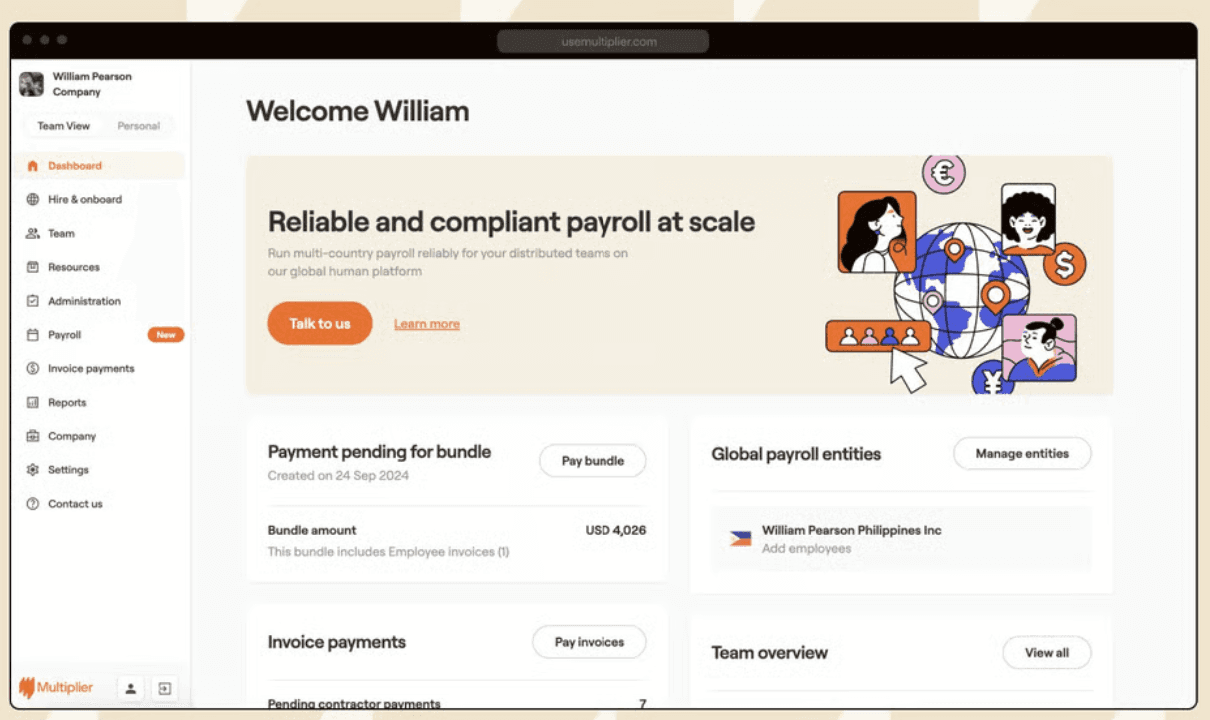
Multiplier focuses on solving global payroll challenges for companies with international operations that are growing fast. It supports payroll in 150+ countries, while also helping you hire, onboard, and pay international employees or contractors without setting up local entities. What stood out the most to me is the simplicity and speed the platform offers. You can process pay cycles, review global payroll data, and send multi-currency payments from one dashboard.
Multiplier's payroll services fit into its broader ecosystem that can also offers benefits management, visa support, and EOR capabilities.
Source: G2
Why businesses choose Multiplier
- Broad payroll and compliance coverage
- Fast setup
- Streamlined onboarding and localised benefits in the same platform
"It is a complete solution for our international hiring, onboarding & payroll needs. Moreover, the multi-lingual contract coverage is a bonus." - Multiplier Capterra review
Top concerns raised by users
Interface design feels basic compared to larger enterprise tools
Not many native integrations
Support response times can vary heavily depending on time zones
Is Multiplier the right choice for you?
Multiplier can be best for fast-growing Australian businesses expanding into new markets quickly. It can be a good fit for teams that want to simplify complex global payroll processes and pay people fast, minus the heavy admin overhead.
11. Neeyamo
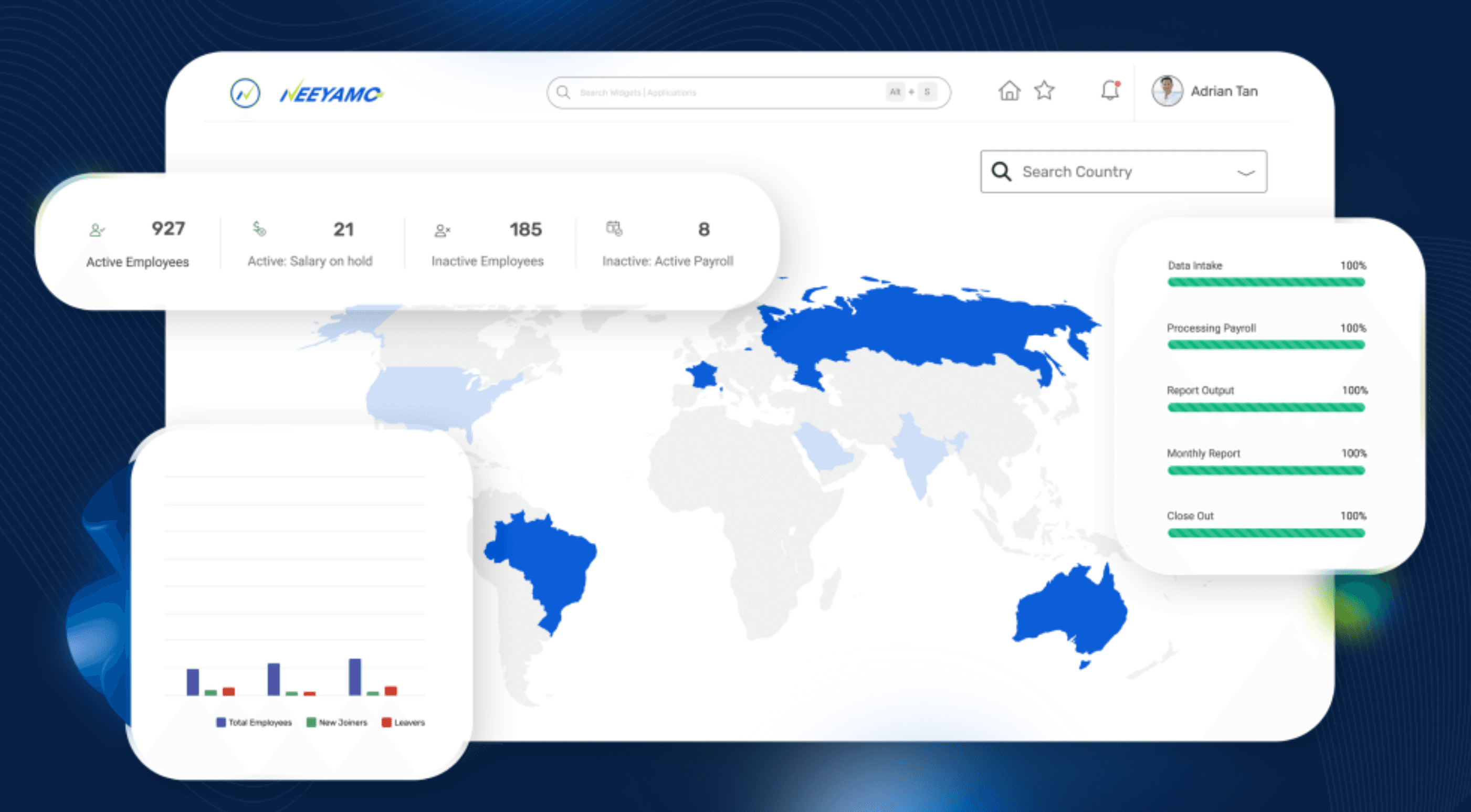
Neeyamo’s global payroll services are for organisations that need to manage payroll across a large, dispersed workforce, including in countries that most providers don’t cover. It supports payroll in more than 180 countries and is particularly strong in what it calls 'long-tail' regions. These are countries with smaller employee populations or more intricate regulatory environments. Neeyamo's global payroll solution doesn't rely on third-party processors. It uses its own native gross-to-net engines to calculate pay correctly and align with local tax laws.
The platform links payroll with time, absence, and compliance modules. It also includes employee self-service features for viewing payslips and tax documents. Neeyamo offers scale and rigor without heavy outsourcing.
Source: Neeyamo
Why businesses choose Neeyamo
- Reliable payroll coverage in hard-to-serve regions
- Owns and maintains its own payroll engines
- Self-service tools for employees and administrators
"One stop solution for payroll. It covers all cases and has a real-time ticketing support system." - Neeyamo G2 review
Top concerns raised by users
Platform navigation can be a bit unintuitive, especially during setup
Change requests can take a while for large organisations
Reporting dashboards and analytics could be more flexible and user-friendly
Is Neeyamo the right choice for you?
Neeyamo can work for Australian businesses with smaller employee counts in far-reaching markets. It can be an option for teams that rate accuracy, coverage, and compliance depth over a modern interface design or rapid deployment.
The hidden compliance traps of paying global teams
When you start paying people in different countries, the rules multiply. What might be simple in Australia can get complicated overseas. Here are a few traps I’ve seen companies fall into on repeat:
- 01Misclassifying workers as contractors
- 02Ignoring local tax and social contribution rules
Every country has its own mix of taxes, social contributions, and filing deadlines. Unfortunately, they rarely line up. I’ve seen teams forget to register for local payroll tax or skip contributions they didn’t even know existed. As a result, they've been on the receiving end of fines, back pay, and a lot of administrative clean-up.
The best global payroll services will track and manage this for you automatically.
- 03Overlooking currency conversions and exchange losses
You approve payroll in one currency, but by the time the payment hits, the exchange rate has shifted, and someone loses out. It sounds insignificant until you multiply that by lots of employees across several countries.
Locking in exchange rates or using international payroll services that handle conversions automatically can avoid this.
- 04Failing to store or transmit employee data compliantly
Payroll data is full of sensitive information: bank details, tax IDs, personal addresses. Different regions (like the EU and Singapore) set very strict data storage and sharing rules. So, you need to manage it carefully.
If you send payslips through unsecured systems or store records without encryption, you could breach regulatory compliance and face serious consequences.
How to choose a payroll provider for local and global teams
The best option depends on how your business operates today and where you plan to grow tomorrow. Here’s a step-by-step way to make choosing easier:
Step 1: Confirm Australian payroll compliance too
If you’re paying staff in Australia and overseas, using separate systems for each creates more stress than necessary. Ideally, you want to look for a provider that does Australian payroll and international payroll in one platform.
The best options will be able to handle Australian tax, superannuation, and entitlements alongside global pay runs. This will enable you to track everything in one place and scale without the hassle of switching tools later.
Step 2: Check that global country coverage matches your hiring plans
Think about where your team is now and also where you plan to grow next. The global payroll solution you choose should already operate in those countries (not just promise they can/will).
The right provider will support your entire global workforce, take care of compliance locally, and be ready to grow with you.
Step 3: Know when to use an EOR versus direct payroll
If you’re hiring in a country where you don’t have a legal entity, you'll need to use an EOR to stay compliant. Once you get to the point where it makes sense to register your business locally, you can switch to direct payroll.
The best providers make it easy to do both as you grow.
Step 4: Assess how easy setup and onboarding really are
Often, the setup can make or break your experience. Ask how long onboarding takes, what kind of support you’ll get, and how soon you can actually run your first payroll. Consider flossy answers a red flag.
A good provider will be transparent about implementation and offer responsive (and human) assistance.
Step 5: Make sure it integrates with your existing tech stack
It's best if your payroll system doesn't live in its own world. Ideally, it should sync smoothly with your HR and spend management tools so data flows automatically. The best global payroll solution is usually part of a full human capital management system, which keeps everything, like your HRIS, HR systems, payroll, and finance connected.
Ultimately, it means fewer spreadsheets, fewer errors, and more time to do things that matter.
Step 6: Look for proof from real-world customers
Don’t rely purely on sales talk. See how it performs in real life. Look for international businesses already using it to deliver payroll for their international workers. Read reviews, ask for case studies, or book a demo that takes you through a real workflow.
This will give you a much better feel for what it’s like to use day to day.
Step 7: Weigh cost against compliance, support, and scalability
Price matters, of course. But it shouldn’t be the only thing that drives your decision. The cheapest platform might look great at a glance, but if it struggles with compliance or offers poor support, you’ll pay for it later in fines and frustration.
Weigh the cost against how well the provider handles compliance management, customer support, and your growth plans down the track.
Global payroll services that tick every box
The best global payroll software needs to do more than cover lots of countries. The strongest platforms are the ones that bring your people, payroll, and compliance under one roof. This way, you can manage local and international teams without switching between systems or losing sight of what’s happening.
Rippling is a great example of that kind of platform and the perfect fit for global businesses. It combines HR, IT, and payroll into one system, letting you hire, pay, and manage teams both locally and globally with ease. If you want to see how it all works in action, you can book a demo.
FAQs
What is the difference between local and international payroll?
Local payroll handles Australian rules only. For instance, STP, super, Modern Awards, and Australian income tax obligations. International payroll adds country-by-country complexity. For example, the taxes, filings, banking, currencies, and data rules in every market you hire.
If you pay people in more than one country, you need a system that can handle both without workarounds.
What is the best global payroll software?
Rippling is by far the best global payroll software because it lets you manage compliance, employment regulations, and employee and contractor payments in one place. It offers real coverage in many countries, strong automation, clear audit trails, and clean integrations with HR and finance.
Plus, it can run Australian payroll and your overseas pay runs side-by-side!
What kinds of hidden fees to look out for when paying global staff?
Look out for per-country setup fees, foreign exchange markups, 'premium' support charges, and extras for off-cycle runs or year-end filings. Some vendors add costs for integrations or approvals inside the payroll tool, or for simple changes like bank updates.
Ask for a full fee table by country before you sign on the dotted line.
Do you need global payroll services to pay independent contractors?
Not always. You can often pay contractors directly. However, you still need compliant contracts, correct classification, and proper withholding where required. Global payroll services help by standardising payouts, taking care of currency and tax settings, and keeping records neat.
If you’re hiring contractors in multiple countries, a single platform can save you lots of admin and reduce misclassification risk.
Your business is complex.
Payroll software shouldn’t be.
Disclaimer
Rippling and its affiliates do not provide tax, accounting, or legal advice. This material has been prepared for informational purposes only, and is not intended to provide or be relied on for tax, accounting, or legal advice. You should consult your own tax, accounting and legal advisers before engaging in any related activities or transactions.
Rippling editorial policy: Rippling puts our customers (and prospective customers!) first. The Rippling team is committed to providing information supported by product data, expert insights, and real customer feedback to inform all of our content. All of our content is reviewed by product experts for accuracy and freshness.

Author

Maaike van Dijk
Manager, Solutions Consulting
Maaike van Dijk is the Manager of Solutions Consulting for APAC at Rippling. Based in Sydney, she leads the regional team and has extensive experience in HR technology across Australia, New Zealand, and internationally. She works with businesses to simplify and automate global hiring, onboarding, and compliance, helping them modernise their workforce systems. Prior to Rippling, Maaike held senior consulting roles at LiveHire.
See Rippling in action
Increase savings, automate busy work, and make better decisions by managing HR, IT and Finance in one place.