



















Good shapeshifters are self-starters, cope well with ambiguity, and are able to problem solve through their own research and analytical skills.
Alysha Salinger
one of the first 10 hires at Rillet
Unlock business-critical insights and delegate tedious tasks to AI built for HR, Payroll, IT, and Finance.
Learn more
Get engineer-built custom apps in Rippling to automate any business process you have.
Learn more

Employer of Record
Hire globally without entities

Global Payroll
Pay employees anywhere

Global Contractors
Pay contractors anywhere

Contractor of Record
Mitigate contractor risk

Global HRIS
Run global HR in one place

Global HR Advisor
Get localised HR expertise

Global Benefits
Manage benefits anywhere

Global Spend
Save everywhere you operate

Customer Stories


Barry’s empowers their workforce with a scalable HR solution

Forterra automates busywork to drive impact

Chess.com creates a frictionless people process

Clay grew 5x by automating 80% of its onboarding tasks

Blank Street Coffee saves 40 hours by automating open enrolment

Rippling gave Andros automation superpowers


EN
United Kingdom (EN)


Australia (EN)

Canada (EN)
Canada (FR)

France (FR)

Germany (DE)

Ireland (EN)

United States (EN)
EN
United Kingdom (EN)
Australia (EN)
Canada (EN)
Canada (FR)
France (FR)
Germany (DE)
Ireland (EN)
United States (EN)
EN
United Kingdom (EN)
Australia (EN)
Canada (EN)
Canada (FR)
France (FR)
Germany (DE)
Ireland (EN)
United States (EN)
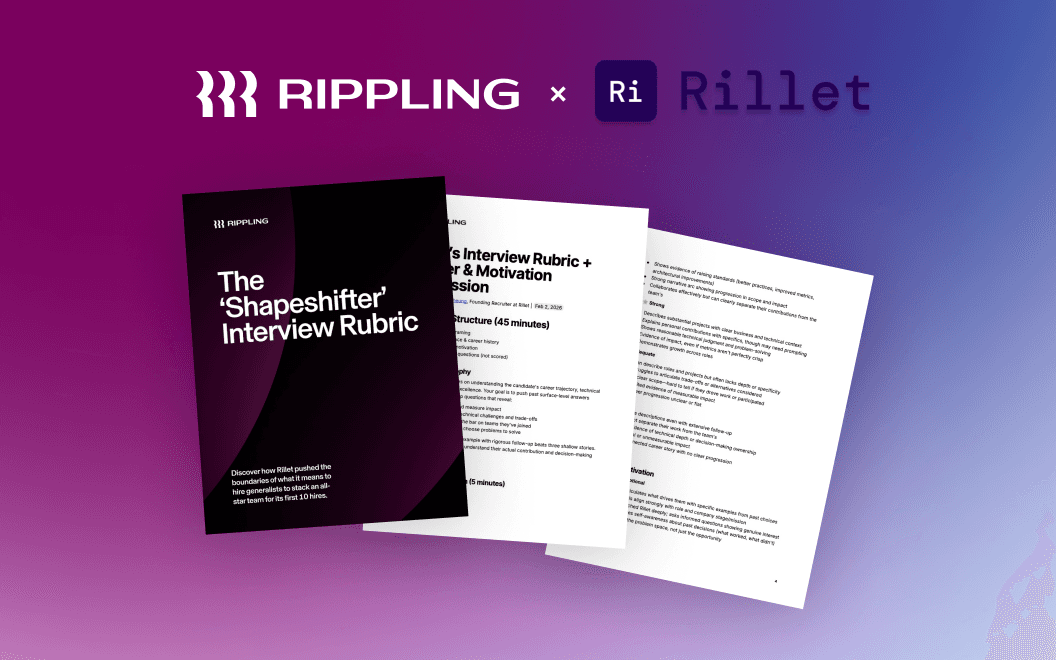
Download Rillet's interview rubric for identifying high-aptitude candidates who thrive in ambiguity
Your first 10 hires aren't just employees — they're co-founders in disguise. And hiring them requires a different playbook than what comes later. You don't have the luxury of systematized interview loops or dedicated recruiters. You need to evaluate candidates with more nuance, because a single mis-hire at this stage doesn't just hurt productivity — it can unravel speed, morale, and trust across your entire team.
The conventional wisdom says hire generalists early. But Rillet, the Sequoia-backed accounting platform processing billions of dollars in transactions, discovered something better: hire shapeshifters. These are candidates who can own bizops on Monday, run sales on Wednesday, and jump into recruiting by Friday — not because they're passable at everything, but because they attack every problem from first principles.
Good shapeshifters are self-starters, cope well with ambiguity, and are able to problem solve through their own research and analytical skills.
Alysha Salinger
one of the first 10 hires at Rillet
The difference between a generalist and a shapeshifter?
Generalists can do many things adequately. Shapeshifters achieve depth across functions because they attack every problem from first principles. They don't need a playbook — they write one.
The problem is spotting people who can reach this level of context switching. It can be tough to tell them apart from polished candidates who've learned to tell good stories. Standard behavioral questions won't separate them. You need a rubric that pressure-tests for ownership, technical judgment, and how candidates operate when the map runs out.
This is the exact interview framework Rillet uses internally. It includes the question sequences that reveal whether someone actually drove the work or just participated, the follow-up patterns that cut through vague answers, and the scoring criteria that keep your hiring bar from drifting.
Rillet's founding team members Alysha Salinger and Ben Cheung developed this rubric as part of First 10 Hires, a crash course for early-stage founders making their most critical hires. Because at your stage, one wrong hire doesn't just cost salary — it costs six months of momentum you can't get back.
See how Rippling can help you manage all your employee data and operations in one place, no matter your business’s size.