








Rippling ranks highest for organizations prioritizing automation, unified data, and scalability, covering HR, payroll, and IT.

Studio de flux de travail
Déclenchez des flux de travail avancés à partir de n’importe quelles données

Analytique
Produisez des rapports sur toutes les données de vos applications

Politiques
Appliquez automatiquement les règles de l’entreprise

Autorisations
Accordez à chacun le bon accès

Intégrations
Optimisez les performances des applications tierces

Studio des applis
Créez des applications personnalisées sans codage
Débloquez des données essentielles pour votre entreprise et déléguez les tâches fastidieuses à une IA conçue pour les RH, la Paie, l'IT et la Finance.
En savoir plus
Obtenez des applications sur mesure, conçues par des ingénieurs de Rippling, pour automatiser n'importe quel processus.
En savoir plus

Fiche de l’employeur
Embauchez dans le monde entier sans entités

Service de la paie international
Payez les employés où qu’ils se trouvent

Prestataires internationaux
Payez les prestataires partout dans le monde

SIRH à l’échelle internationale
Exécutez les processus de RH mondiales en un seul endroit

Conseillers en RH mondiales
Obtenez une expertise locale en RH

Avantages sociaux internationaux
Gérez les avantages sociaux partout dans le monde

Dépenses mondiales
Économisez partout où vous exercez vos activités


Témoignages des clients


Barry’s donne plus de pouvoir à ses équipes grâce à une solution RH évolutive

Forterra automatise les tâches répétitives pour maximiser son efficacité

Chess.com crée des processus de personnel transparents

Clay a multiplié sa croissance par cinq en automatisant 80 % de ses tâches d’accueil et d’intégration

Blank Street Coffee a économisé 40 heures en automatisant sa période d’inscription

Rippling a donné des superpouvoirs d’automatisation à Andros


FR
Canada (FR)


Australie (EN)
Canada (EN)

France (FR)

Allemagne (DE)

Irlande (EN)

Pays-Bas (NL)

Espagne (ES)

Royaume-Uni (EN)

États-Unis (EN)
FR
Canada (FR)
Australie (EN)
Canada (EN)
France (FR)
Allemagne (DE)
Irlande (EN)
Pays-Bas (NL)
Espagne (ES)
Royaume-Uni (EN)
États-Unis (EN)
FR
Canada (FR)
Australie (EN)
Canada (EN)
France (FR)
Allemagne (DE)
Irlande (EN)
Pays-Bas (NL)
Espagne (ES)
Royaume-Uni (EN)
États-Unis (EN)

Dans cet article
The best PEO companies in 2026 are differentiated primarily by their software platforms, not their co-employment services, with automation depth, data consistency, and scalability being the top evaluation criteria.
Rippling ranks first among 11 PEO providers because its unified employee graph connects HR, payroll, benefits, compliance, and IT in a single real-time system, eliminating the manual handoffs common in legacy PEOs.
Multi-state compliance is a primary driver of PEO adoption in the US, as wage rules, overtime thresholds, and leave requirements vary by state, city, and county, making manual tracking a significant risk.
Software-first PEOs like Rippling and Justworks prioritize workflow automation and fast onboarding, while service-led PEOs like Insperity and TriNet focus on hands-on advisory and regulatory expertise for highly regulated industries.
When evaluating PEO platforms, the most important question is not whether a provider covers payroll and benefits, but where hidden manual work and data inconsistencies will create friction as the business grows.
A professional employer organization (PEO) is a service model where your business enters a co-employment relationship. You continue to manage your people day to day, while the PEO becomes the legal employer for payroll, tax, benefits, and certain compliance responsibilities.
In 2026, the difference between PEOs increasingly comes down to their software platforms. Modern PEOs deliver their services through integrated HR systems that manage employee data, payroll, benefits, tax filings, and compliance in one place. When this software is well designed, it simplifies onboarding, reduces payroll errors, and makes multi-state compliance easier as teams grow.
When it doesn’t, the problems tend to bubble up later. Payroll corrections. Conflicting employee records. Compliance questions that take too long to answer.
This guide focuses specifically on PEO companies that deliver strong HR software experiences, not just traditional co-employment services. It’s designed for business owners, HR leaders, and operations teams who already know they want a PEO, but want to understand which platforms will support your organization’s growth ambitions rather than slowing it down.
To help you identify the best PEO software platforms for your business, we reviewed and scored leading providers based on how effectively their platforms support:
Core PEO services
Employee benefits and access
HR compliance and risk management
Payroll and HR technology
Business scalability
Value and customer experience
A quick note on transparency: Rippling is our product, and it is included in this list. The same scoring criteria were applied across all platforms using publicly available information. You can see the methodology behind our assessments in the full research spreadsheet.
PEO company | Best for | Choose this if |
|---|---|---|
1. Rippling | Automation-first teams | You want HR, payroll, benefits, and IT in one system |
2. Insperity | Compliance-led organizations | Advisory depth matters more than UI |
Enterprise HR | Scale and payroll reliability are priorities | |
4. Paychex | Payroll-centric teams | Accuracy and tax compliance come first |
5. Paycor | Mid-market HR teams | You want modern payroll and reporting |
6. TriNet | Regulated industries | Industry-specific compliance expertise |
7. Justworks | Small businesses | You value simplicity and fast setup |
8. Sequoia | VC-backed startups | Equity support and premium benefits matter |
Complex organizations | You manage multiple entities or locations | |
10. CoAdvantage | Regional US firms | Local compliance and support are key |
11. XcelHR | Flexible PEO needs | You want modular service options |
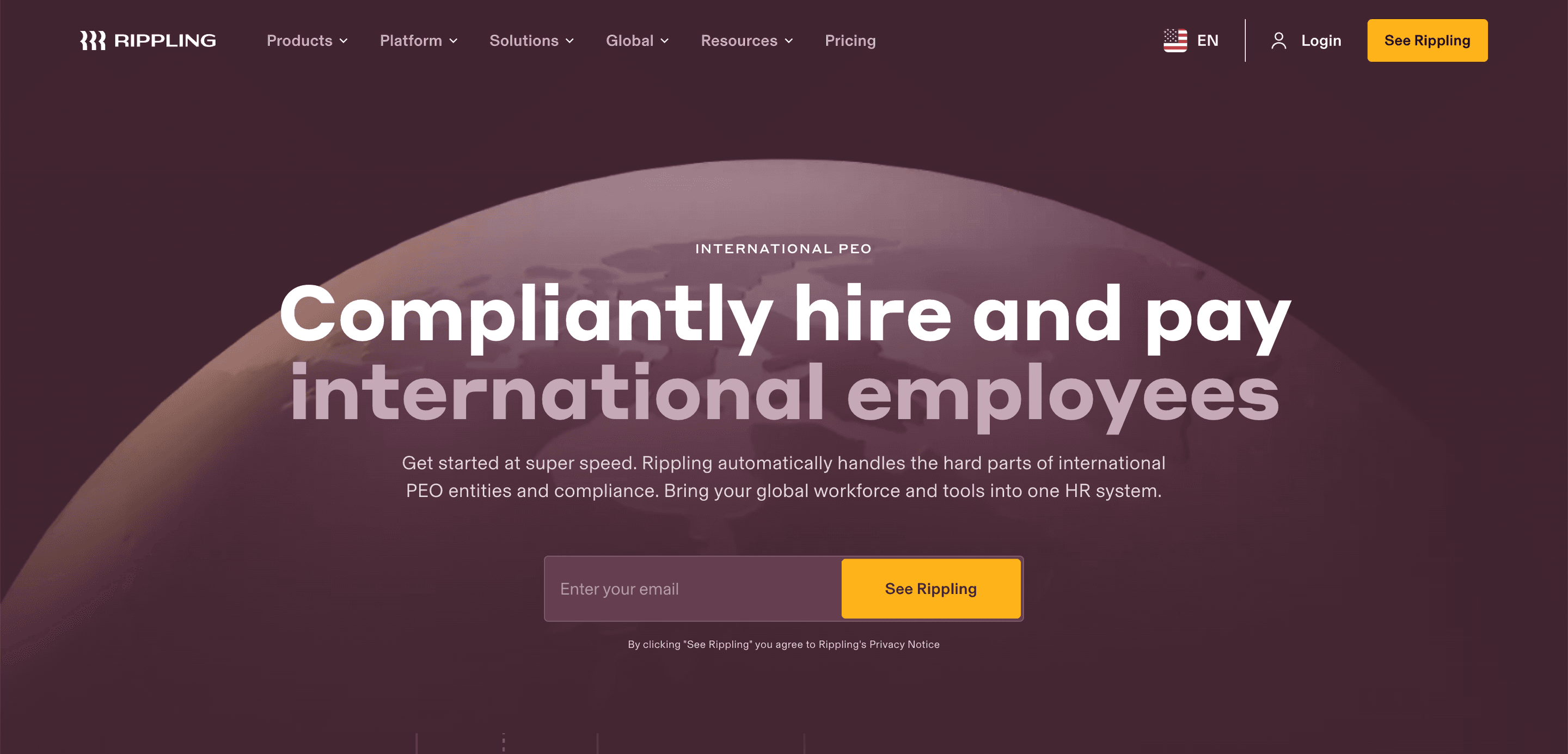
Rippling is ideally suited for organizations that want a single system to run HR, payroll, benefits, compliance, and IT without relying on a series of individual disconnected tools.
Rippling ranks first because its PEO offering is built on a modern platform rather than layered on top of legacy systems. At the center of Rippling’s approach is a unified employee graph that connects HR data, payroll, benefits, compliance rules, device access, and third-party applications, all in real-time.
This architectural style enables Rippling to automate workflows that are still manual for most PEO providers. When a new employee is hired, the software automatically triggers the tax setup, payroll enrollment, benefits eligibility, device provisioning, and access to core business software. This also takes effect when there are changes to a role, compensation, or location.
One area where Rippling stands out is with IT management. Organizations can manage laptops, enforce security policies, and control application access from the same platform that runs HR and payroll.
Source: Rippling
Why do companies choose Insperity?
Strong compliance and risk management support
Access to experienced HR professionals
Established US regulatory expertise
“It’s a highly intuitive platform. Currently saving our team and HR dept valuable time. We have tried many platforms, Rippling is currently winning.” - Rippling Capterra review
No free trial for PEO services
Feature depth requires structured onboarding to realise full value
Insperity is best suited for businesses that prefer regulatory support and hands-on HR guidance over software flexibility.
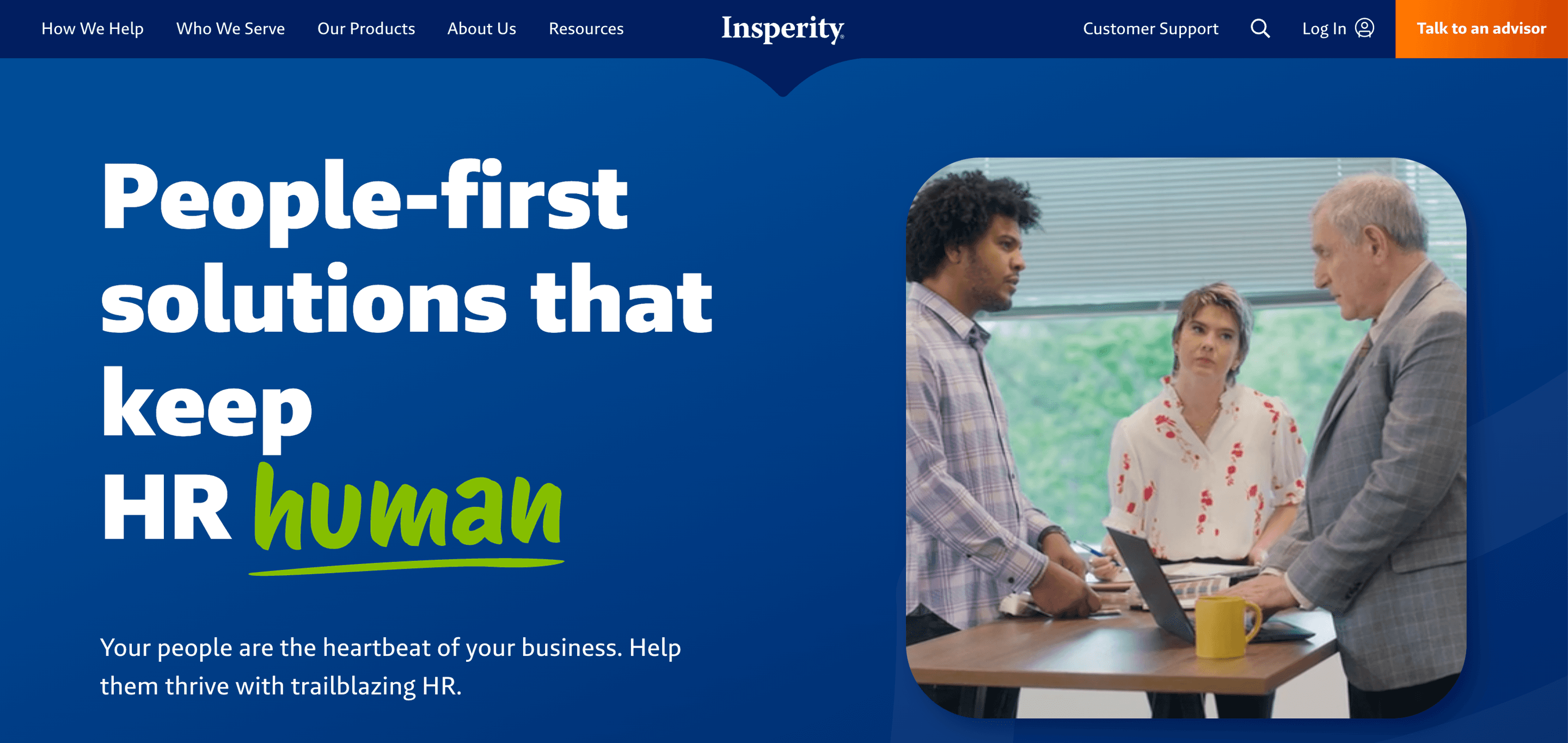
Insperity takes a service-led approach to the PEO model. It places strong emphasis on compliance management, risk mitigation, and human-led HR advisory. This makes it especially attractive to organizations operating in highly regulated industries or those without in-house HR expertise.
Its HR software supports core functions, including employee records, payroll processing, benefits administration, and compliance reporting. The platform itself is more traditional in design and offers fewer opportunities for workflow automation. That trade-off is deliberate.
In practice, Insperity tends to work best when HR decisions are infrequent but high-risk. The platform handles policy interpretation, employee relations issues, and regulatory edge cases well. If teams need more autonomy, however, this can raise some challenges. Routine changes all still benefit from oversight, but the volume of manual coordination increases as headcount grows or workforces become more distributed.
Source: Insperity
Strong compliance and risk management support
Access to experienced HR professionals
Established US regulatory expertise
The user interface feels a little dated compared to more modern systems
Limited automation and integrations compared to modern platforms
ADP TotalSource is best for large organizations with complex payroll and reporting requirements that require reliability.
ADP TotalSource combines ADP’s already highly respected enterprise payroll infrastructure with a full PEO service model. Its main sweet spot lies with organizations at scale. Large workforces, multiple jurisdictions, and extensive reporting requirements are all handled strongly.
The HR software ecosystem includes employee records, payroll, benefits administration, compliance tools, and analytics. Functionality is spread across multiple modules, which can make workflows feel fragmented.
In practice, ADP excels where process consistency matters more than speed. Payroll accuracy and audit readiness are strong factors in the decision-making process.
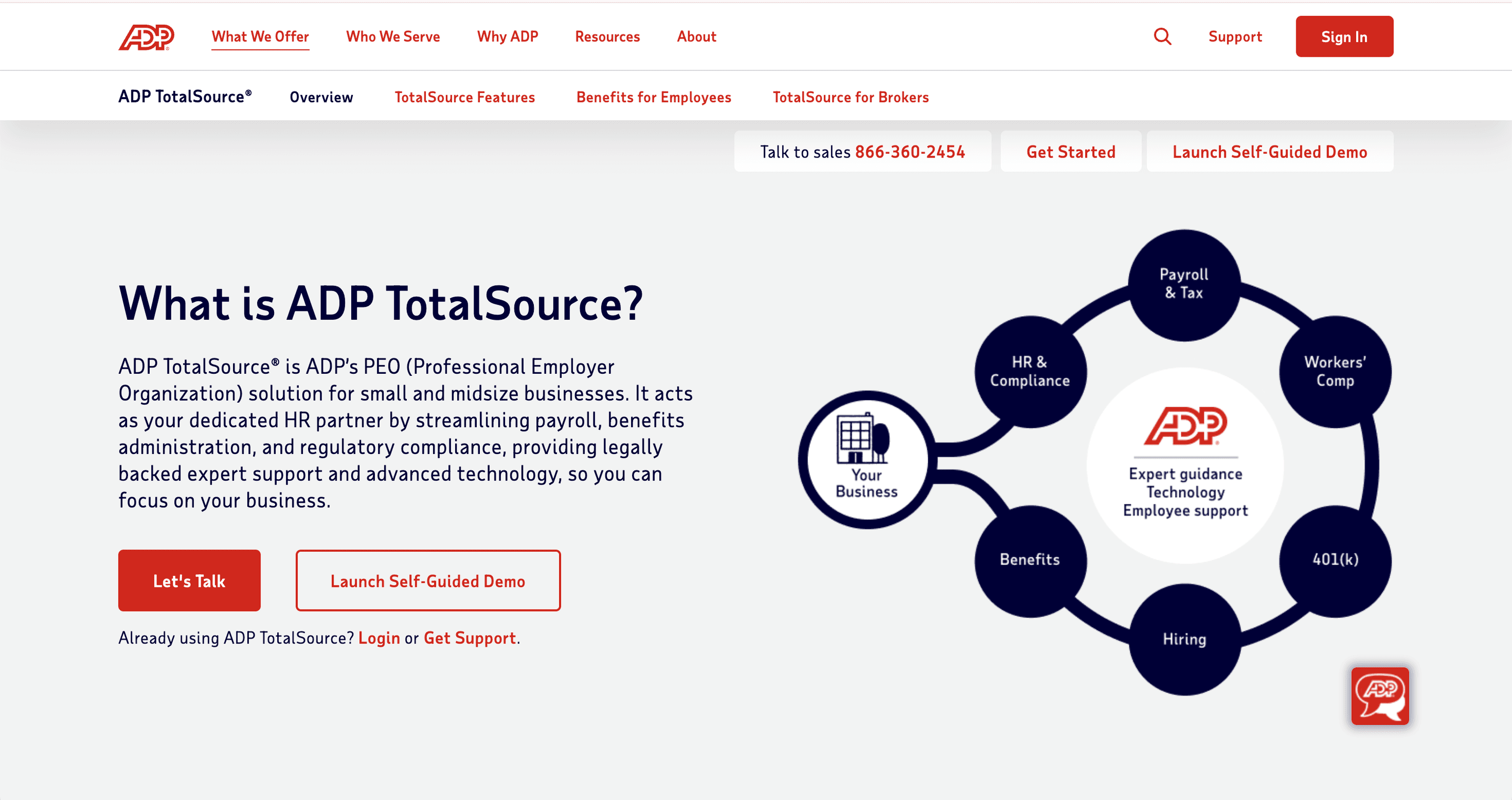
Source: ADP TotalSource
Enterprise-grade payroll processing
Strong analytics and reporting capabilities
Recognized global brand with deep compliance coverage
“Overall, my experience with ADP was good. It has a user-friendly interface that is easy to navigate without confusion. It’s also security conscious.” - ADP TotalSource Capterra review
Complex setup and navigation
Less intuitive automation than software-first PEOs
Paychex suits businesses that rely on payroll precision and tax compliance. The platform is already well known for dependable payroll services and nationwide tax compliance. Its HR software covers employee records, payroll processing, benefits administration, and compliance reporting. This becomes worthwhile for organizations operating across multiple states. Tax filings, remittances, and reporting are all handled efficiently.
The trade-off, however, is flexibility. The platform focuses on core payroll workflows rather than advanced HR automation. As teams grow, manual work frequently arises around approvals, customized reporting, and integrations.
Source: Paychex
Reliable payroll and tax filing
Strong customer support
Broad US coverage
“Overall, I had an amazing experience with Paychex. Although I am a self-learner, I felt confident the entire time that if needed, customer service would be there to help.” - Paychex Capterra review
Limited HR automation
Basic integration functions
Paycor is ideal for growing organizations that want clearer HR reporting without moving into enterprise complexity.
Paycor functions as a modern HR and payroll provider for mid-sized businesses. Its PEO offering reflects that focus, with tools covering employee records, payroll processing, benefits administration, time tracking, and workforce analytics.
Where Paycor tends to perform best is through its visibility. Dashboards and reporting give HR teams clearer insight into headcount trends, payroll costs, and workforce metrics. This usually matters once leadership starts asking tougher questions about cost control.
Automation exists, but it is less than that of many of the software-first PEOs. Many workflows still require manual configuration. This works well until teams expand across multiple states.
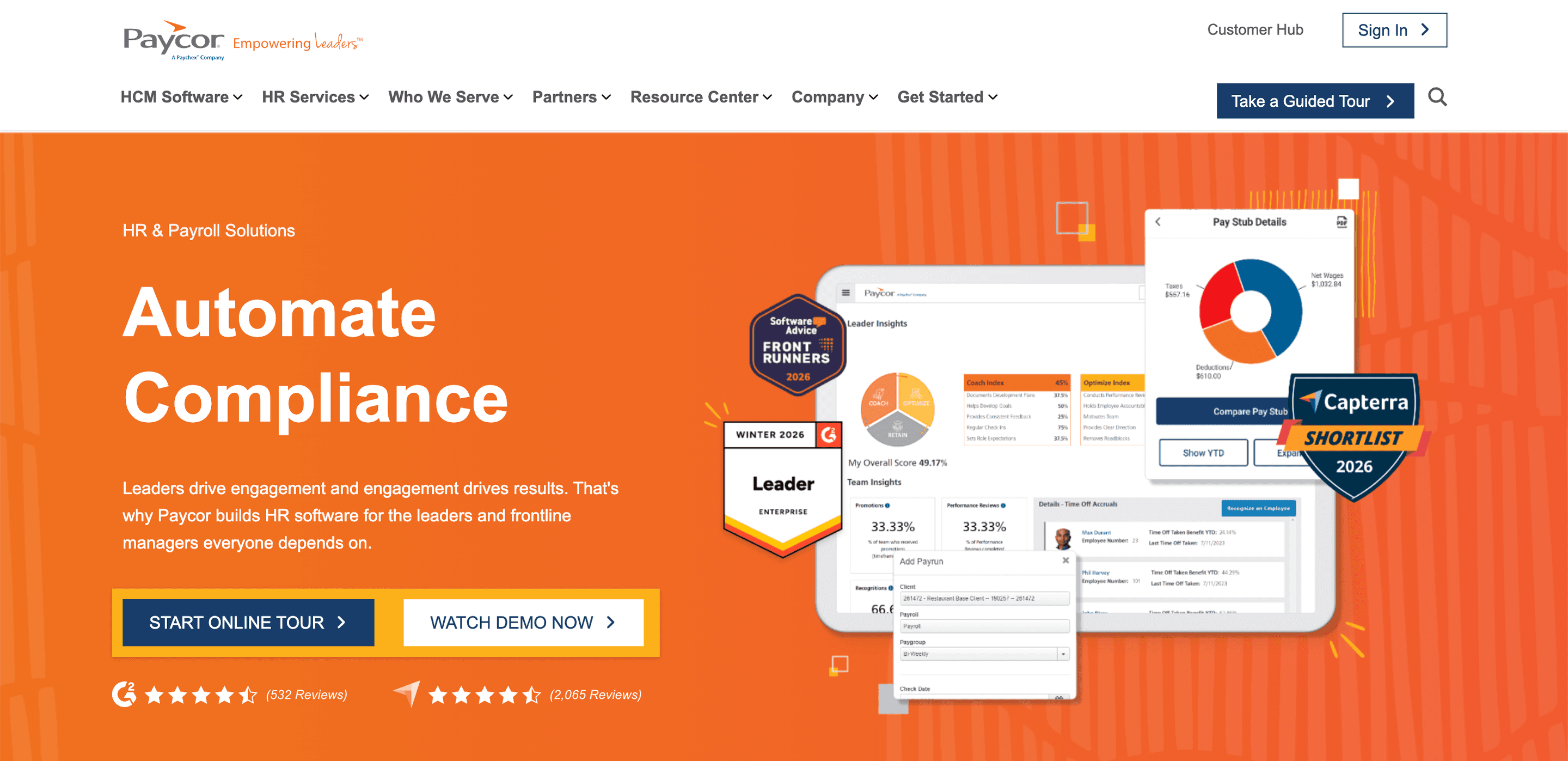
Source: Paycor
Modern interface
Strong reporting and analytics
Solid payroll coverage
“After working with Paycor for the past four years, I truly love the system and know it like the back of my hand. I often praise the platform and credit it as a key contributor to my success in my role.” - Paycor Capterra review
Limited end-to-end automation
Integration depth varies by module
TriNet is best for those sectors with strict regulatory requirements, such as healthcare and finance.
TriNet is built around compliance expertise. Its PEO services are designed to help organizations navigate labor laws, benefits requirements, and regulatory structures that change by industry and location.
The HR software supports payroll, benefits administration, compliance reporting, and employee records. The emphasis is less on automation and more on accuracy and oversight. That trade-off is by design.
This approach works well when regulatory exposure is the primary concern. It becomes less appealing when speed and flexibility are required.
Source: TriNet
Industry-specific compliance support
Strong benefits administration
Deep regulatory knowledge
“TriNet gives me a strong sense of security. There are numerous safeguards in place to make sure you always remain compliant with state, federal, and local regulations.” - TriNet G2 review
Traditional platform experience
Limited workflow automation
Justworks is ideal for small businesses adopting a PEO for the first time that want both simplicity and fast onboarding.
Justworks focuses on simplicity. The HR software is designed from the ground up to be highly approachable, covering the usual key operational requirements such as payroll, benefits, compliance support, and basic HR management - all without heavy configuration.
This simplicity lowers the barrier to entry. Onboarding is fast, and pricing is more transparent than many competitors. That said, simplicity comes with its limits.
This setup works until teams grow or processes become more complex. So, if your organization is already familiar with PEOs and expanding rapidly, this may not suit your needs.
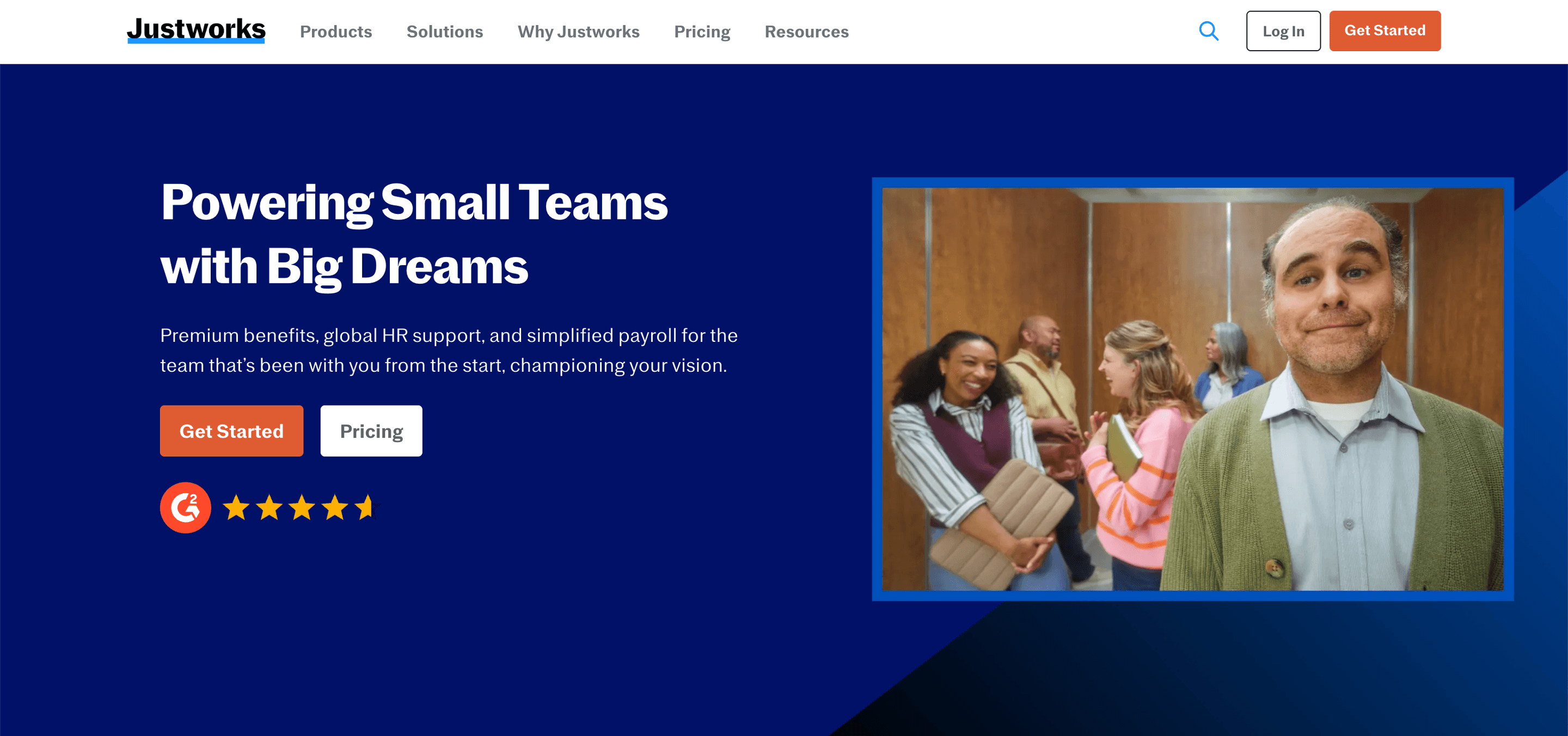
Source: Justworks
Clean, clear interface
Straightforward pricing model
Fast implementation
“What I like most about Justworks is how user-friendly and well-organized the platform is. It makes payroll, benefits, and HR tasks feel straightforward rather than overwhelming. The interface is clean and intuitive, so it’s easy to find what you need without digging through multiple menus.” - Justworks Capterra review
Limited scalability
Basic automation
Sequoia is designed from the ground up for high-growth startups that are typically VC-backed and managing equity compensation alongside traditional HR and benefits. Its PEO services combine benefits administration, HR support, and compliance with specialist expertise in equity compensation.
While the software supports core HR and payroll needs, its configuration options are limited when compared to those of automation-led platforms.
This model suits early-stage companies, but tends to feel pressured as operational complexity rises.
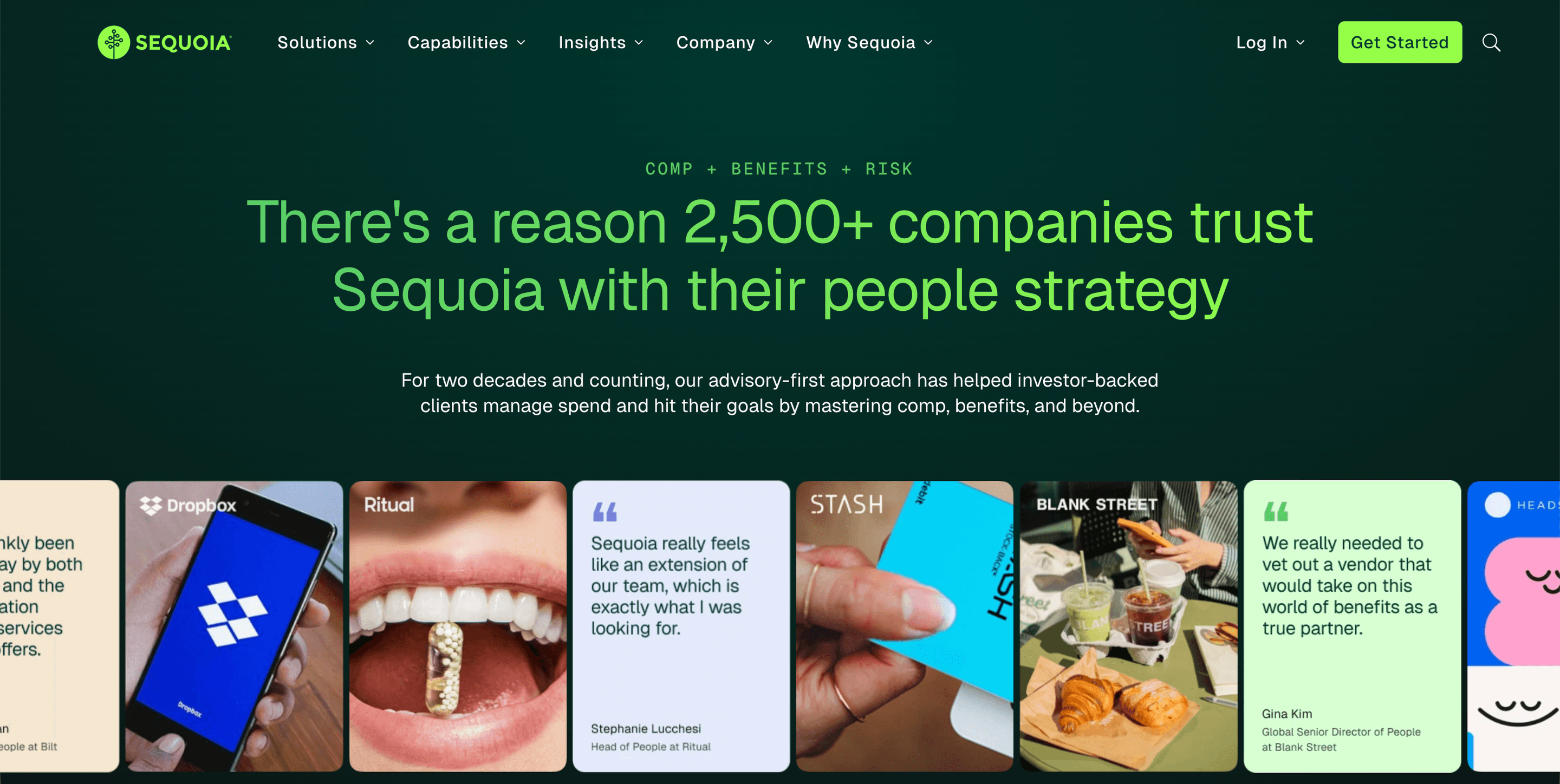
Source: Sequoia
Startup and VC ecosystem expertise
Strong benefits offerings
Equity compensation support
“Excellent customer service with quick response times. They have knowledgeable staff who can assist with tricky situations. They make payroll, benefits, and compliance much easier than handling it all by yourself.” - Sequoia Capterra review
Limited software innovation
Not designed for long-term scale
Vensure Employer Services is crafted for complexity. It ideally suits businesses that manage multiple legal entities or operate under multiple structures. Its PEO offering supports organizations with layered corporate structures and geographically distributed teams.
The HR software is configurable, covering payroll, benefits administration, compliance reporting, and employee management. While configuration flexibility is a core strength, consistency can be a challenge.
This works well with appropriate support. It becomes harder when teams need uniform workflows.

Source: Vensure Employer Services
Handles complex organizational structures
Flexible service model
“So many amazing features! Taking care of payroll and benefits for our employees. Customer support is also great. Employees find it easy to use, and it was easy to implement and integrate.” - Vensure Employer Services G2 review
Inconsistent user experience
Automation depth varies by implementation
CoAdvantage best suits organizations seeking localized HR and compliance support. It tends to focus on regional service delivery. Its HR software includes payroll, benefits administration, and basic HR management tools.
The platform is functional rather than flexible, which tends to fit businesses with modest HR requirements.
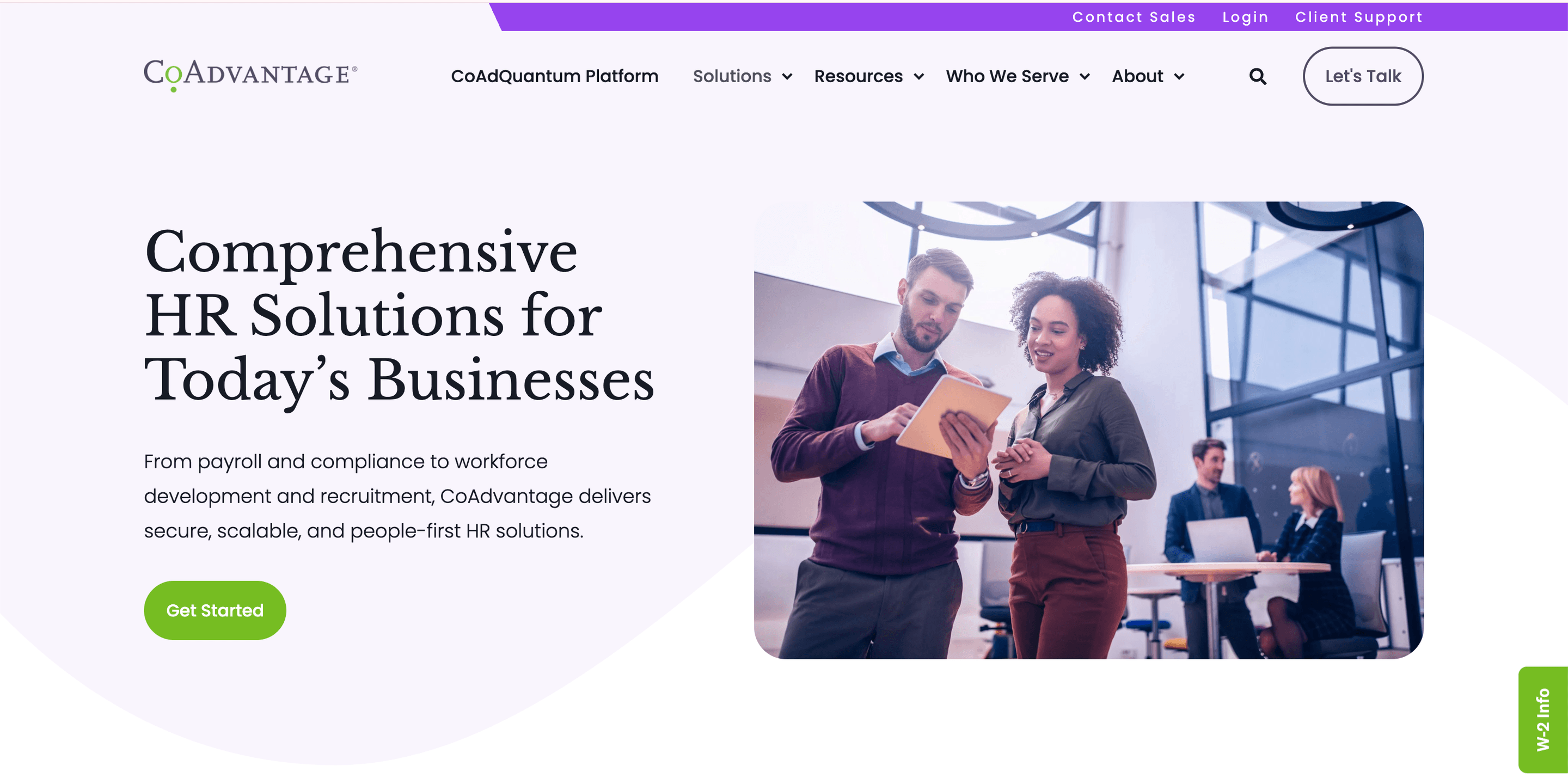
Source: CoAdvantage
Local compliance expertise
Personalized service
“I like the all-inclusiveness of CoAdvantage, with one login spot to handle everything. The biggest help is their benefits portal, which ensures all our employees are able to enroll or waive insurance.” - CoAdvantage G2 review
Basic platform capabilities
Limited analytics
XcelHR offers modular PEO services with supporting HR software. Payroll, benefits administration, and employee management are covered. It’s best for small to mid-sized businesses needing adaptable PEO services.
The platform overall reflects older design patterns, but has flexibility as its key selling point.
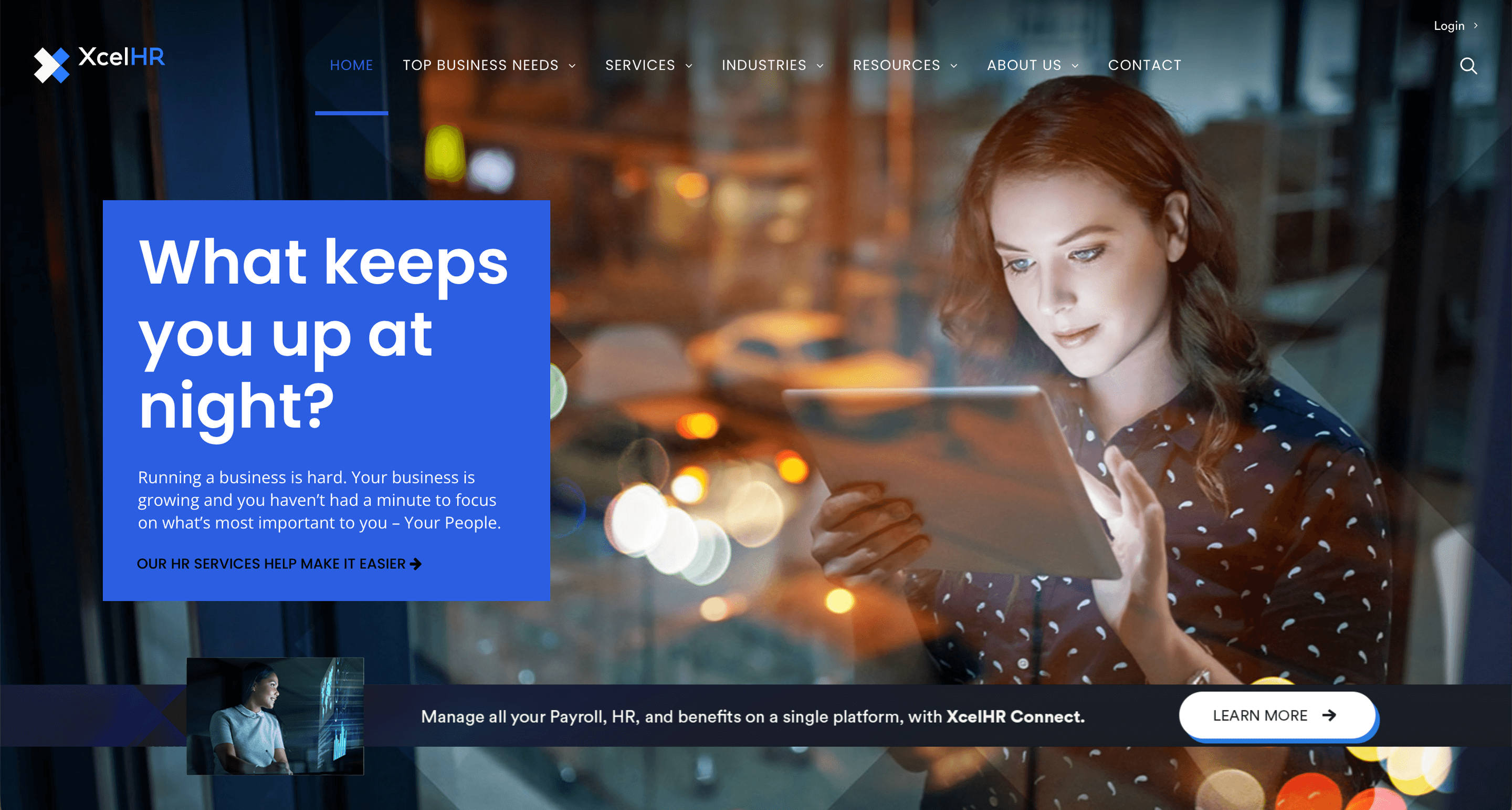
Source: XcelHR
Flexible service options
Broad HR coverage
“We have switched to XcelHR from ADP TotalSource over a year ago and couldn't be happier. After extensive research and demos of many other PEO service providers, XcelHR was an absolute winner for our organization.” - Trustpilot XcelHR review
Older interface
Limited automation
Choosing the right PEO is both an operational and a compliance decision. The question isn’t based on handling payroll or benefits (as most can). The question is where friction arises as the business evolves and changes.
Here are some of the key things you’ll want to consider before choosing a provider.
Platforms that automate onboarding, payroll updates, and compliance reporting minimize manual errors. As an important by-product, it also reduces the reliance on individual knowledge. This is particularly important once teams expand beyond a single office or state.
Employee data should be housed in a single system. With partial syncs or manual updates, errors can surface further downstream, usually at payroll, increasing both frustration and costs.
Look for systems that handle tax calculations, filings, and regulatory updates without requiring constant review and that minimize manual updating.
Determine whether a platform can absorb change without costly revisions. New states, new entities, and new benefit structures all add to complexity.
These matter less for feature checklists and more for workflow consistency. Finance, IT, and HR systems should not require reconciliation meetings.
In practice, the platforms companies leave are not the ones that lack features. They are the ones that create hidden work.
Highly complex and fragmented employment compliance is a firm driver of PEO adoption in the US, particularly for those organizations operating across multiple states. Wage rules, overtime thresholds, and leave requirements vary not only by state, but also by city or county.
Worker classification continues to present a risk, especially for organizations engaging contractors or remote workers. Misclassification issues surface later, often during audits, disputes, or funding events.
Benefits compliance also adds complexity. Health insurance eligibility, retirement plans, and statutory leave policies must comply with both federal and state regulations. Manual tracking increases exposure.
Strong platforms embed the appropriate compliance logic directly into payroll and HR workflows. Others rely more strongly on human review. Neither approach is inherently wrong. The difference is where risk accumulates.
Choosing a PEO shapes business operations on a day-to-day basis. It affects onboarding speed, payroll confidence, and how easily teams expand into new jurisdictions.
The strongest platforms reduce friction to help drive smooth and efficient operations.
In my research, Rippling’s PEO solution came out as number one because it unifies HR, payroll, benefits, compliance, and IT in a single system, reducing manual work, preventing data drift, and scaling cleanly as organizations grow.
If you want to see why more than 4,000 businesses have given Rippling a 4.9-star rating, you can explore the platform with a free demo.
Rippling ranks highest for organizations prioritizing automation, unified data, and scalability, covering HR, payroll, and IT.
Most PEOs include HR software, but the depth of capability can vary markedly. Some platforms act as full systems of record, while others provide just the basic administrative tools.
No. Differences usually appear in automation depth, reporting, and how well the individual system components stay in sync as your teams continue to grow.
Yes, primarily for businesses managing multi-state payroll and compliance. Software-led PEOs often replace separate HRIS tools.
Pricing is typically based on a percentage of payroll or a per-employee fee. Costs vary by headcount, benefits selection, and service scope. Most vendors do not disclose their pricing, requiring you to contact the vendor directly.
Ask how the platform handles multi-state changes, reporting, integrations, and what manual work remains once the system is live.
Clause de non-responsabilité
Rippling et ses sociétés affiliées ne fournissent pas de conseils fiscaux, comptables ou juridiques. Ce document a été préparé à titre informatif uniquement et n’est pas destiné à fournir des conseils fiscaux, comptables ou juridiques, ou ne doit pas être utilisé à cette fin. Il est recommandé de consulter vos propres conseillers fiscaux, comptables et juridiques avant de vous engager dans toute activité ou transaction connexe.

Responsable du marketing de contenu, RH
Vanessa Kahkesh est spécialiste du marketing de contenu pour les RH, passionnée par la création de conversations à l’intersection des personnes, de la stratégie et de la culture d’entreprise. Chez Rippling, elle supervise la création de contenus axés sur les RH. Vanessa a perfectionné ses compétences en marketing, mise en récit et croissance grâce à des expériences en marketing produit, en création de communautés et dans des startups. Elle a travaillé au sein de l’équipe marketing produit de Replit et a fondé STUDENTpreneurs, une plateforme communautaire mondiale pour les étudiants entrepreneurs. Son expérience multidisciplinaire, alliant narration, gestion de la marque et opérations, lui offre une perspective unique sur le contenu RH : elle parvient à relier efficacement l’aspect technique des ressources humaines aux histoires humaines qui les sous-tendent.
Économisez davantage, automatisez les tâches fastidieuses et prenez de meilleures décisions en gérant les RH, les TI et les finances au même endroit.
